
It isn’t often you get to compare your writing with that of your father and grandfather. My grandfather was a PhD with published works. I should try to find his thesis and other publications. I have read his unpublished autobiography.
My father had a few articles published, and I’m sure he wrote more. I should attempt to get his master’s thesis from ODU.
Yesterday my daughter stumbled onto a couple of articles published by my father. I write like he did. I guess I speak like he did as well.
I’m positive that much of my very dry humor comes from him.
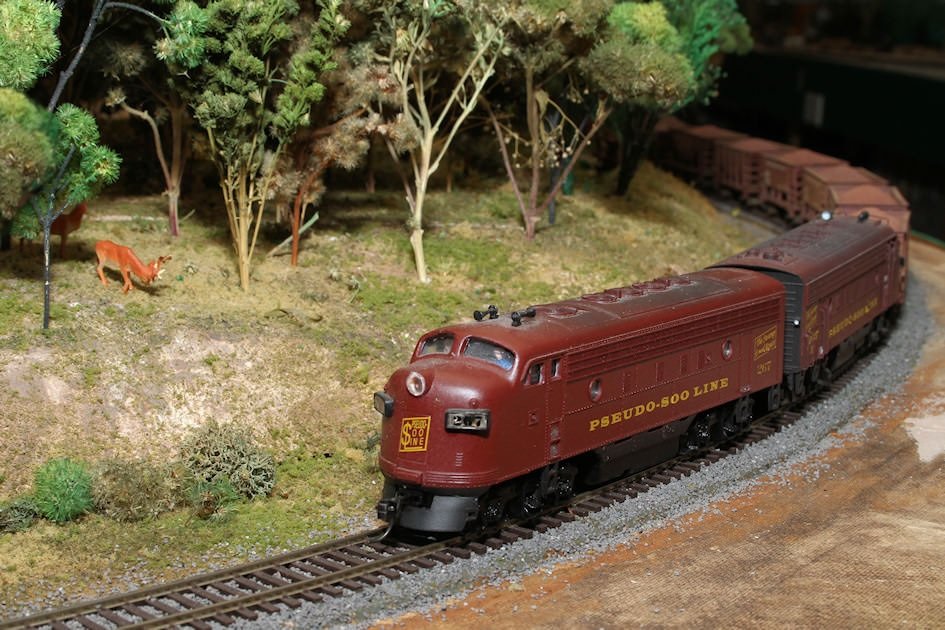
The original Pseudo-Soo Line was located in Golden Valley (Minneapolis), Minnesota, and was on the Northstar99 layout tours. We moved into this basement, then totally barren, in April 2000, and the new Pseudo-Soo Line was up and running for the Gateway2001 layout tours 15 months later. Approximately 230 model railroad enthusiasts visited the layout during the convention.
The new PSL occupies a space 50′ long and 12′ to 22′ wide. It is an “around the walls” layout with a long center peninsula. The mainline is a closed loop with two single ended, “nose-to-nose” staging yards. These represent Sault Ste. Marie, MI (“The Soo”) and Minneapolis, MN. The main loop from “The Soo” to Minneapolis is approximately 200′ long. Another 100′ of track represent branch lines and interchanges. Abracadata 3D Railroad Concept and Design software was not only used to design the layout but the entire basement. [This software is no longer available.] The design was essentially complete before we moved in, and I have made very few changes to the original design.
The three classification yards: Rhinelander, Ladysmith, and Weyerhauser. There is a passing siding between Prentice and Hawkins, and two short run-around tracks elsewhere. A branch line leads to a reversing loop that represents the Wisconsin Central routes to Superior, WI and the Bessemer, MI iron mine complex. Another branch line goes to Rice Lake, WI. There are 60 industries including team tracks and ice houses, plus four standard gauge interchanges: C&NW at Rhinelander, The Milwaukee Road at Heafford Junction, the Wisconsin Central at Ladysmith, and the C&NW at Rice Lake. The narrow gauge Thunder Lake logging railroad crosses the PSL at Robbins Junction and transfer hardwood logs going to several online users. The hand-laid Thunder Lake RR module is the only part of the layout used intact from Golden Valley.
Operation include both passenger and freight movements. The Atlantic Limited (East and West) and the Superior Lake (North and South) represent high-class varnish. All runs include some switching moves. The Milk Runs (East and West) drop-off and pick-up cars at Lassig Dairy and make a number of stops for passengers and milk. There are 13 freight jobs including manifests, peddlers, ore trains, turns, and dedicated industry and interchange moves. A 6:1 fast clock is used, so the seven or more operators required to run the railroad keep busy during a typical 3-hour session.
Digitrax DCC is used. A 6-wire telephone bus forms a LAN to all points of the layout with jacks along the fascia. There are also receivers for infrared and radio (both simplex and duplex) throttles. Guest operators are invited to bring their own compatible throttles. All turnouts are hand-thrown with Caboose Industries throws.
— Bob Johnson's Pseudo Soo Line, LDSIG, https://ldsig.net/bob-johnson/ (last visited Dec. 21, 2025).
His layout was what was known as an “operational” layout. This meant that you could run it realistically. He had cards that represented loads and destinations. The yard operators would have to make up trains, which would then be moved over the main line to different yards by other operators.
Still other operators would run the locals. These were the little trains that went to the different businesses to pick up and drop off loads.
A standard operating session would be 7 or more operators working over 3 hours on a 6:1 fast clock. In other words, they would simulate 18 hours of operations in just 3 hours. Generally, was made up by the fact that the locations did not have real distances between them. So the dairy was only a 1/2 mile from the yard, while it was more like 6 miles in reality.
Regardless, I love and miss Dad. If you feel like it, go read his entire article. He has pictures and more.