
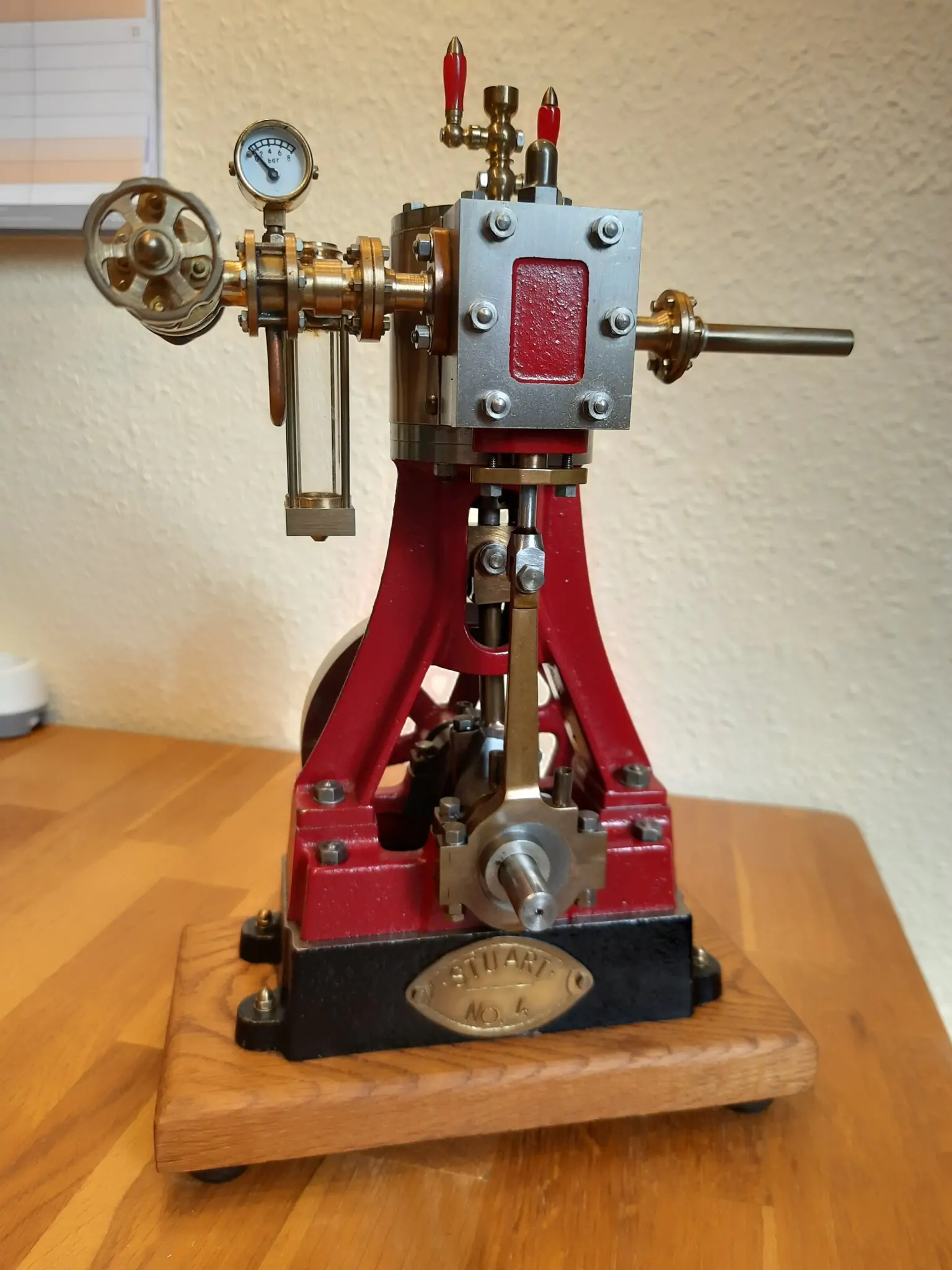
It is difficult to comprehend what a piston powered steam engine is capable of doing. It is a different sort of beast than the internal combustion engine.
For those that are old, you might have grown up with a manual transmission. There is a considerable skill in learning how to balance the clutch and engine speed to get smooth motion.
This is hidden in a value we call “horse power”. Horse power is also expressed in Watts. There are 745 watts to a HP, depending on sources. Close counts in this calculation. HP and watts are a measure of work.
Consider picking up a barbell. By measuring the force required to lift it, the time it takes to lift it, and the distance moved, we can measure the power used.
Now consider that same barbell, but it is too heavy to lift even a fraction of an inch. You strain trying to lift it. You have expended energy but have no performed any work. Hence the HP and watts are zero.
Regardless, an internal combustion engine needs some type of clutch to allow the engine to run at a comfortable speed while slowly bringing a different part of the powertrain up to speed.
With a steam engine, you have full torque at every speed. They are spectacular engines at slow speeds.
This takes us to present times.
I’m using FreeCAD to create the 3D model of the engines. A side advantage of this is that I also get assemblies that allow me to check how all the parts fit together. All very nice. This has helped me identify errors in my reading of the drawings.
A simple little thing: The cylinder has a built in bracket system. This is a face used to mount the cylinder to the base and the face used to attach the steam chest. These faces are slightly offset from the bore.
Which leads to my error, times 3. The cylinder mounting holes are not on the center line of the cylinder. They are instead on the center line of the bore. The bore is offset away from the steam chest and away from the mounting holes.
My error? I’ve put those damn mounting holes in the wrong place multiple times.
In the end, I added a spreadsheet to the model. For every shared measurement between parts, I’ve put that value in the spreadsheet. This means that I can do things like change the stroke by changing one value. Sort of.
My understanding of this mechanical marvel is much improved from being able to see the parts work together.
Another thing I noticed was that all the engine plans have an assumption you will be working with castings. They expect you to hire a pattern maker to create the patterns and then have your local foundry cast them.
While I would love to make my castings from iron, I will start with making them from aluminum. And the new tools I have and new skills I have in woodworking allow me to make real patterns.
My final goal is to have master patterns and molding boards for patterns for a couple of different engines. If I can accomplish that and make a few of them, I’ll be very happy.
Next stop, learning how to be a safe boilermaker. And not the happy drink type.
Do you have the Gingery books on aluminum casting? Those are basic and perhaps not quite good enough for steam engines, though he used them quite effectively for making bench-sized metalworking machines. Lindsay published them; I don’t know if they are still in print.
Re torque at all speeds: that property is why locomotives use steam engines or electric motors, which also have that feature. Neither of them needs a clutch, or a multi-speed transmission. Internal combustion engines driving a train are not entirely non-existent but they are very rare. I once rode on one, which looked more like a glorified streetcar. It had an IC engine (Diesel I assume), with a manual transmission using a LONG shift stick. It was pretty amazing to watch the operator shifting gears as the thing pulled away from the station. That was in Belgium, on a rural branch line in the Ardennes, around 1970. It also had a windshield wiper actuated by a handle on the inside, no motor.