
Fort at #4

Zombie hands rising in dark Halloween night.

Preppers and The Zombie Apocalypse

I grew up a prepper. Most of the people I knew were preppers. The difference was that it was normal.

My parents were born at the tail of the great depression. They lived through WWII as children and suffered the rationing that took place in the US.

My grandparents planted and tended a garden every summer. It was just the norm.

We once lived a good 2 hours from any supermarket. There was a local grocery, but everything there was pricey. It was the sort of place you went if you ran out of eggs.

Once a month, my mother would drive onto base in DC and shop at the commissary. She would have three or four carts of food. She purchased a month’s worth of milk. When we got home, everything was put away in freezers. We had “fresh” milk for about 3 days per month, thereafter, it was from frozen.

When we could, mom had a garden. She was never happier than when she had an entire acre of garden.

People think about “getting started” with prepping.

I believe this is the wrong mindset. The correct mindset is to start thinking about what knowledge and skills do you need?

Skills and knowledge are entirely different things. You might know how to wire an electrical outlet, but do you have you done it? Do you know how to use the tools? Do you have the right tools? Can you do it without harming yourself or others?

Because of my parents, I started with a “being prepared” mindset. There was always enough food in the pantry, freezer, and refrigerator. It was just the way I grew up.

I remember the first major snowstorm in Maryland after my daughter was born. Wife number one wasn’t satisfied with what we had in the refrigerator. Our child would starve if I didn’t get some milk, right now.

I put on my calf high moccasins, my wide brimmed hat, my winter coat and walked to the 7/11 to get milk.

On the way there, I pushed a female cop’s car out of the snow bank three times.

My wife was in a panic. I was not. I had powdered milk, a supply of gravity feed fresh water, and a camp stove. There was nothing to worry about.

I was wrong. I had knowledge, but not enough skills.

I’ve spent the last forty years learning more skills. What skills I didn’t learn for myself, I found people I love and trust to have those skills.

When I lived in Maryland, it felt like there was a strong chance of a war engulfing the East Coast. Not American vs. American, but of actual foreign soldiers on our soil. I had the money, I spent that money on firearms for battle. I wasn’t thinking of hunting. I wasn’t thinking of food and shelter.

I was ignorant. But it was a step in the correct direction.

Today I have more skills, I have a better idea of what I don’t know. I still don’t know what I don’t know, but I can see that I have gaps.

One of the people making comments suggested that I have a flintlock style firearm. Amazingly enough, that is coming to my home shortly.

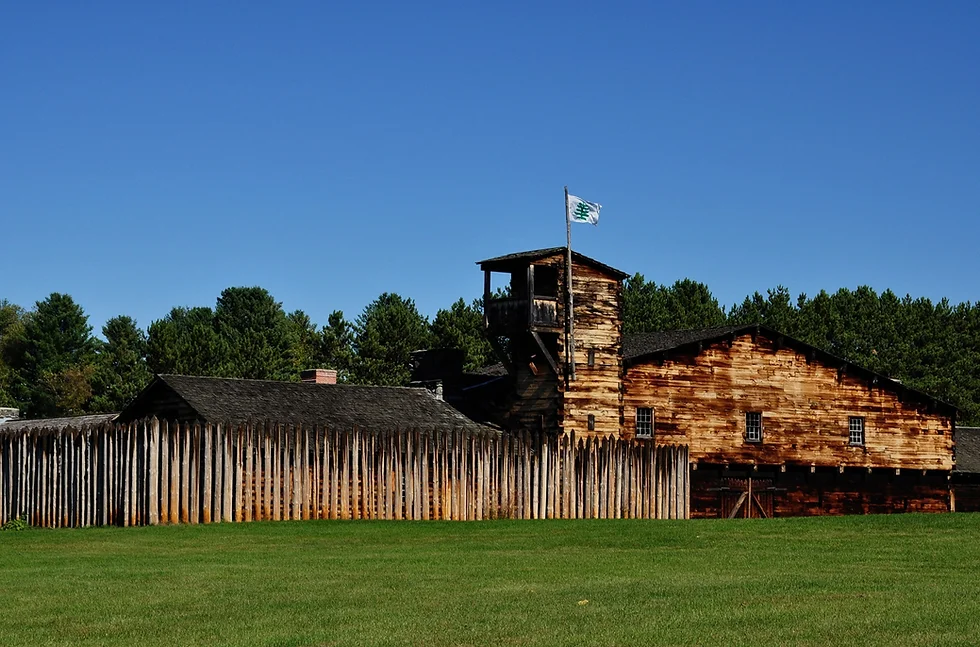
The Fort At #4 represents the time around of the French and Indian war. I am working with some reenactors to find a smoothbore that is period correct and a rifle. I want a Kentucky long rifle. I’ve loved the look of that rifle since watching Daniel Boone on TV.

I not only know how to make black powder, I’ve done it. I have extensive notes on how I did it. I have the tools to manufacture it, about 2 pounds at a time.

We are practicing making salt-peter but haven’t succeeded yet. I’ve made proper charcoal. And I have some sulfur. KNO3 is also around here.

I want to make my own primers, but it is not worth the risk.

I’ve made my own slow fuse and my own fast fuse. I’ve made fireworks. All cools stuff.

If I’m talking to somebody knew to prepping, I always start with the rule of threes.

  1. You can live 3 minutes without air
  2. You can live 3 hours without shelter
  3. You can live 3 days without water
  4. You can live 3 weeks without food
  5. You can live 3 months without hope

Without air is first-aid, hygiene, medical. If you are bleeding out, you aren’t going to make it the 3 hours to die without shelter. If you aren’t breathing, nothing else will matter in a few minutes.

Without shelter includes fire making, proper clothing, proper shelter from the elements, and the skills to build a home.

While 3 hours sounds extreme, consider falling into a freezing river in winter. How long will you survive? How long will you survive in the desert without proper protection from the sun?

For whatever reason, most people put food before water. Water is life.

Back in the ’80s, the army was looking at the best way to hydrate their soldiers. One method was to only allow the men to drink at rest stops, and only as much as they wanted. Another was to make them drink a certain amount at rest stops. Another was drinking on the move and making sure they drank “enough”.

The test was simple, take a group of soldiers, make them hike a distance, then test them in a combat situation.

Method one had the men combat ineffective at the end of the march. They were combat ineffective for a couple of days after.

Method two had the men combat effective after a few hours of rest at the end of the march. They were combat ineffective for the next few days.

The third method? The troops arrived and immediately went into combat, they were effective. They were able to repeat the test the next day without issue.

There is a reason that the military has hydration rules that push water into the men. There is a reason that hydration packs are worn by sailors.

Three weeks without food is pushing it. People become less capable after only a few days without food.

Our family added, “Three months without hope.” Hope is having some form of joy with you. Pictures of loved ones. A deck of cards. Anything to help take your mind off what you are going through.

One of the biggest takeaways I can give you, if you are starting to prep, “Don’t plan on survival, plan on living. Life was strong before our modern society, and life was good.”

I close with a definition of a zombie. A zombie is that city dweller, from a deep blue city, that hasn’t eaten in a week, is drinking unfiltered water wherever they find it, and they are stripping the countryside clean of all food and goods.

We saw zombies burning down cities because a criminal died of heart disease while in police custody. When you think of zombies, think of those drones, living in a city with less than 24 hours of food.
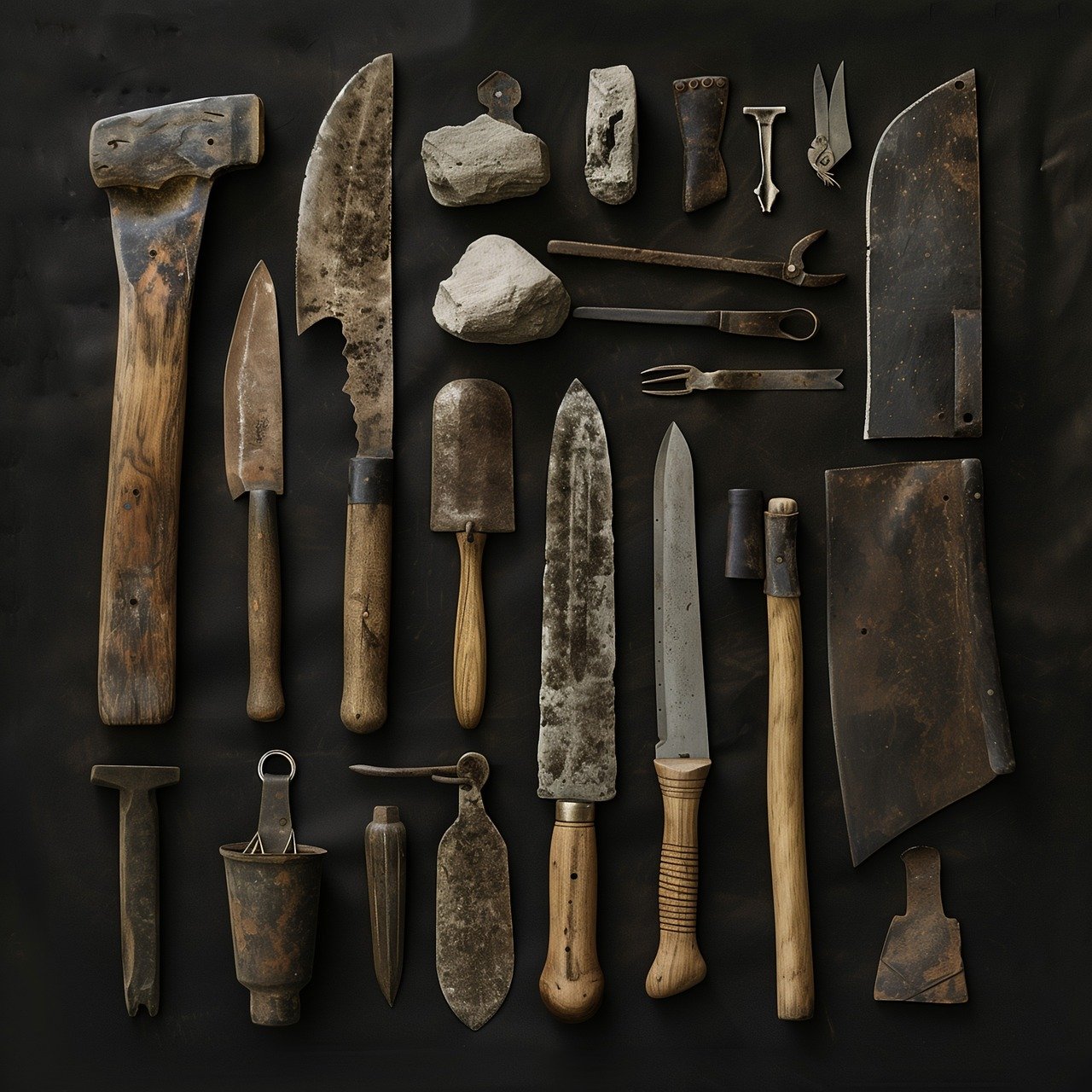
ai generated, antique, tools

Extant, Reproduction, Good Enough

Doing work at the Fort is wonderful. It is also an exercise in interpreting what you are seeing vs what you expect to see.

When you look at the different items in the Fort, it is often surprising to find that they are “modern” items. We laugh when people pick up the wooden cup because stamped on the bottom is “Pier One”.

It is good enough at a distance.

We use the tools at the Fort. We use the spinning wheels from the 1700s, we use the warping board from the same time. We use all these things. And occasionally, it isn’t really that old.

One of the ladies that volunteers is an excellent spinner. She has left her person spinning wheel at the Fort. On my first walk through, I was examining the wheels to see if they needed fixing.

Hers took me aback. It had metal bearing surfaces. Then I took a step back and realized that the entire wheel is no more than 20 years old.

Somebody brought me a sickle to sharpen. On of the volunteers was using it to cut some longer vegetation. This is the type of task that worries me. If this thing is 300 years old, I can ruin it by touching a stone to it. I was asked to proceed.

A few minutes of working on the blade with the stone showed that it was a modern blade. It was both a relief and a disappointment.

The Froe

One of the workhorses of an older shop is the Froe. It is a 12″ blade with the sharpened edge away from you. You hold it by the handle to position the froe against the end grain of a log. You then rap the back of the blade with a wooden mallet.

With a bit of work, you can split a long, straight piece off the log that can be turned into something else. Such as barrel staves.

I’ve known of them for years. I only got a chance to handle one a few months ago. I was surprised at how thick the blade was. I was expecting a knife thickness. Instead it was 3/8+ inches thick.

When I set the blade against the log, to split of a slap, hit it hard with the wood mallet, the damn blade bounced back at me.

The blade was so dull that it didn’t even pretend to enter the wood.

45 minutes later, it was sharp enough to use. And I was worried that I was modifying a piece of history.

Then two weeks ago, I received permission to take the froe home to properly sharpen it. Instead of taking it home, the blacksmith Sam sharpened it with a file.

As we worked on the blade, it became obvious that it wasn’t from the 1700s. It had a wield repair, the fold wasn’t forge wielded. It was a reproduction that really wasn’t a working tool. Close, but not really.

Sam has been tasked to make a reproduction froe that I can use at the Fort without worrying about breaking something 100s of years old.

He made a beautiful blade. It looks like a froe blade, it is not.

A froe is used by reefing on the handle to twist the blade in the wood. By twisting the blade, you can guide the split.

That is why it is so thick. That is why the handle is so long.

Sam made this blade from some scrap he had around. It is 3/32’s thick. This is not thick enough. The eye is not long enough. This does not qualify as a reproduction.

What it is, is a safety splitter for Ally. When you are starting a fire, you need kindling. She uses a splitting stand.

You put your stick of split firewood in the mouth of this thing, resting on the fixed blade. Then you wack the back side with another piece of wood, driving the wood onto the blade and splitting it.

This is much safer than holding the stick with one hand while swinging a blade at it with the other. Even people that are good at this will sometimes make mistakes. Mistakes that can be life-threatening.

This splitting gizmo is a very modern tool. It will pass, but it never existed in the 1700s.

The froe that Sam made will work perfectly at the task of splitting kindling from a firewood stick. With one hand, balance the stick on an end, hold it there. Use the other hand to position the froe blade where you want it. Your offhand is on the handle of the froe. The blade is on the stick of firewood. You can let go of the stick.

Pick up your wooden mallet and drive the froe into the stick of firewood, splitting it.

As long as you are driving it straight into the wood, this tool will work. And it looks great.

I do have to make a handle for it. Not difficult with the wood lathe.

Markings

When I or Sam make reproductions, we mark the reproductions with our marks. If they would not have had makers marks, we hide them. We’ve given our marks to the Fort. This means that they can look at one of our reproductions, 30 years from now, and know it was made as a reproduction.

Finding A Teacher

A few weeks ago, I went up to the Fort at #4 to use their warping board. I have a warping board, I just do not know where it is. I could make a warping board, I didn’t want to spend the time to do so.

On the way up, I stopped to pick up some more yarn for the warp. I have some yarn for the weft and I intend to spin more and have my wife dye it.

They didn’t have what I needed in stock. While the clerk went down to the warehouse to get more, I was introduced to the fiber club. This was three or four older women who had been working in fiber arts for some period of time.

“YES!” I thought, I was going to have a chance to learn something about spinning or weaving, or fiber prep. There must be a wealth of knowledge there.

But first I had to teach them how I clean my fleeces before combing or carding.

Then they wanted to know why I combed my fleeces, they had tried, but it didn’t work for them.

So then I ended up teaching them how to comb the fibers.

And I taught them how to put the flocks properly on the comb so that they aligned correctly.

When the clerk finally arrived with the rest of my yarn, I had spent the entire time in teaching mode. I had learned more about teaching. I hadn’t learned anything new about fiber prep, spinning, knitting or weaving.

At The Fort

As we drove into the fort to offload, the blacksmith waved at us. I figured this was meant that I would get a chance to play at the forge. It has been years since I was in a position to do any blacksmithing.

As I drove out, there was nobody at the smithy. Darn.

Back to Ally, in the house. I start combing some wool, just to keep my hands doing something. Shortly, our blacksmith comes in.

It is a younger man. We get to talking, and it is cool to hear about his skills.

We started talking about types of steel. The neat thing is that I know which steels I want and what their characteristics are. He was telling me the composition of the different steels. Amazing. I gave him some references to metal sources that he might be able to use.

He is primarily a blade smith. I’ve seen too many so-called “knife makers” to think it has any real meaning. Hell, even my brother makes knives. So I took the “trust, but verify” path.

Later, I went over to the smithy with him to sharpen a froe and to get him started on making a reproduction to use in the jointing shop.

It was interesting because this froe blade had seen some “repairs”. By repairs, I mean that somebody had wielded strange metal to the tip and maybe along the entire cutting edge.

Sam was using a file to sharpen and kept asking me if I thought the metal was hardened. It is a sort of test. People who work with metal can feel how hard a metal is based on how it files. He was doing a very polite test.

Then I was invited to actually do something at the forge.

Before I began, he taught me how to create a good, hot, fire. This is something I’ve done. But a method he used, of reaching under the fire to lift it, causing the crust to crack, is something I didn’t know how to do. I’ve always cracked the crust with my poker.

He wasn’t teaching, he was just doing.

Next he put a piece of iron rod in there to let me work it. On my first heat he couldn’t handle my lack of skill. I thought I knew what I was doing, I did not.

In 30 seconds, he demonstrated four or five things I was doing wrong. I learned.

I was intending to make a J-hook. There was a call for lunch, so he finished it up quickly, with me watching and taking mental notes. It was a wonderful learning experience.

History

After lunch, I was peopled out, I had worked with some visitors, now it was time to escape the people. I headed to the truck. Except, my keys are back in my jacket. Not with me in my 1700s garb. I go to see Sam at the shop.

After a bit, some visitors came to see what he was working on. The then proceeds to give a 30-minute lecture on trade knives of the 1750s. How they were made, what the differences are, why they were made the way they were, and who would be using them, and why.

He had manipulatives (knifes without handles) to show the visitors. He explained each type clearly.

I’ve been collecting knives since the 1980s. I learned more about knives in general, in that 30 minutes, than I have in the past 40 years.

It is wonderful to have somebody to learn from.

Yes, I did go to the Fort this weekend!

I’ll write more about my experience at the Fort later, but I leave you with a video of some bread making I did, put together by my friend Garrett. He’s filmed me at ren faires before, but I made a specific invite for him to come this weekend and see me doing something new. He and his mother came, and they had a great time!

AAR – Show and Tell at the Fort at #4

It was a beautiful day for a visit to the Fort.

You all would have had a chuckle if you had seen me.

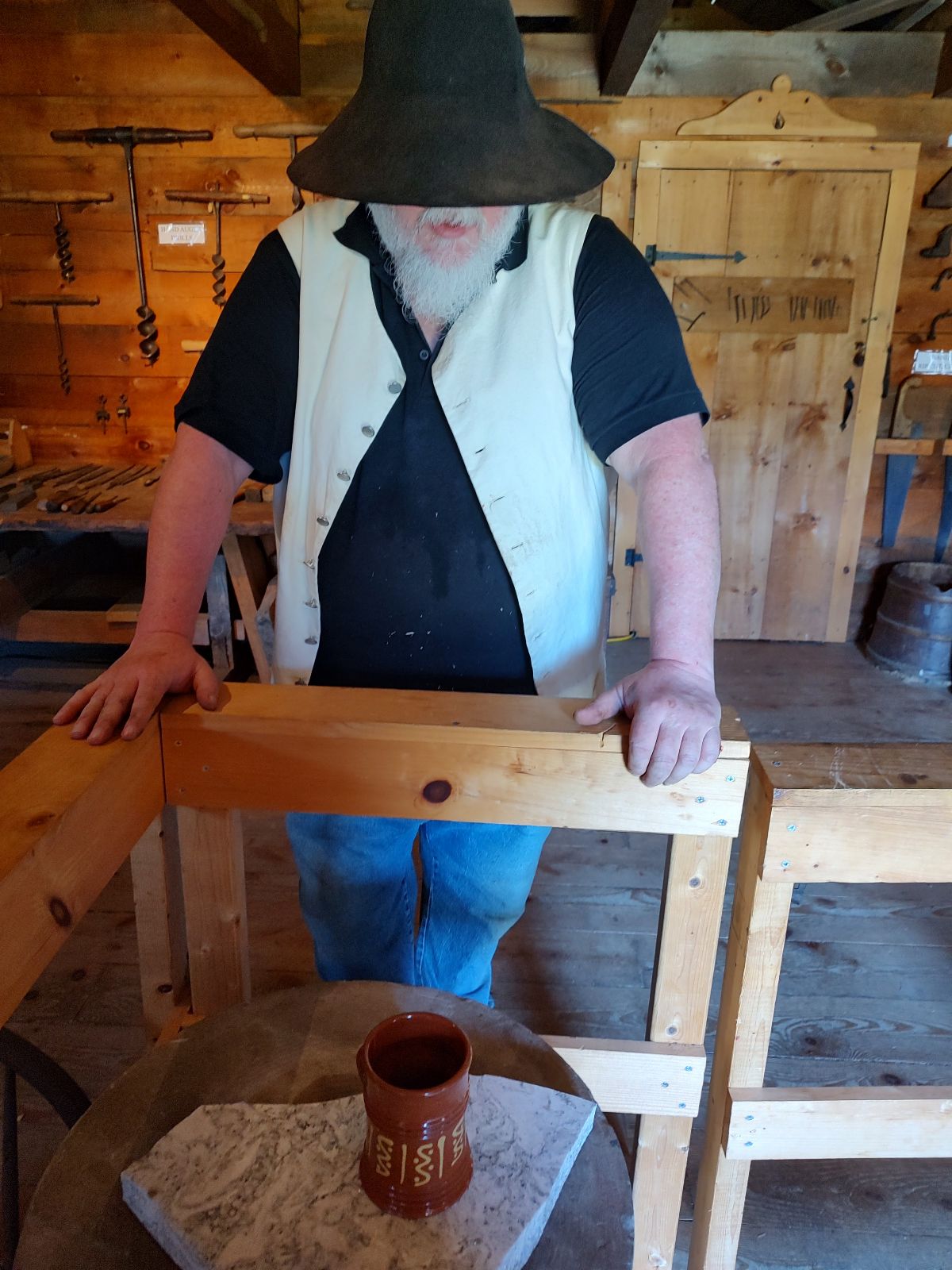
Remember the movie True Grit with John Wayne and Glen Campbell? Mattie Ross wore a black hat. That is the hat I felt I was wearing yesterday. Except mine didn’t have a tie strap. I kept waiting for it to fly away in the wind.

This was topped with a white linen vest, about four inches too small across the belly and 2 across the chest. But it looked period.

That was over a linen shirt. The shoulders of which were a little tight.

Black pants finished the look.

I had planned to do some spinning. I didn’t. I spent most of the day talking to people and learning and finding things that need to be fixed.

My primary learning goal was to observe and ask questions about how linen is made. They didn’t have anybody in the weaving room.

I did find a very knowledgeable lady, but she had knowledge but not skill.

A bit later, I managed to get one of the interpreters to actual show me how it was done. It is an interesting process. There are some specialized tools that are needed for the processing. I don’t have them, I think I can make them.

We bought a bound of flax seed from some monks a few years go. I think we might plant it this coming spring. Maybe at the fort.

Subsequently, I ended up talking to guests. I do not have the skill to disengage when I am done. So many interactions lasted to long.

Tomorrow’s post will be about some feedback I got from an Australian farmer who was there when they took the guns.

My daughter spent several years working for a corporation where she didn’t feel her skills were appreciated. One of her coworkers did not interact well with her.

When she changed positions and is in a new team, with a new chain of command, she was exposed to some people that she described as having “quiet competence”.

Ally came to me with a sickle. Told me it needed to be sharpened. I found some sharpening stones and did so.

I’m sitting out in the courtyard for the light on a capped well. The director took pictures.

Seems that there is a skill to sharpening, which I have been working on, but which I didn’t have on my list.

So I got another, “He just sharpened it, amazing.”

All in all, I had a good time. My bad knee hurts, but that’s a good hurt. I was outside most of the day. I meet people.

The only thing that would have enhanced it would have been if there was live fire involved.

Show and Tell At the Fort!

I’m up at the Fort with Ally and my wife. They are having a show and tell.

She picked out the garb to wear, and I have my black felt hat.

Originally, I intended to do some wood working, but that is currently on hold until I get some raw lumber.

The lathe needs bracing before it can be put into use. We could just use 2x4s, but that wouldn’t look very nice.

My goal is to bring up a 4 or 5 foot length of Oak from the woods. It will be heavy.

That will be fed through my bandsaw to make some rough blanks. The blanks will be taken up to the fort to be hand planed and turned into braces.

So… What will I be doing up there today?

I will be combing wool and spinning it. I have my wheel up there to use, but it is likely I’ll be using something a little older. Some 100+ years older than mine.

I am also hoping to learn how to process flax into fibers for spinning. It is an example of something I have knowledge of but no skill.

The next project is to make an inkle loom. My fine felt hat is too boring, even for me. I want a hat band. That requires me to make a hat band.

To make the hat band, I will need some sort of loom. I’ve decided to use an inkle loom. I could spend dollars to buy one, instead I plan to make it.

There will be some shortcuts used. The intent is to use the modern jointer, plainer, and lathe to make the components, but we will be starting from a log in the woods.

The threads for the hat band? Those are what I will be spinning. My wife will be dying some of the thread, I will have to decide on colors.

I hope that some of you make it out to the Fort this weekend.

Learning A New Skill

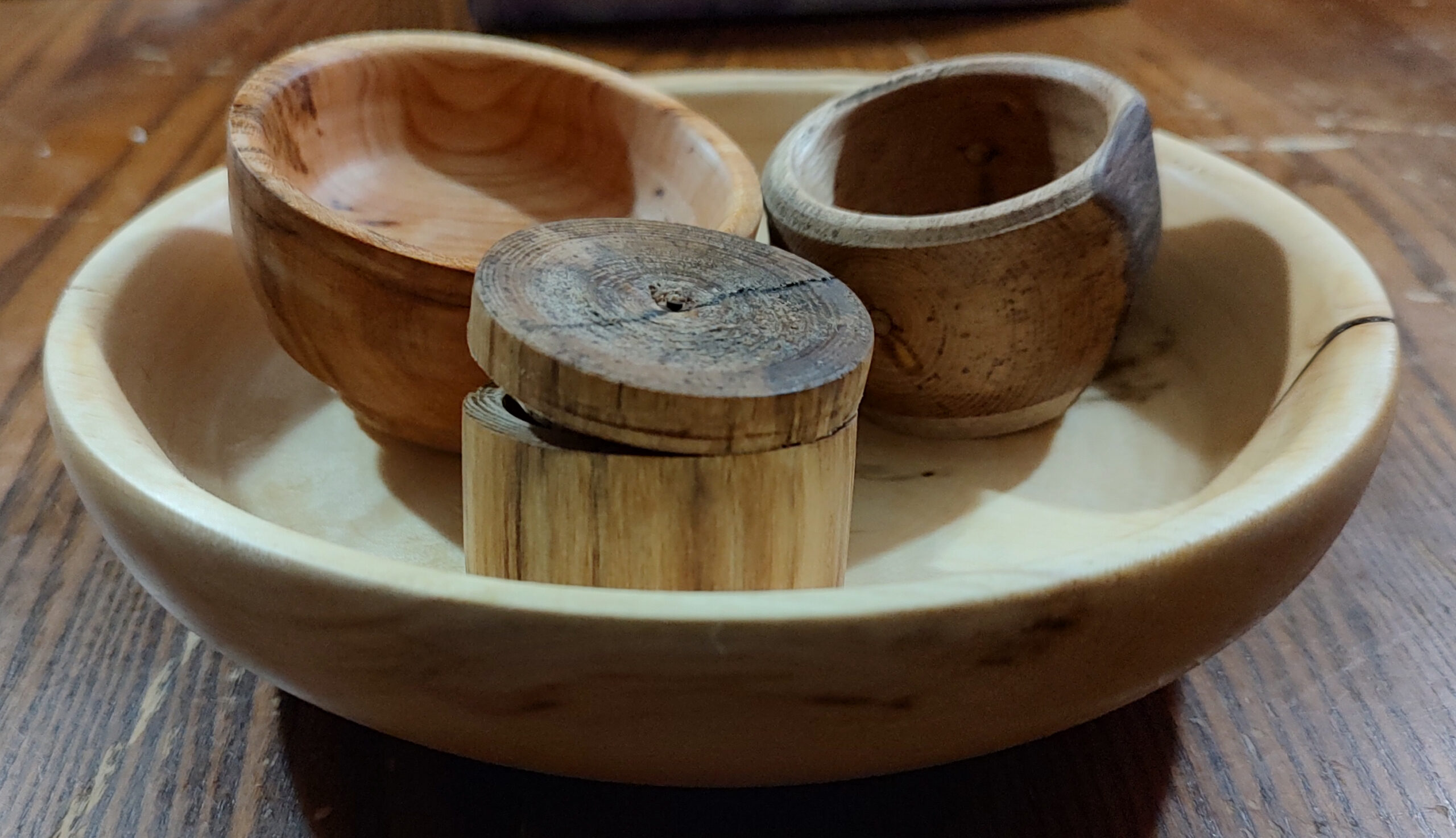
I like to learn new things. My goal is to be able to fix anything at The Fort At #4. A large part of that is learning how to turn wood.

This is not as difficult as it could be because I have experience with a metal lathe. The concepts are similar, but very different.

In metal working, we look at the type of metal, the amount of metal we want to remove, and the speed at which we wish to do it. This informs us of the type of tool to use.

Steel likes larger nose radius than aluminum. The chip breakers are different, the rake is different. The cutter shape defines speeds and feeds. What tool I pick is dependent on what I am doing.

In wood turning, there are two major types, “spindle” and “bowl”. A spindle is a long, round thing. Think of round legs on chairs, or the spindles in the back of a chair. Round chair rungs. All of those are spindle turnings.

Bowl turning is just about would it sounds like. You are carving out wood from the center of a round, thick piece of wood. The difference is grain orientation.

In spindle turning, the grain is oriented end to end. In bowl turning, it is side to side.

When cutting the outside of a spindle, you are always cutting away the along the grain. The easy way. In bowl turning, you are cutting side grain, then end grain, then back again.

The tools are different. A bowl gouge and a spindle gouge have different shapes and different sturdiness.

Read More

For Want of a Nail…

The Fort has been trying to recover from the lack of visitors during covid. It is also working with volunteers that know much about their area of interest, but not so much about other parts.

Consider power transmission. We have been working with power transmission since ancient Roman times. What is power transmission? It is how you transmit movement from one place to another.

In the modern era, we will convert running water, high heat or a dozen other things into electricity. That electricity is then transmitted over wires to a motor. At the motor, the power is converted back to motion.

Another part of the transmission of power, is the simpler physical transmission. Consider a water wheel. The wheel rides on an axle. The axle sits in bearings. When the wheel turns, the shaft turns. Anything attached to that shaft will also turn, doing work.

Read More

Spending a Week at the Fort

header, a week at the fort, fort interior

So back in May, I spent 8 days and 7 nights at the Fort at No. 4 up in Charlestown, NH. I was there for a number of reasons. First, they needed someone to do a cooking demo for a few school groups going through, and that’s entirely my wheelhouse. Second, there was a Rendezvous going on (sort of an 18th century “con”) and they wanted people in the Fort. Third, and perhaps most important, I wanted to teach myself how to bake in a beehive oven.

salt pork on a table beside a candle and a crock of butter
Salt pork made at the Fort, ready to use in a bean dish.

The Fort is a wonderful and very magical place. It does have running water in the bathrooms (cold only, and only in the summer), and the bathrooms are set up outhouse style (you have to go out of the fort to a small two stall privy to use them). There is electricity in some of the buildings, but when I’m there I rarely use it other than to charge my phone (which I do in a staff room that is not open to the public, during the day when I’m not using it). I do use the fridge in the staff room for keeping food from going off, but only because there is no root cellar there for me to keep things in. If there was, I probably wouldn’t use the staff room at all.

So, in spending a week at the Fort, I learned a number of things about myself. First and foremost, my stress level went down tremendously when I wasn’t reading FaceBook and the news. About the end of the third day, living in a one room cabin and sleeping on a rope bed began to feel like the “new normal” and I settled in very nicely. The rope bed has a lovely, fluffy down feather tick mattress, over which I laid my sheepskins so that the pin feathers didn’t prick my bottom while sleeping. It was still a bit chilly in Charlestown during the evenings, so I was happy to have the warmth of the fireplace radiating beside my bed. If I had wanted, I could have kept the fire going all night, but I didn’t see the point. The residual heat from the beehive oven actually kept it quite dry and comfortable (outside was a bit moist and cool). I learned that sleeping on the rope bed, my shoulder ceases hurting almost entirely… but my hips go out of whack instead and I must pinch a nerve. Apparently I should spend a every other night flipping between my bed and a rope bed to get the best sleep possible. LOL!

wood fired bake oven
Firing the beehive oven in preparation for baking bread.

I learned that you get up early because there’s light, and you go to bed early (for me at least, because I’m a night owl usually) because there isn’t light. The cabin I’m in is lit entirely by the hearth and candles. I have a large candelabra, several smaller candle stands, and a few lanterns. Most nights, I burned a single candle and not much more, because there didn’t seem much point. The one night I was attempting to finish a sewing project, I actually lit up six candles in the candelabra, and that was enough light to allow me to complete my work. It was interesting, seeing the way my body adjusted when I cut out electric light from my life.

The entire time I was there, I dressed as a Fort dweller. I wore a petticoat (a skirt) or two depending on the temperature, and a bedgown (which is a type of blouse that ties or pins closed), a chemise that covered my elbows but not my lower arms, and a frilly cap that covered most of my hair. I wore an apron the entire time, partly to keep my bedgown closed and partly because much of what I was doing was dirty.

I cleaned the house I was staying in. I swept at least twice a day, and always found more dust. It’s a hazard of burning wood – the ash gets everywhere. I washed dishes in the dry sink, with water heated over the fire in a tin kettle. I cooked over the fire in cast iron pots and a spider (basically a frying pan on legs, that allows you to cook over the coals). If I didn’t make a fire, I didn’t eat cooked food, so I made a fire every day. I carted my water in from elsewhere in the Fort. I washed myself in the evenings over a bucket in front of the fire.

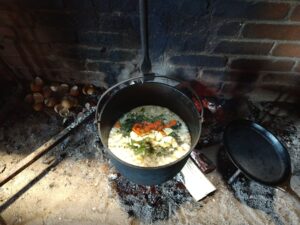
soup cooking over a fire
The beginnings of a Habitant pea soup, 1750s style.

I think the most striking thing I learned was that it’s really hard to stay clean when you’re living like that. We are absolutely, completely spoiled by showers. I spent almost 45 minutes each night, cleaning myself from top to bottom. I didn’t wash my hair with soap every night, but I did wet it down and scrub my scalp with a washcloth. I used soap on all the “important bits” every day. I made sure to thoroughly clean my feet at least once a day, and always before bed. It took a long time, and sometimes I didn’t feel like doing it, but I always felt better after my evening “spitz bath.” Still, when AWA came to pick me up from the Fort after my week, I noted he drove home with the windows open. I cannot tell you the filth that came off me when I showered at home. It was startling, because I really thought I was pretty clean the whole time. I’d made a point of it! But the bottom of the tub told a different story.

I did well learning my beehive oven use. I have now baked about ten or twelve loaves of bread and several pies in the beehive oven, and am comfortable with the use of it. I learned how to close certain windows while bringing the oven up to temperature, because otherwise the wind would whip the smoke down from the chimney and right back into the cabin. I discovered that it doesn’t matter how many windows you close at night, mosquitoes will find their way down the short, straight chimney to eat you. Might as well leave the window open for a nice breeze.

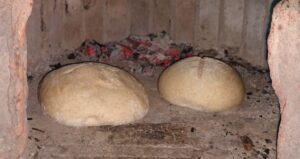
bread, baking in the wood fired beehive oven
Bread, almost ready to come out of the beehive oven.

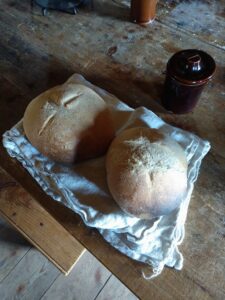
bread cooling on a table
The first batch of bread got a bit burnt at the back edge, but was otherwise delicious!

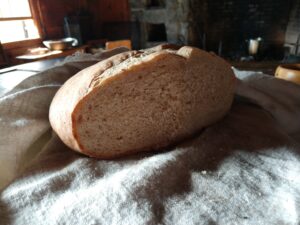
open loaf of bread
As you can see, the crumb of the loaf turned out beautifully!

While I was there, I collected all my hardwood ash. It’s my intention to use it to create lye in the autumn, so that I can then make both clothes washing soap (which is sort of soupy and mushy) and body washing soap (which can be in bar form). I hope to make two batches of bar soap, for comparison… one batch made with my homemade lye, and one made with commercially purchased lye designed for modern soap making. My sister makes soap, both lye and other types, and I’ve helped a number of times, so I figure between the two of us we can probably do a great “compare and contrast” for the Fort patrons.

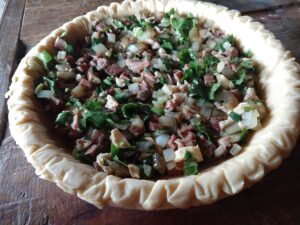
Chicken and beef pie with horseradish greens.
Chicken and beef pie with horseradish greens, right before the top went onto it.

The profound thing I discovered about myself, is that when I am at the Fort and away from the modern hustle and bustle, I am more quiet, more peaceful, and less klutzy. I tend to rush around from task to task, overly busy at all times when I’m at home. I have so much to do between taking care of the house and cooking and kids, writing books, planning events, marketing, helping out AWA with the blog, and the dozen other things I do every day. When I rush, I do stupid stuff, like trip and fall, or cut myself with knives. At the Fort, the pace was just much slower. I had as much or more work to do, honestly, but there was no rush. Part of it was that I was by myself for the majority of the time (school groups and other people were only during open hours, from 10am to 3pm generally). But part of it was just that I knew what needed doing, and I did it. There was no rush. I just had to move along at an even pace, and I did. No trips and falls. No cutting myself. I did get one splinter, but it got dealt with and I was fine.

There’s so much to be learned by doing things “the old fashioned way.” I like doing it because I love taking those old recipes (whether for food, or soap, or whatever) and trying them out. Every time I do something, I learn new stuff, about myself, and about history. Yes, it’s good for learning how to live without modern machinery. But it’s also just good for the soul, in my opinion. Doing things with your hands, getting more in touch with the world we live in, breathing in fresh air and allowing your circadian rhythms to sync up… it’s all good.

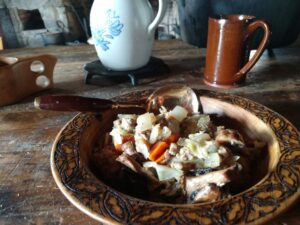
an 18th century meal in a wooden bowl
Sausage hash, made at the Fort and enjoyed by the author.

The Fort was designed to teach adults and children about the history of the French and Indian War, and about the colonization of New Hampshire. Perhaps it’s also teaching us about how to live, going forward into our future. I think we’ve lost a lot of knowledge that we used to have. Those people who lived in the original Fort were not stupid. They did amazing things, and without the machinery and computing power that we “cheat” with today. We’ve lost some of that drive. It’s time we got it back.

I’m not entirely sure how to go about injecting that drive into today’s youth, but it’s something I think must be done, and as quickly as possible. My own kids are a mixed bag. I will say that the one who spent the most time “visiting the past” with me is the one with the most insane drive for success and internal motivation. I think that’s something to keep in mind. Allowing children to actually DO things, instead of just reading them or watching them in a video, gives them the opportunity to invest themselves. In order to become a successful person, you have to fail. Without failure,  you don’t learn to work as hard. You don’t learn that … that thing which made America such an amazing place when it was founded. People flocked here because with hard work and effort, with blood, sweat, and tears, you could better yourself and your family. That’s not America today, though.

We need more children learning trades, learning to put their personal sweat equity into the work they’re doing. We need more adults teaching it, and yes, pushing it. The stigma of going into the trades should be eradicated, and instead, the plumbers, carpenters, welders, electricians, HVAC folks, and all the others, should be elevated and celebrated. They are the ones carrying us forward, for the most part.

Turn about is fair play

Yesterday, I went up to the Fort at #4 to pick up Allyson and to play with the Lathe.

This time I took my chisels and was better prepared. I also took along some grease.

With a bit of patience, I got the lathe belted back up. About that time, Allyson arrived. She took on the task of pumping.

Since I brought up some grease, I was prepared to liberate some wear points. But, I was so excited, I just didn’t.

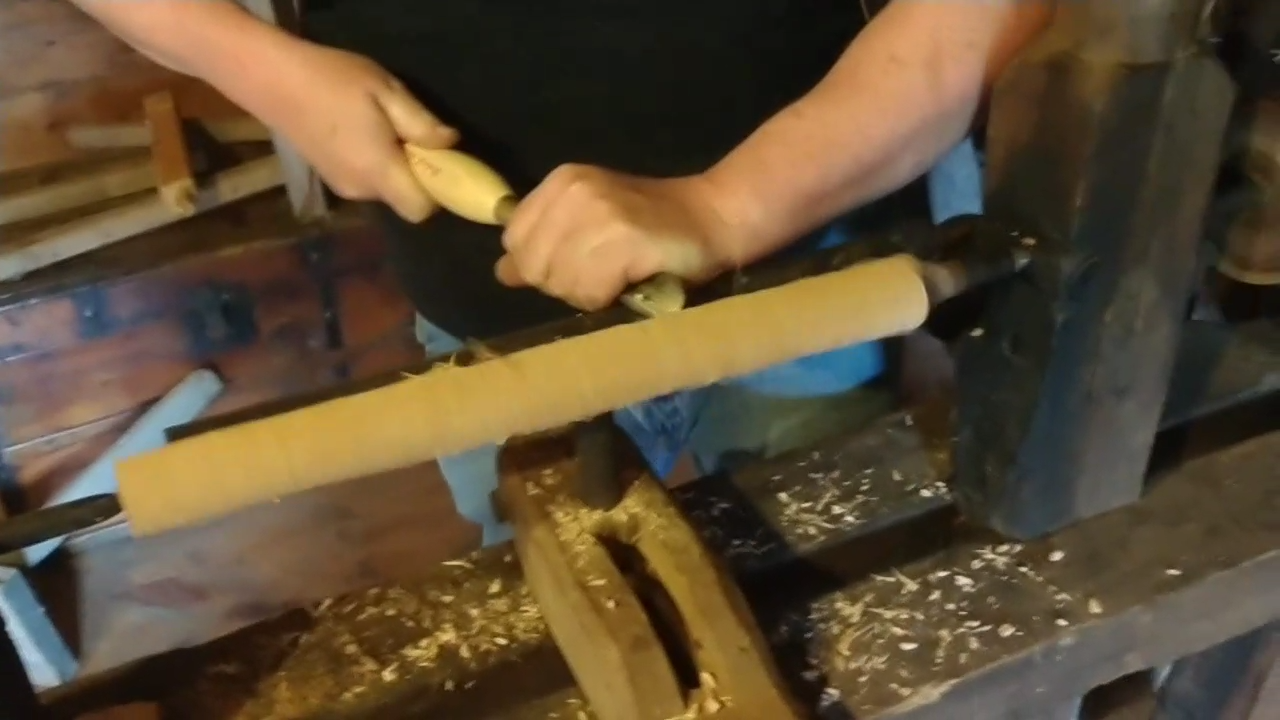
It took us a few tries, but we finally go things moving, and I was able to make chips. The squarish thing is slowly becoming round.

I checked the drive, and it was getting warm/hot. I stopped to get some grease into place. That seemed to have made a difference.

With that, I could try, try again. I could get it spinning. I can’t keep it spinning as I lose coordination. But for the time it is spinning, I was able to make wood chips.

I hope you notice the 2A shirt and the Kimber 1911 on my right hip.