
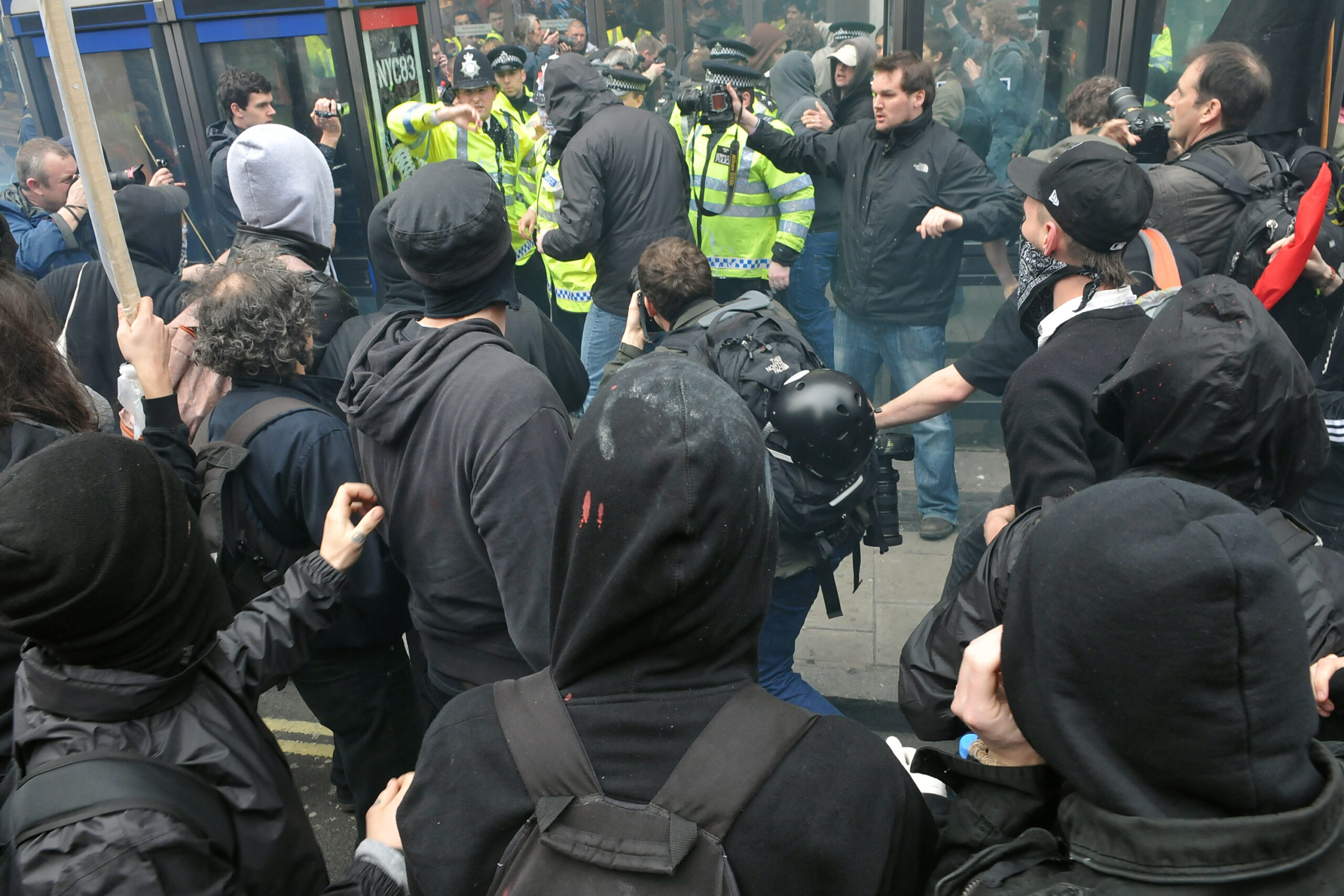
Mobs are an organism. They act like a living creature. They might be made of people, but they react in known and predictable ways.
Mobs move in the path of least resistance towards their goal. If one person chooses a different path, others in the mob will follow, not a lot. But more people will follow those, and pretty soon there is a significant part of the mob moving in that new direction.
This is why breaking contact with the mob can be difficult. You need to fade out of the mob, not attract attention that causes parts to follow.
When there is a junction, the mob will flow down multiple paths from that junction unless guided. This is how multiple blocks can become involved with the mob: they move in the same general direction, but they fill all available space.
Mobs avoid hard points. They will flow around those hard points, but hard points cause a pain-like response, and the mob recoils from contact.
Riots are a type of mob behavior. My mentor told the story of how he and his Johns Hopkins buddies rushed to the rowhouse of one of the buddy’s moms. There they set up in the front window with long guns.
As the story was recounted to me, every rowhouse on that block suffered serious damage except for three. The rowhouse they were in and the two rowhouses directly across the street from them.
The mob avoided that hardpoint. It wasn’t worth the pain, and the organism retreated.
Mobs are dangerous. People get caught up in them and don’t know how to extract themselves. People that would never dream of being violent or vandalizing property will do it without even a thought. They follow anybody who acts like a leader.
During student protests that turned into riots at my University in the 60s, before I got there, there was no vandalism until one person threw a brick through the plate glass window of an upscale store. The student newspaper ran a picture of the man throwing that brick through the window to go with the story of the police vowing to track down the student who did it.
Oh, the man throwing the brick? He was dressed as a police officer.
The REST of the windows, those were broken by students who followed suit. Once one act of violence happened, the rest of the mob followed suit.
During the January 6th march to the Capitol, instigators changed the protest into a mob. That mob did not turn into a riot; they just did things that, as individuals, they would not normally do.
The reason that it didn’t turn into a riot was because there was no drive among the people to be violent.
We compare that to the BLM riots.
In Kenosha, we saw protests turn to mobs turn to riots. One of the interesting things that was caught on camera was people in all-black clothing, carrying umbrellas, throwing those first bricks. Starting the process of turning the mob into a riot.
The people in the streets were already angry. The media had been stirring up hate and anger for days and weeks. It took very little to drive the protests into mobs and the mobs into riots.
But there are things that mobs don’t do. They don’t have Command and Control structures. They don’t have security details. They don’t have assigned tasks for different units. They don’t have units.
One of the interesting, but not surprising, features of the “mobs” in MN is just how well organized they are.
All of which leads me to believe that they are not organic. There are parts that are useful fools/tools. But there are other parts that are most definitely acting to destabilize societal norms in the area. To foment a revolution.
I still remember reading about pallets of bricks standing unguarded a block or so off the route of the “protest” in 2020. Really weird that a construction company would leave their materials unguarded and open to theft. Even weirder is that often there was no actual construction in the area. Today’s events give me the same exact vibe.
.
Your post raised an interesting thought.
The contrast between the St. George of Floyd riots and the Jan 6th “insurrection” and today’s events in Minneapolis, Portland, etc… Why is there such a disparity? The elements are all there. A large number of people, a measurable amount of anger, agitators in the crowd. But, Jan 6th was the most peaceful insurrection the world has ever known for some reason. (Yes… there was violence and damage, but get real.)
.
My guess is the makeup of the crowd was the difference. On Jan 6th, it was mostly adults. They took time off of work to be there. They were there to support a candidate they felt lost in an unfair election. Whereas, the mobs making up todays riots are not adults who took time off of work. Protesting IS their work. They are also leftists who feel entitled, who get their news from social media. They hear Trump is a fascist, and they believe it. They make decisions based on their feelings more often than on hard data/evidence. And, as a result, they tend to throw tantrums instead of trying to figure it out, negotiate, or work toward a goal. They want, and they want NOW!
The organism and following aspects you mention line up with my personal experience. I can state that your hard point theory is accurate based on what I’ve seen; I will also say that escalation will come back 10-fold, so discipline is absolutely necessary.
Here is a single experience. Many years ago, I worked at an embassy as one of the Marine Security Guards. Israel had done something that ticked off the Muslims in South Africa and so they decided they were going to protest at the US embassy and then move to the Israeli embassy and continue. The local cops were on hand as were we.
Watching through the cameras, there were about 2000 people outside the perimeter and chanting, waiving signs and the like. There were also about 8-10 rabble rousers in the crowd. They were unsuccessfully trying to get the crowd spun up through various antics. At one point, one of them whipped a beer bottle sidearm style toward the South African cops. Hit the police chief above the left eyebrow and split him open down past his cheekbone. That triggered the South African cops to charge the crowd looking for the rabble rousers to roll up. They got about 5 of them, if I recall correctly. The crowd had started moving at that point, recoiling from the mobile hard point. I do believe that those on the periphery were initially unaware of all of this. As the crowd started moving, an older guy in front of one of the cameras started clutching his chest, obviously having a cardiac event and went down. EMTs on hand loaded him up and took him away. He didn’t make it I later found out. That sent the crowd into a straight frenzy and was attributed to the cops charging the crowd and busting heads, literally. The atmosphere changed instantly and you could almost watch it radiate through the crowd and it got intense. What was generally a peaceful protest escalated in seconds. Cops started pushing the crowd with vehicles and they finally departed. On the way to the Israeli embassy, this mob overturned 4 cars, lit them on fire and two people caught up in their path were stabbed multiple times. This all happened in the span of about 10 minutes.
I have other experiences. You have to almost melt out of a mob to escape it lest you get followed or turned on. Grey man mentality and behavior are your friend.
Wait! The muslims got upset about something? I just do not believe it. /sarc
.
Good write up and good reminder that it does not take the full crowd to decide to go mob, all it takes is a few agitators. On individual, dedicated to the ’cause’ willing to take a beating for it, will commit an act of violence, and the police will respond. It is literally part of the plan.