
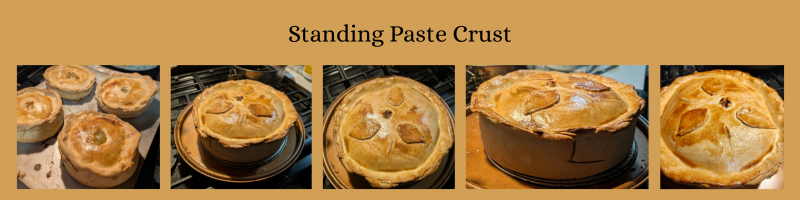
Pie crusts in the medieval era were rarely the flaky, buttery confection we are used to today. Instead, they were the ancient version of take-out food containers, only sort of edible, and designed to allow you to eat their delicious innards and then throw the crusts away. This recipe is a more edible but just as solid version of those “hot water crusts” as they were known in later periods of history.
Ingredients:
- 1.5 lbs flour
- 2 tsp salt
- 3 oz lard
- 3 oz butter/margarine
- 8 oz water
To make a standing paste crust, we’re going to ignore the sort of instructions you may be used to while attempting flaky pastry. There is a reason these crusts were sometimes called “coffins” and you’re about to discover it in person!
Add your flour (by weight, please) to a large bowl, then sprinkle the salt over it. Whisk or otherwise mix the dry ingredients well to distribute the salt as evenly as possible.
In a small pot, add the water and heat it up gently. Add in the butter or margarine, and the lard, and heat until they are all melted together. DO NOT BOIL or even simmer this mixture, if at all possible. You just want it warm enough that the ingredients can combine together.
Add the liquid ingredients to the dry ones, and then use a spoon or fork to begin mixing the dough together. You should continue using the spoon or fork until the dough has come mostly together, or it’s cool enough for you to knead by hand without burning yourself. Please be careful, and remember that the water you just poured into your flour mixture is HOT. Knead this until the dough has come completely together. It will be a very stiff dough, and that’s fine. You don’t want to over-work this dough.
If you are making a single pie, split off about 1/4 of your dough (this will be turned into a lid for your pie) and set it aside under some parchment paper or in a plastic baggie. On a Formica counter or granite dough surface, sprinkle some flour and then begin to roll out the dough. You want to have a circle of dough large enough to fill an 8″ spring-form pan, and it should be between 1/4″ and 1/8″ thick when it is ready.
To make the pie crust, you are either going to press the dough into a pie pan, or drape it over the outside of the pie pan, in order to get the shape right. Flour the pan well, regardless! While the dough is still on or in the form, refrigerate it for at least one hour. While the pie crust is chilling, roll out the lid for your pie, which should be about one inch larger in diameter than your pie pan. If you look at the pictures in the header, you can see that the crust for a standing paste pie goes inside the outer crust, not over it as you would for a flaky pie. Let the pie lid sit, sandwiched between two pieces of parchment paper, until it’s ready to be used. If it will be more than an hour, consider covering it with plastic wrap so it doesn’t dry out. Do NOT put it in the fridge.
If you are making multiple small pies (this recipe should make about 3 individual pies), separate the dough into three equal sized pieces. From each of those, remove about 1/4 of the dough for the lid of that individual pie. To form small pies, flour a glass or mini pie pan and follow the same general directions as for a large pie. Roll out the lids as well, and set aside for use after refrigeration.
When the crusts are well chilled (which allows them to be standing until they bake and become stiff), unmold them from the pie pan or whatever you’re using for a form. Put the pie crust on a parchment paper lined baking sheet (lipped, please), and add in your filling. Please note, fillings can be cooked or raw, as your cooking time will be about 90 minutes, which is enough for most meats to cook. The fillings should be cool when added to the crust, however. Hot fillings would melt the fats in the crust, making them prone to drooping, and you don’t want that! The filling needn’t be cold from the fridge, but make sure it isn’t hot, either. If you can’t stick your finger in it for 30 seconds, it’s too hot.
Once your filling is in, regardless of size of pie, whisk up an egg to use for an egg wash. Brush the edges of the lid and pie with the egg wash, then add the lid to your pie, and crimp the edges closed with your fingers, a pie crimper, or a fork. Cut a small hole in the center of the pie. This is easily achieved by using a sharp knife to cut an X in the center, then peeling back the triangles. Egg wash the entire pie and sprinkle with herbs, if you like.
If you want to decorate your pie, simply use bits of left-over crust rolled out thin to create leaves, vines, or other images. Have some fun with it! Attach them by using egg wash as a “paste”, then egg wash over the decorations as well. You could also press herbs or cracked spices into the lid, if you liked. I would suggest doing that before attaching it to the top of the pie, however.
Bake the pie in a 350°F oven for 80 to 90 minutes. Start checking your pie at the 60 minute mark, and every ten minutes thereafter. When the pie is dark brown and solid when tapped, it’s ready. See the pictures in the header for reference!
Many types of fillings can go into pies like this. In medieval times, they would add chunks of beef, goat, or chicken into standing pastes, and then cook them up. Gravy wouldn’t be added until it was time to serve the pie. The gravy was poured in the hole on the top. Later period pies of this type would have contained ground or minced meats, or mixes of meats and fish. They also had fruit pies made in these types of crusts.
In my opinion, standing paste done this way is much easier than a flaky crust, and more forgiving. It doesn’t require “blind baking” (pre-baking the crust before filling it, in order to keep the crust from being mushy) because it’s so darn solid.
Serve your pies with a side of mashed potatoes or some “bashed neeps and carrots” for an authentic meal that will fill your belly and warm your soul.
So … (looking in freezer for breakfast, sees likely candidate) (light bulb moment) … Basically a Hot Pocket is a reverse-engineered medieval food. (closes freezer door)
.
Suddenly I want oat meal. 😉
.
Have a great weekend, stay warm & snug.
Hot Pockets are a variation of hand pies, which are basically “medieval take out” food! 😀 There’s a really cool barley mush recipe I make from a Viking themed cookbook, which tastes rather like oatmeal when you first make it. Then you chill it and, like lasagna, it kind of grows. Then you can slice it and fry the slices and top them with eggs, and it’s really yummy! 😀
go listen to Jim Gaffigains commentary on hot pockets..
you will pee a little.
“breakfast hot pockets? great, hot pockets for breakfast, hot pocket for lunch and be dead by dinner”..
heh heh