

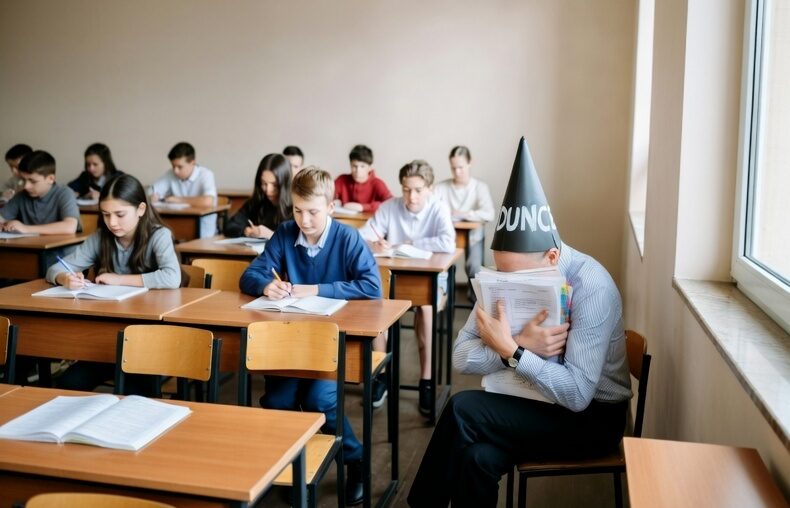
The only clear correlation we can find in education is this: as spending goes up, student results go down.
Our local school system just had its budget rejected for the second time in five years. They’re already talking about “what to cut,” as if the budget was slashed. It wasn’t. They simply didn’t get the increase they wanted. This happens every time the public pushes back.
Meanwhile, our high school has a math competency rate of 15 to 30 percent. At best, only three out of ten kids are performing at grade level in math. Reading is better but still unacceptable. For comparison, my old high school currently posts 90% in math and 95% in reading. The difference is night and day.
This shouldn’t surprise anyone. The education industry has largely stopped functioning as an education system. When you ask them “What is it that you do?”, you get soft, nebulous answers that mean nothing. They’ve become expensive, glorified babysitters who speak in jargon and resist any attempt to pin them down on results.
Look at how they train teachers. I sat through some of my wife’s online education courses. The instructors treated grown adults — many with advanced degrees — like children. The lectures were repetitive and shallow. Any reasonably intelligent person could ace them without much effort. We are not training teachers to teach. We are training them to manage classrooms.
The system has also abandoned fundamentals. I remember the first time I was told homework was useless. The kids who didn’t need it got penalized for not doing it, while the kids who needed it most had parents doing it for them. Some of those parents were getting failing grades themselves.
We desperately need to start over. Forget last year’s budget. This year we should build the budget from the ground up with one simple question: *What is it we do?*
The answer should be clear: Teach kids to read, write, and do math. Everything else comes after. If they can’t read the textbook, they can’t learn science. If they can’t do basic math, they’ll never manage a household budget. Yet we have people claiming it costs more to shop and cook at home than ordering Uber Eats.
I don’t know if this can still be fixed. This may be the first generation to graduate high school less skilled and more ignorant than their parents. We might have crossed the tipping point.
But if we’re going to try, we start with the basics. No more vague mission statements. No more throwing money at failure. When someone can’t explain what they do in clear terms, they shouldn’t be running our schools.
That’s what Elon did when he took over Twitter. He asked, “What is it that you do?” Some good people got fired by mistake and he hired them back at higher pay. But the ones who couldn’t explain their job stayed gone. Schools need the same clarity of purpose.
We owe our kids at least that much.
complacency breeds failure.. We the People have been complicit for far too long.
these schools have been nothing but a giant vacuum sucking up unbelievable amounts of money for years and proper education is the last thing adult-sized-toddlers running them care about
School budget debates/discussions are nothing more than political theater.
“If we do not get every penny we ask for, we will have to fire teachers!!!!!” Meanwhile, not a penny will be cut from the administration staff budget, no a single vice principal will get walking papers, not a single “special program” will get even the most modest cut. Nope, the only thing the school administration will consider cutting is teachers.
.
Why? Because it sells, and scares parents.
.
I have been paying real estate taxes for longer than I want to admit, and at no point did I ever see the number of vice principals go down in the school system. I have never seen the number of guidance counselors drop. I have never seen the “sports” budget get a cut. But, I have seen the teachers get cut. Every time.
In some towns I have seen the way politicians deal with uppity voters: when budgets don’t grow as much as they want, they begin by cutting the important positions: fire and police. They never cut the waste or the patronage. They don’t want to save money, they want to punish the voters for voting “the wrong way”.
its way past time to “punish” politicians….
That is the SOP.
Right now, my assembly seems to adore the homeless industrial complex. We need to float bonds, and borrow money to get the police and firefighters the gear they need, but nothing is stopping them from appropriating millions from the general fund to pay for homeless services.
.
And they are now floating a sales tax. Because we cannot afford road service and police. Not a whisper about the vagrants.
Oh, our school system just explained that they have to cut all after school programs, plus art and music. I’m sure threatened to do so because they wanted to bully the neighborhood into paying, but that seems to have backfired on them. As I’ve said, a school’s mandate is to educate our children. Until they’re doing so at a decent level (say 70% of students being competent at each of the core educational goals), there should be nothing to distract them (or funnel money away from) their students. Art and music can absolutely help some students, but if they’re failing so badly that they aren’t even getting D’s in class, music isn’t going to fix it.
From watching them perform on the news, I have reached the conclusion that it is a professional requirement for school principals and superintendents not to have a functioning brain.
The best answer I can see is to abolish all public schools.
A somewhat less drastic solution would involve some or all of:
1. Ban all unions
2. Reduce the number of non-teaching positions to less than 10% of the total.
3. Fire everyone who has an Ed.D.
4. Never use the word “educator”. The job title is “teacher”.
Growing up I went to a secondary school that had about 30 teachers, a principal (who was a former teacher and occasionally substituted), a lab assistant, a secretary, and two custodians. The teachers all had university degrees, but no Ed.D (I don’t know that one even existed back then). I think they had internship type training for teaching as part of their academic work.
This worked well. The teaching ranged from fairly decent to excellent — mostly the latter. And clearly the overhead was low; spending went mostly towards paying the people who were actually doing the work, and they were indeed doing it.
“I don’t know if this can still be fixed.”
A large part of the problem is not within the school systems themselves. Sorry to rehash the rant I had on Ally’s column about education, but the biggest problem is the degradation of the two parent family unit. Too many parents are too busy pursuing careers to be an active participant in their children’s lives. Not to the extent they need to be. So… what is the result of “We cannot afford to live without two incomes?”
.
Parents subcontract the raising of their children to daycare and schools. Perhaps not all of it, but a lot. Because society says pursuing luxuries is more important than raising your children. (Please do not point out all the exceptions to this. We are talking about demographics and stats here, not individuals.) And, pre-school learning suffers as a result. I am not particularly intelligent, but I was reading well above my age before I entered kindergarten. When we were doing the ABCs, I was bored mindless. But, these days, people are graduating HS and becoming Congressmen without knowing what letter goes after R.
.
And, because no parent wants to admit their choice led to their child’s lack of education, they demand more from the schools. And, push for higher budgets. But, without fixing the root cause of the problem, the results will not change.
.
Finally, getting the feds involved made the situation a million times worse. The biggest disaster to hit the education industry was the No Child Left Behind act. Sure, it was passed with good intentions, but because it did not address the family, the result was schools lowering standards in order to continue receiving federal funds. Gotta pass everyone, but not all of the students were capable. So, pass them anyway. But… wait, you have to document they passed, so reduce the passing grade from 70 to 50.
There’s an easy answer to “we can’t live without two incomes.” Have more than two incomes. My family has two adults working full time, and one adult (me) working part time at writing, part time at reenacting/teaching, and part time at cleaning house. When the kids were smaller, I took some of the writing and reenacting time out and added “attention to children’s homework” instead. Having three allowed us to do all the things we wanted, without sacrificing our children in the least.
.
My own family isn’t necessarily for everyone. But at one time, grandparents were around to help. This might not be the time to involve grandparents, but maybe we form co-ops of parents instead. I read a study a while ago about a single-mom co-op in BC, where the moms and kids all shared a big house and all the chores. The kids did go to public school, but they also had lots of parent attention at home. A couple of the moms stayed home and dealt with all the “home stuff” (chores, cooking, cleaning, getting kids to doc appts and ballet lessons, etc), and the rest worked. None of them were in intimate relationships with the others, but they all worked AS A FAMILY UNIT, allowing them to do more. Their kids’ test scores were up there with two parent families. Why? Because they had more than one distracted parent paying attention. What I see from various studies is that children need a *minimum* of one undistracted parent and one distracted parent involved in their lives in order to succeed. Adding more parental figures doesn’t seem to mess with the numbers (unless those “parental figures” are going through a rotating door… NOT the same thing).
.
I’d love to see ethically poly parenting studied more in depth. I’d love to see more about blended and “unusual” families, where there are at least three parental figures involved (for whatever reasons). I suspect we’d see a replay of the BC study… more involvement leads to child success rates going up.
.
I don’t like it when the feds touch anything. Government has the opposite of the Midas Touch. But I can see the wisdom in knowing that a kid in third grade is expected to know X Y and Z before graduation, across the country. The federal input was initiated partly because of the varying levels of education throughout the country. If we want to continue to be a single country (and that’s *also* up for debate), then we should know what minimums are required for each grade level. But I also think that’s where fed involvement should stop.
Not sure what the problem is here.
Public schools are working exactly as democrats intended.