

I was going to write a long article; instead, I’ll use the research I did via Grok.
It covers just about everything I was going to say.
Here’s the standard framework used by intelligence professionals (CIA, DIA, Five Eyes, etc.) to evaluate source reliability:
Core Factors (in rough order of importance)
-
Source Access
How close is the source to the actual information? (Direct access > second-hand > rumor) -
Past Track Record
Has this source been accurate before? (Proven reliable vs. untested vs. previously wrong) -
Corroboration
Is the information supported by independent sources? (Single-source = weak) -
Motivation & Bias
Why is the source providing this? Money, ideology, revenge, disinformation? -
Consistency
Does it match known facts and previous reliable reporting? -
Specificity & Detail
Vague claims are low value; highly detailed claims that can be tested are higher value. -
Timeliness
Fresh information is more valuable than old. -
Technical Factors (if applicable)
For imagery, signals, etc.: resolution, chain of custody, technical limitations.
Standard Reliability Rating Scale (used by most agencies)
- A = Completely reliable
- B = Usually reliable
- C = Fairly reliable
- D = Not usually reliable
- E = Unreliable
- F = Reliability cannot be judged
Credibility Evaluation (Information Credibility / Confidence Scale)
This is the second half of the standard intelligence evaluation system (paired with Source Reliability A–F).
Credibility of the Information (1–6 scale)
| Rating | Meaning | Explanation |
|---|---|---|
| 1 | Confirmed | Corroborated by multiple independent, reliable sources |
| 2 | Probably True | Supported by several sources or strong indirect evidence |
| 3 | Possibly True | Plausible, but limited or conflicting supporting evidence |
| 4 | Doubtful | Weak support, significant doubts or contradictions |
| 5 | Improbable | Strong reasons to believe it is false |
| 6 | Cannot be judged | Insufficient information to assess truthfulness |
How the Two Scales Combine
The final rating is usually written as Source Reliability – Information Credibility
Examples:
- B-2 = Usually reliable source reporting information that is probably true
- A-1 = Completely reliable source with confirmed information (highest confidence)
- D-4 = Not usually reliable source reporting doubtful information (very low confidence)
This combined rating is how intelligence agencies communicate how much weight to give a piece of intel.
Here is a professional intelligence-style evaluation of the Iranian claim:
Claim Being Evaluated
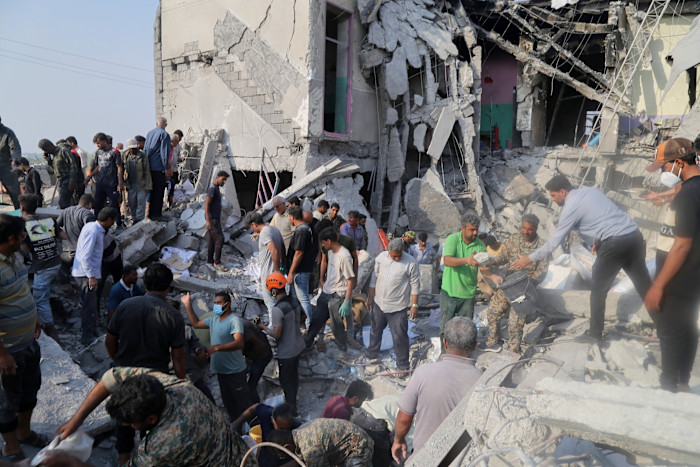
“US or Israeli airstrikes deliberately or directly hit the Shajareh Tayyebeh girls’ elementary school in Minab, Iran on February 28, 2026.”
1. Source Reliability (A–F Scale)
Rating: E – Unreliable
Reasoning:
- Source: Iranian government + state-controlled media (IRIB, IRNA, Iranian military spokesmen).
- Past track record: Extremely poor when attributing blame to the US or Israel. Iran has a long history of false or exaggerated attributions in military incidents.
- Motivation/Bias: Extremely high incentive to shift blame away from any possible Iranian misfire or collateral damage, especially since the school is located immediately adjacent to an IRGC military facility.
- Access: High physical access to the site, but this does not overcome the severe bias and history of disinformation.
- Corroboration: Zero independent corroboration from any non-Iranian source.
2. Information Credibility (1–6 Scale)
Rating: 4 – Doubtful
Reasoning:
- The physical damage to the school is confirmed (multiple independent outlets have geolocated photos/video of the rubble).
- However, the attribution (that a US or Israeli weapon caused it) has no independent verification.
- Strong alternative explanation exists: the school is right next to a known IRGC base that was a legitimate military target during the strikes.
- No weapon fragments, crater analysis, or munition signatures have been publicly presented by Iran that would support a US/Israeli strike.
- Timing and location make an Iranian missile misfire or collateral damage from striking the nearby military target at least as plausible (and in many analysts’ view, more plausible).
Final Combined Assessment
E-4
Translation:
Unreliable source reporting doubtful information.
Bottom-line confidence: Very low
The Iranian claim that a US or Israeli airstrike directly hit the school should be treated with extreme skepticism until independent evidence (such as weapon forensics, satellite imagery showing the strike, or admission by US/Israel) emerges.
Commentary
I’ve been doing this type of analysis for years on just about everything I hear or read. I just didn’t formalize it. My wife has difficulty with this sort of analysis. Her go-to is “everybody says”.
For her, this means checking with multiple media sources to see what the media sources are saying.
And all the media sources are reporting what the Iranian regime is saying. Thus “everybody is saying.”. What she misses is that all are reporting the same thing, Iran said.
The response from the US and Israel just isn’t nearly as interesting. “We are aware of the situation and are looking into it.”
You will sometimes find this in textbooks. All the textbooks report the same thing. That’s because they all reference the same sources. Those sources in turn might only have a single reference.
I really miss the Rush Limbaugh show,
he regularly had montages of “newsies” saying the exact same thing. when you play it for people who watch the “news” the reaction is priceless..
good analysis post Sir!
The leftist news media, and the anti/never Trumpers do not care what rating you give the information.
.
Trump killed little innocent girls by bombing Iran. In fact, Trump and Israel deliberately and systematically targeted that school. Source of information and reliability and accuracy is meaningless. Hating Trump is all that matters.
And all the media sources are reporting what the Iranian regime is saying. Thus “everybody is saying.”. What she misses is that all are reporting the same thing, Iran said.
.
What she’s also missing is that the American media only has three primary sources: the Associated Press (AP), Reuters, and (to a lesser extent) the Guardian.
.
Thus, even when “everybody is saying” something, odds are if you drill down, it’s actually single-source — from one of those three (with AP and Reuters having a long, known history of political bias) — and its reliability and credibility should thus be weighed accordingly.
.
The case with Iranian reporting is particularly unique in that ALL the figures — if you dig deep enough — source from the Iranian regime. Sure, Iranian “independent media” is also reporting it, and AP/Reuters/Guardian picked it up and are all reporting it, etc., BUT Iranian media is state-controlled; there is no independent media — they report what the regime tells them to report, so their figures are the regime’s figures. A single-source doesn’t become multiple independent corroborating sources in the presence of a bunch of megaphones.
.
Finally, as the familiar saying goes, a lie makes it half-way around the world before the truth has its pants on. You can bet the Iranian regime knows that saying, knows their narrative will be “known by everyone” long before the real truth comes out, and knows most people would rather hold their false first-impressions than listen to the real facts that come later. It’s a safe bet that they’re counting on it.
I like to point out that if consensus were the measure of truth / reality, we would not be here, because Columbus would have sailed off the edge of the flat earth.
The methods for rating intelligence reminds me of the methods used by historians to reach solid insights about old societies whose records may be incomplete, distorted, or all of the above. One of them was a Frenchman named Emmanuel Todd, and he used the techniques he learned to analyze the Soviet Union — not because it’s old but because its records are also incomplete and distorted, intentionally so in their case. This allowed him to dig through the smoke screen of disinformation and propaganda and reach some amount of truth, which in turn told him that the USSR was a fragile construct that would fall apart fairly soon. And indeed it did, a decade after he published the book. An English translation can be found under the title “The Final Fall: An Essay on the Decomposition of the Soviet Sphere”