

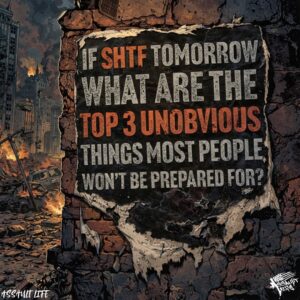
One of my FB prepper groups posted this a week or so ago, and I’ve been watching what people talk about. Lots of stuff about toilet paper. Medications. Food, of course. Pretty much everything mentioned was STUFF, though. And I don’t think that the top 3 “unobvious” things are … well, things.
My first thing that I think people haven’t bothered to think about is garbage. By garbage, I mean both waste from our homes (food packages, moldy leftovers, clothing beyond repair, etc.) and waste from we humans. I don’t think most people give a second thought to garbage. Either they’re like me, and they’re used to taking their garbage to the dump, or they’re like my neighbor, and the magic truck just arrives once a week and takes it all away. In a real SHTF scenario, neither of those things are going to happen.
If the SHTF, you won’t get me within a mile of the public dump. Either everything there will be hella unsanitary (because public dumps require attendants to keep them clean and tidy, and a lot of the recyclables and such are removed each day, as is much of the actual garbage. If the social contract dissolves, there will be no attendants, and nowhere for the garbage to go. It’ll become rat infested, and frankly, human infested.
Human waste is an issue I don’t think the average citizen thinks over long about. I think about it all the time. What do you do with your piss and shit? I like that I flush and it goes away. That’s nice. But I also spend quite a bit of time every summer in places where that’s not the case, and I have to be careful. Port-a-potties are okay, but they fill up (quickly, more quickly than you think they will), and are not a long term solution. Trust me when I say, if the SHTF you want to turn off your toilet and block your access to the street once you’ve assured yourself it’s truly SHTF. You do not want that stuff backing up into your bathroom. Toilets can continue to be used until sewage overflows its bounds at whatever downhill facility it’s going to, at which point it’ll start coming up the tube to meet you.
What DO we do with human waste then? I’m a firm proponent of the “lovey loo” as one company decided to call it. The composting toilet, which need not be expensive or complex if building codes are no longer an issue, is the perfect answer to human waste. If you have even an acre of land, you can put it to use. There’s an fantastic book called The Humanure Handbook that explains the whole process, what to do with waste, and what not to do.
Basically, #1 should go into a bucket with a tight sealing lid, and when full, disposed of either in a hole that goes deeper than 10 inches, or poured out over an area that is not near any running water. Digging a hole is the best way to deal with it, and if you’re ONLY using it for urine, you can dig it and leave it dug, with just a cover over it to avoid anyone falling in. The urine will work its way through the soil and return to the water table safely. Remember that, for the most part, pee is sterile. You want to keep it separate from solid waste.
#2 can be collected in a homer bucket (lined with a garbage bag if you’re squeamish) with a layer of fresh wood shavings over each (ahem) movement. If you’re diligent about keeping urine separate and using your wood shavings, there usually isn’t any smell. You keep using the bucket until it’s full, and then you add in a handful of worm casings and bang the lid on tightly. Carefully label the exterior of the bucket ALL OVER, and set it neatly in the brush at the back of your property. After one year, it’s probably soil that’s fine to use. After two years, even the most delicate of scientists will tell you that all that’s left is dirt. Go use it in your garden. It’s compost, and it’ll be very rich. You work it right and you’ll have enough compost to keep your garden going basically forever.
Please note, all of the above is very short-handed. Go read the book. They explain everything in great detail. I have only given you the highlights here.
The second thing that I don’t think people are the least bit prepared for is the general idea that, if you have a disease or health issue, you’re going to die a lot faster than everyone else. If the SHTF, even if you have stored medication, it’s limited. When it runs out, your risk of dying skyrockets. Now if you’re lucky and the problem is Type II Diabetes, you might manage to work yourself into a safe zone and survive. Working your ass off will do that. But if the problem is cancer or Type I Diabetes, or PCOS or any number of other diseases, you have to be prepared to die. I hate to say it, and it’s uncomfortable to think about, but it’s the truth. It’s important to come to terms with the idea that you or others could die of stuff that was “easy to fix/control” just months earlier.
I deal with this stuff all the time, because I talk to people at historical events. They always ask, “Well, what would have happened to my dad in the 15th century, what with his diabetes?” Well, hon, he’d die. People with gluten intolerance or dairy intolerance? Dead. Allergic to bees? Dead (though not quite as easily as some other deaths). Allergic to a food that’s needed for survival (bread, peanut butter, cheese)? Dead. Have asthma? Dead. It’s a shitty reality that people need to be aware of long before the SHTF. It’s important to ask yourself NOW… am I more help to my family if I stockpile meds and try to make it through the worst days of the SHTF, or would my death be more useful (in which case, don’t store meds and accept what’s coming much more quickly)?
And number three, simply the amount of work people will need to do in order to survive. I do not for a minute believe that most people in our country today will survive the process of making soap to clean their clothes, or the sheer amount of work it takes to make a hot bath, or clearing a driveway without a snow blower. I’ve got a SMALL taste of it, when I spend my 7 to 10 days up at the fort. I only have to cart my water a few yards instead of up from the river, and I have modern soap to clean my clothing with, but I do my best to live like they did. It’s a lot of work. I don’t have time to look at my phone, or read a book. If I have time during daylight hours, I use it to mend clothing or do something else that requires light. On an average stay at the Fort, I walk between 11 and 17 miles a day, and that’s just when I’m staying IN the fort and not going for walks or wandering down to the river. That’s 15 or so miles walking from table to hearth to wood pile, in a big circle, a bazillion times. And that’s me acting as a woman, with a lot of work but a lot LESS walking than my menfolk will be doing.
What are three things you think people are unprepared for? Not the obvious stuff. No toilet paper. What situations or things or thoughts have you contemplated, that you don’t believe others have put thought into?
One thing that comes to mind: most people have jobs/skills that are not relevant after SHTF.
I’m one example. By profession I’m a computer programmer. Without electricity that’s a useless skill. I do know some other things, like basic machining, math, physics. Some of those are potentially useful — not so much for personal survival but to earn a place in a community.
I like to use Lucifer’s Hammer (Niven & Pournelle) as an example of what things might look like. And in particular I think I might be like a less capable imitation of the diabetic rocket scientist that appears in that novel (go read it if you haven’t, it’s amazingly good). Lucifer’s Hammer is a reasonably optimistic story, not unrealistically so like the TV show “The Day After” but nowhere near as pessimistic as Bracken’s “Alas, Brave New Babylon” (a short story, also worth reading) or his “Enemies Trilogy”.
I’ve heard of Lucifer’s Hammer but haven’t read it. I do like both Niven and Pournelle though, so I will add it to The List. 😉
.
Here’s the thing about programming: you know how to logic. Look at the average 20 year old right now, and you’ll see NONE of them know how to logic. You have something of incredible import to them. *shrug*
.
I have lots of skills, and almost all of them can be easily learned by anyone who wants to do so. Sewing, cooking, baking, making soap, weaving, spinning, growing a garden, raising livestock, butchering, foraging… None of these are brain surgery. Anyone with an ounce of brain matter can learn any of them. I’m only unusual for having learned so many of them for the time I live in.
Read Lucifer’s Hammer. Good book.
At one point I recommended getting a copy of The Way Things Work by David Macauley to add to your survival library. I had already had a copy of that book, and I enjoyed it. One of the protagonists in Lucifer’s Hammer has the forethought to cache copies of that book to assist in rebuilding after the comet hits. I immediately moved the book from my regular library to my SHTF library.
1) For garbage and trash get a burn barrel (non-flamable container of some kind with holes in the sides and with a screen top, to prevent flying burning debris. Burn to cinders, dump it our somewhere, repeat as necessary.
2) Hu-waste – I keep my eye out for porta-potty locations in my area. Should SHTF I will”acquire” one (hopefully just emptied). Remove the plastic bottom of the porta-potty holding tank (coverall, gloves, eye protection, and face mask suggested), and you have an instsa-outhouse. Then with a post hole digger or shovel dig a hole as deep ay you can. Place the outhouse over the hole. Quicklime is usually used to accellerate decomposition of waste. Lime may be problamatical to acquire unless you live in a rural area, however a shovel full of dirt on top each time works as well. When “full” drag the porta-potty a few feet and repeat.
for more definative information read and/or acquire:
https://static.e-publishing.af.mil/production/1/af_a4/publication/afttp3-32.33v1/afttp3-32.33v1.pdf
https://rdl.train.army.mil/catalog-ws/view/ATP4-25-12Supplement/index.html
Read good apocalyptic and post-apocalyptic fiction, there some that stand head and shoulders above the rest, and sort the good info from the fantical, I.E. A prepper wins the gazillion dollar lottery before SHTF
Number one thing people will not be prepared for is… everything. People lack knowledge of how everyday stuff works. They have no idea about chemistry, electricity, or mechanics. What are you unprepared for? SHTF in and upon itself.
.
Troubleshooting. Do you know how to do it? Any experience with it? No? Get the book “The Art of Troubleshooting.” Step 1 is always ‘know how it is supposed to work.’ Do you know how your plumbing works? Do you know how to plant a garden? Do you know when to harvest your garden? Are you currently doing anything solely because “it is how it is done.” or it is how you were taught? If you do not know why you are doing it, find out. When the SHTF goes down, you will be able to improvise if you know the “why.”
.
Knowledge is more important than supplies and tools. And, on a scale of 1-10, tools and supplies are a 17. That makes knowledge somewhere around a 418 on that same scale.
This is a lot of what I feel. We cannot afford to be specialists right now. Pick one field and become an expert in it, but continue to learn a little about everything else. It can save your life.
.
One of the things I really appreciate about reenacting is it gives me tracts of time to actually try this stuff out. One weekend in the middle of February we all trek out to the Fort and spend the weekend (usually… this year I’m just going for the day because I have other things going on). You learn how to survive in cold weather. You learn why they had high backed benches which got dragged over to the fire. You learn why people sometimes slept in the kitchen. You learn just how much firewood it takes to keep a leaky house heated in extreme cold. This is all stuff you can read about, but it doesn’t have the same “sticking” impact as LIVING it.
Can you compensate for the effects of age on the human being? Physical ans me tal capacity can be very important!
I mean… not really. If you’re old, you’re old. That said, if we stay relatively healthy and active, both physically and mentally, there’s no reason to lay down and die just because we’re a bit older. 🙂
We started looking at SHTF during the first BO presidency. The most important thing I learned is that no matter what you read, you learn best from your own personal mistakes. But read anyway. Read, read, read. And research and experiment while you have the time. Admittedly a huge fan of good post-apocalyptic fiction, I definitely agree with Lucifer’s Hammer. I also recommend Alas Babylon (a classic that goes into human nature under stress of nuclear war) and the early Dies the Fire collection (power goes away somewhat like EMP but it just “happens, and other random but useful things don’t work as well – like guns and gunpowder). Welcome to the new early middle ages… for those that can adapt. (I also found being an early period medieval re-enactor doesn’t hurt my skill set either). I have a bunch of old cookbooks and historical cookbooks, and we also got a lot of Latter Day Saints books on using old time-y method for everyday things. But again, experiment, practice and correct (if need be) while you have the chance. I also found being an early period medieval re-enactor doesn’t hurt my skill set either. 🙂
Yeah, reenacting gives me plenty of time to actually practice the practical aspects of “non-electric” living. When I stay at the Fort for the Rendezvous each spring (last week of May), I’m there anywhere from 7 to 10 days. I have clothing for 3 days. This means I have to do laundry while up there. So I break out the big cauldron, put it in the yard, and fill it with warm water heated over the hearth fire. Then I use homemade lye soap to scrub my clothing on a scrub board. Rinse it all up well and wring it, rinse again, and done. Hang to dry out on the line, or if it’s raining, inside by the fire. It takes forever, and it’s not “as clean” as it would be in a machine. It takes longer to dry because I don’t have a wringer (they weren’t invented yet during Fort times, I believe). I don’t always get all the soap out, and am still learning the best way to achieve my goals (clean clothes).
.
Being able to practice things I’ve read about really helps.