“That’s a nice business you have here, it would be a shame if anything happened to it.”
For years and years, I was told to shut up and sit down when the Supreme Court made a 6-3 or 5-4 decision. My side lost. Just shut up.
And once I lost, I was told that I couldn’t fight it anymore.
When the left loses at the polls, they run to the court. They can always find a judge to rule the way they want.
I am reminded of the gay marriage fight in California. The people of California were asked to make gay marriage legal in multiple referendums. The people voted “no” each time.
Finally, they got a referendum to modify the California constitution to codify that marriage was between a man and a woman. The voters approved and the California constitution was amended to add that definition.
The left screamed and took it to court. In court, they got a judge to say that the amendment to their constitution, don constitutionally, was itself unconstitutional.
The court literally said that the constitution was unconstitutional.
When the Dobbs opinion was released, the left protested, violently. When Bruen was decided, the left had a violent meltdown.
Every time they lose, it is always because the other side is cheating.
The left is the party that breaks with tradition, to give themselves more power. Then they scream for the very protections they dismantled, once they are out of power.
The odds of Joe Bidden being the next President of these United States is getting lower and lower as the MSM finally stops hiding his abuse.
If Trump were to win, I am afraid that they will burn this country down. It will make the “mostly peaceful protests” of BLM and saint Floyd look like a small corner protest.
They are currently claiming that the Supreme Court has said that the President can murder people and get away with it. That’s not how it works. But it was another 6-3 opinion, which means that the left will not accept the results.
Yesterday, I went up to the Fort at #4 to pick up Allyson and to play with the Lathe.
This time I took my chisels and was better prepared. I also took along some grease.
With a bit of patience, I got the lathe belted back up. About that time, Allyson arrived. She took on the task of pumping.
Since I brought up some grease, I was prepared to liberate some wear points. But, I was so excited, I just didn’t.
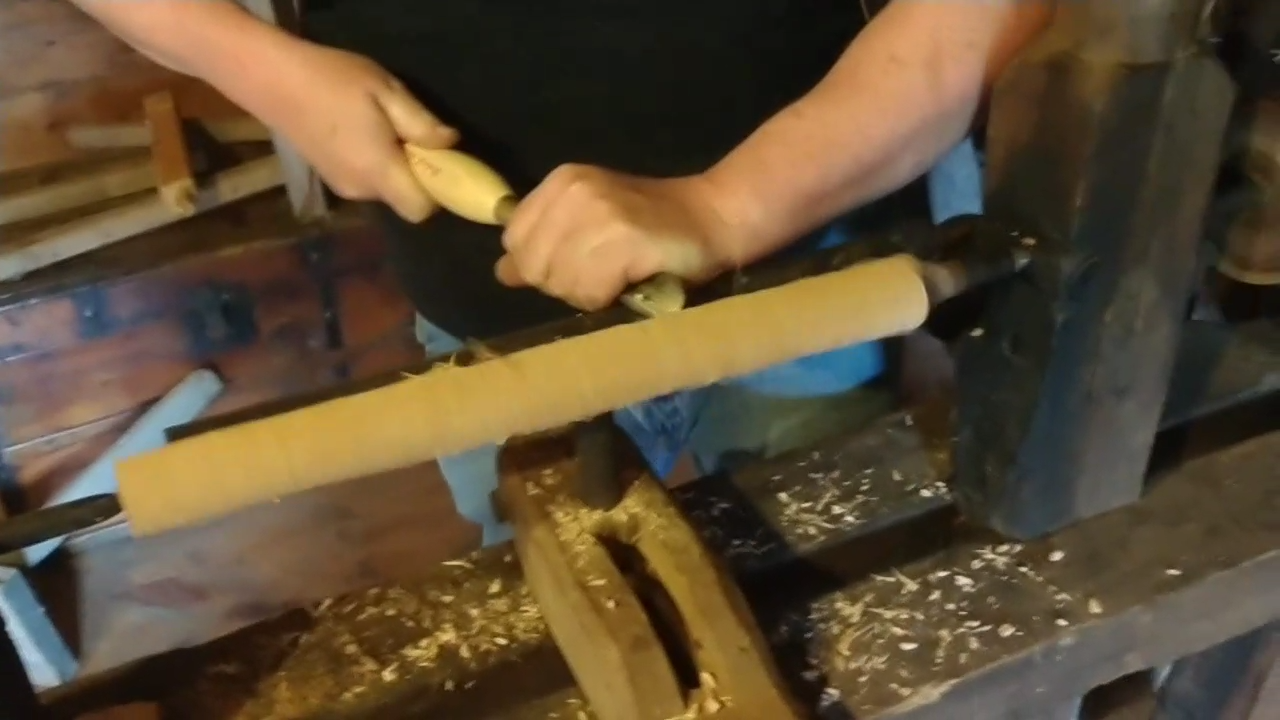
It took us a few tries, but we finally go things moving, and I was able to make chips. The squarish thing is slowly becoming round.
I checked the drive, and it was getting warm/hot. I stopped to get some grease into place. That seemed to have made a difference.
With that, I could try, try again. I could get it spinning. I can’t keep it spinning as I lose coordination. But for the time it is spinning, I was able to make wood chips.
The goal is to make my shop a usable space again. I used to have around 8 square feet of workbench, of which 2+ were taken up with the bench vise.
The wielding table is outside. The hydrologic press is outside. The blast cabinet is outside. Normally, they are under tarps, but that isn’t a long-term solution.
Mind you, the cost of those three tools was about $50 in raw steel.
The shop is really two shops in one. There is the wood shop and there is the metal shop. The wood shop consists of jointer, plainer, table saw, freestanding drill press, shaper, mortising machine, small belt sander and 12-inch disk sander, two vertical bandsaws.
There is 8 sq foot of cabinet top for all of that, 4 square feet of which is taken up by my bench grinder.
The other cabinet is supporting my wood machinist chest.
Just what is [xCite item=”BKRA4GWA” pos=0 pos=0]? Chevron is the case where the Supreme Court found that the courts, both the Supreme and the inferior courts, should defer to “permissible” agency interpretations of statutes those agencies administer.[xCite item=”68UX6LY9″ pos=1].
The Chevron doctrine was another two-step framework. 1) Did Congress directly address the precise question, and was the congressional intent clear? 2) Is the statute silent or ambiguous with the specific issue at hand.
If the answer to both questions was “yes”, then the court was required to defer to the agency administrating the statute.
Like the two-step shuffle of pre-Bruen Second Amendment jurisprudence, the courts always found for the state. Is the puddle in my backyard navigable waters of the United States, as defined in the EPA? Congress did not precisely address puddles, and since this is a dispute, it must be ambiguous. EPA, do you think that puddles in his backyard qualify as navigable waters of the United States?
Well, yes. You see, that water flows into that ditch, that ditch flows into that stream (which is dry 9 out of 12 months), from there it flows into that creek, from there into that river. Rivers are navigable waters and this puddle is connected to it and contributes to it. If the owner of the property were to divert that water, they are effecting the river.
Now, that might sound like a made up example, it is not. It is a case from memory where the EPA took a homeowner to court for violating the Environmental Protection Act because they changed the contours of their backyard to eliminate a soft spot that got yucky a few times a year.
There was a reason that the DoJ wanted Rahimi before the Supreme Court. The facts in his case were bad facts. Bad facts lead to bad law.
The first thing to note about the Rahimi opinion, is that it is an “as applied”. This means the opinion only counts for Rahimi. The decision does not directly affect anybody else.
Rahimi claimed that §922(g)(8) was unconstitutional on its face. This requires that there are no circumstances where it could be constitutional. This is an extremely high bar to meet.
This is where the bad facts start. Rahimi was subject to a domestic violence temporary restraining order. This requires that certain requirements be met. As stated in other articles, the law, as written, does not require that the accused receive notification, only that the notification was sent. It does not require that the accused appear at the hearing, only that they have an opportunity to attend.
Rahimi received his notification, appeared in court. This means that the first two, of three requirements are met.
The third requirement, is that the accused be found to be a credible threat.
Rahimi admitted, and the court found, that he was a credible threat.
This meets all three prongs of §922(g)(8) Read More
There was a remark about the lathe flywheel I recently worked on. Something about the precision of previous eras.
They had more precision than you might think.
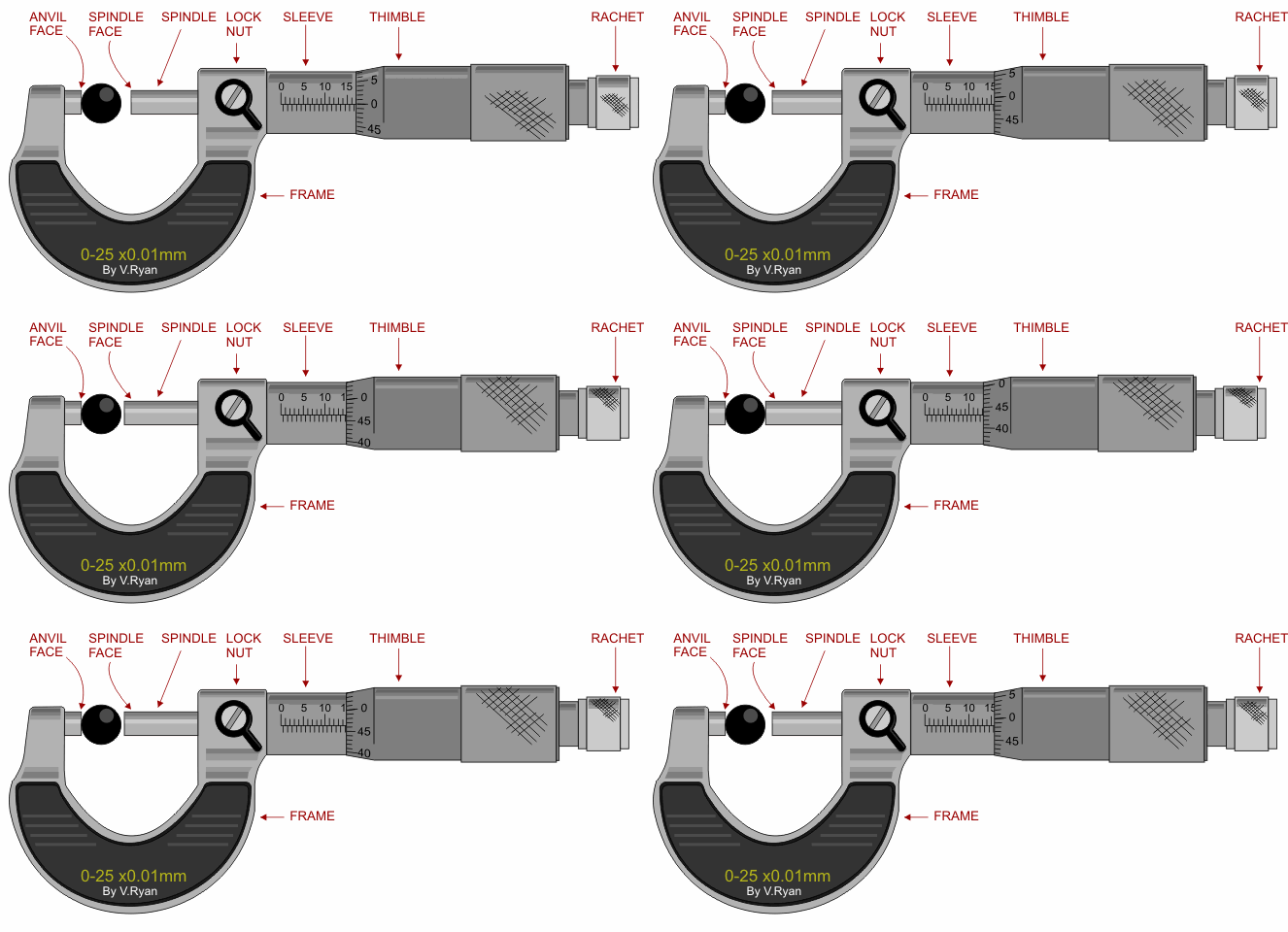
Today, one of the tools we use to measure accurately is a micrometer.
This magic device allows use to measure down to 0.0001, all because of a screw.
Inside the thimble is a threaded rod. It is 40 TPI on an imperial micrometer. When you turn the thimble one full revolution, the spindle advances 0.025 inches.
The thimble is marked with 25 evenly spaced marks. With just those, we can measure to 0.001″
But what about those 1/10,000s? That is done with another piece of old tech, the vernier.
If you take and mark the sleeve with 10 marks, with 9 spaces between them, such that the 10th mark aligns with the 11th mark (10 spaces) on the thimble, we have a vernier scale.
The lines of the vernier align with the lines on the thimble at exactly 0.0001 increments.
You can use this method in larger things as well. If I have a stick with 101 marks and I place that against a stick with 100 marks, I’ve created an ability to subdivide that stick by 100. It is pretty remarkable.
The Wheel
The wheel is laminated to create a width of 3 inches. The wood is a hardwood that does not expand or contract. One laminate is about 2 inches thick, and the other is 1 inch thick.
If we were to remake the wheel, we would likely do it with two layers, 1.5 inches thick.
The jointers create wheel layers by jointing two or more planks of equal thickness together to make a single plank, 44+ inches wide in both directions.
To hold the laminates together, holes are drilled in each plank, about a foot apart. The holes are then transferred to the other layer. The other layer then has the hole drilled slightly offset. When the wooden pegs are driven into the holes, that offset pulls the planks together to make everything tight.
A piece of cordage or a beam compass can be used to draw the perimeter of the wheel. This would be at 44+ inches.
The laminate would be trimmed close to the line but not touching.
A hole would be drilled at the center point, and then made square with chisels.
The entire thing would then be mounted on a spindle to drive it. That could be as simple as two benches with a groove to hold the spindle. The wheel would then be spun up to speed.
A tool rest, would be brought in, the craftsman would then use his lathe chisels to make the wheel completely round. This is an easy, but time-consuming process.
It is easy because the task is to slowly move the chisel from one edge to the other. The speed of that movement requires that the cutting chisel be in contact with the work for one complete revolution.
Since the wheel is turning slowly, 40 to 60 RPM, it means that you can only move a 1/16th of an inch per revolution, or so.
After the wheel is turned true (completely round), the crown is put in via the same method.
A reasonable person turning a wheel like that can expect to get a 44-inch wheel running true within 1/32 of an inch, without having to work at it. It is easy.
There are entire volumes written about making things flat or straight. If you can make something flat or straight, you can make right angles. It is not difficult. If you can make right angles, you can make many other angles.
While the micrometer is a new invention, a simpler tool was used before, it was just a straight stick that was fairly long. It was placed on a pivot, near the nose of the stick. The other end moved across some sort of scale. As the nose moves, the tail moves more. If the distance from the pivot to the nose point is 0.5 inches, and the distance from the pivot to the tail point is 12 inches, every movement of the nose is amplified 24 times.
While you might not be able to see a movement of 0.001 in the nose, you can see the movement of 0.024 in the tail.
We can have precision with simple, old tools. It just takes a bit of work to get there.
The Harrel v. Raoul case is one of the many challenges to the Illinois PICA act. It is grouped with other PICA challenges.
For the last 6 Fridays, the case has been distributed for Conference. On the following Monday, the Supreme Court issues their orders. For 6 weeks, the case has been redistributed for Conference the following Friday.
Today’s order list is out. They did not grant nor did they deny cert.
They also did not Distribute for Conference on 2024-06-28. That could just be normal holiday behavior, but something different happened.
I’ve been enjoying visiting the Fort. Hagar is a volunteer interpreter there.
The first time I visited the Fort, Hagar showed me around. As we moved from room to room, I noticed that some artifacts were damaged or missing parts.
One of the artifacts I noticed was missing some spindles and toppers. This is not an issue if you have a wood turning lathe.
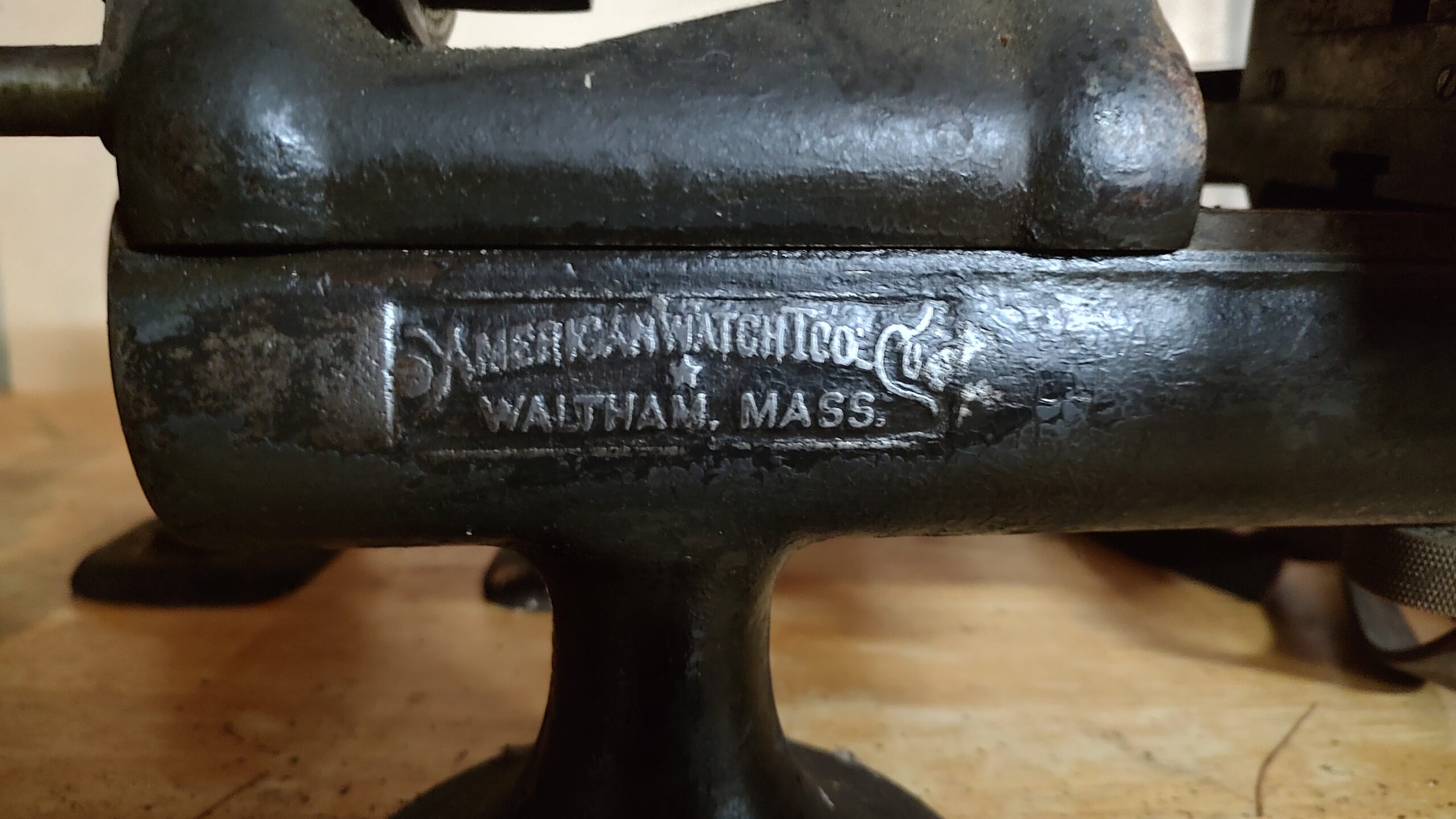
They did have a treadle lathe. I received permission to use it from Bill. Once I had his permission, he told me that the belt wasn’t hooked up.
I told him I knew and then proceeded to get it belted up. He sat and watched. I now know that the belt hasn’t been on the lathe in years.
Then I found out why, as soon as I started trying to treadle, the belt came off the big wheel in the joists. In addition to not staying on, the wheel had massive wobble from side to side.
Bill explained that it was unlikely to work because the driven wheel, on the lathe, wasn’t flat. I explained to him that it was crowned on purpose and that the reason the belt comes off the drive wheel/fly wheel is because it wasn’t crowned.
After talking to the acting director and Bill some more, I received permission to take the wheel home to work on it.
I was intending to pick it up a week ago last Friday, when I took Hagar to the fort. They didn’t have it down, so I couldn’t take it home.
When I asked to pick up the wheel this last Friday, they told me that the really didn’t want it gone during the upcoming High Land games. When I explained I wanted to pick it up on Friday, so I could bring it back on Sunday, things moved.
They had the wheel down and ready for pickup on Wed. I picked it up on Friday and brought it home.
It took some work, but by that night I was able to get the wheel mounted on the back side of my lathe.
This involved squaring the end of a one-inch piece of round stock. I messed up the first attempt, but got it right the second time.
The Blue Haired Fairie helped me get it onto the lathe. It isn’t that it is just heavy, it is awkward as well. 44 inches in one diameter.
Once it was up and running, I moved on to crowning the wheel.
The belt sander wasn’t where I wanted it to be, so I used an angle grinder with a flapping disk. This worked, but not well. It bounced so it was making rippling waves on the surface of the wheel.
In addition, the wheel was out of round about a 1/4 inch, maybe more. Not happy making.
I called it a night.
On Saturday, I decided to turn it round and then to crown it. Except I don’t have a single spindle turning tool. I’ve got metal working tools, I don’t have wood turning tools.
I got my best chisel. A mortising chisel, or it might be a registration chisel. It is for squaring up the corners of pockets.
I created a make shift freestanding tool rest. Spun the wheel up to 40 RPM and started cutting. It was slow-going. I was learning how to cut. Sometimes it was working ok, sometimes it was not. I was experimenting with angles and other possibilities.
The problem was that the tool rest was not rigid enough. Every time the chisel took a bite, the tool rest would flex out of the way. I could not move the chisel smoothly from side to side.
With the RPM being so slow, every move had to be slow, to allow the wheel to spin all the way around.
At the end of about 4 hours, I called it a day. The wheel was “good enough, maybe”.
Overnight, I had a different idea, instead of using the out feed table directly, I was going to clamp a piece of metal to the out feed table to act as the physical rest.
This still kept me close enough to center line, and the new tool rest allowed me to more easily move the chisel from side to side.
I also ran the lathe up to 135 RPM. This took me to 1500 SFM. A better cutting speed than 460 Feet Per Minute.
In short order, I had sawdust and shavings coming off everywhere. I am pleased to report that the wheel is mostly true now. It also has a 5-degree crown.
When I arrived, they let me in to unload. Then got the truck out of there as there were still patrons going around.
When I got back to the joiners shop, Bill was talking to a group. We waited for them to leave. I showed Bill how the drive crank should only go into the hub in one orientation. I drove the wedge in on the “free” side, checked the wiggle. There was none.
We discussed how to get the wheel back in the rafters, he made the sage decision to get help.
He was soon back with Tom to give us an assist.
So there are three old men, about to lift 100+ pounds, into the rafters to hang. That thing is awkward.
The first attempt failed. The belt didn’t stay in place. We reset.
On the second lift, we got it up and the crank side was resting in the axle support. I quickly moved the offside axle support into place, screwed on the wood adjustment nut, and we had the wheel up.
We had to do a little manipulation to get it to seat properly, but that was easy.
With the wheel up, we worked together to guide the belt up and over. The belt was now on the drive flywheel.
I putt the driven wheel in place, and we carefully moved the belt onto the driven wheel.
With that done, I started checking the tracking. It wasn’t looking good, the belt would rapidly move to the edge and start to come off.
I adjusted the tracking and in a few minutes, we had the belt tracking.
With that, it was time to attach the treadle.
Bill connected the drive rod to the crank. I attached the drive rod to the treadle.
We were ready to go.
Yes, it spun! It took a little bit, and it didn’t want to keep spinning, but it is spinning.
With a bit of work, we got the workpiece in place, as well as the tail stock and tool rest.
While Bill was working on attaching the treadle rod to the crank, I had sharpened the chisel I had found.
With Bill in charge of motive power, I started making chips.
IT WORKS!
I knew it should work, but this was the first time I have crowned a pulley. In addition to having added the crown, cutting the wheel round and attaching the crank correctly solved the issue of the wheel wobble and the horrible sounds the drive system was making.
I’ve noticed that she likes to write her own little pieces. Almost as if she wanted the attention.
One of my favorite Jackson statements was something similar to “that would make it too hard for the government.”
This case tests our Second Amendment jurisprudence as shaped in particular by New York State Rifle & Pistol Assn., Inc. v. Bruen, 597 U. S. 1 (2022). I disagree with the methodology of that decision; I would have joined the dissent had I been a Member of the Court at that time. See generally id., at 83–133 (Breyer, J., dissenting). But Bruen is now binding law. Today’s decision fairly applies that precedent, so I join the opinion in full.
[xCite item=”UETRMP2L” pos=0]
It is always nice when a Justice tells us they are biased. She thinks she is better than those that who sat for Bruen. Regardless, even she agrees that Bruen affirming Heller is binding law. No two-step shuffle anymore. No interest balancing. The weakest Justice on the court sees it, so to should inferior courts.
I write separately because we now have two years’ worth of post-Bruen cases under our belts, and the experiences of courts applying its history-and-tradition test should bear on our assessment of the workability of that legal standard. This case highlights the apparent difficulty faced by judges on the ground. Make no mistake: Today’s effort to clear up “misunderst[andings],” ante, at 7, is a tacit admission that lower courts are struggling. In my view, the blame may lie with us, not with them.
[xCite item=”UETRMP2L” pos=1]
The apparent difficulty that she is seeing is inferior courts attempting to circumvent the clear instructions in Bruen. Is it an arm? Does somebody want to keep or bear it? The Second Amendment’s plain text is implicated. The burden shifts to the state.
This isn’t difficult. Any judge or lawyer that wasn’t result/agenda driven could see that.
“It’s too hard!” they scream. Yes, it is too difficult to infringe on The People and not sound like a pretzel maker.
They are struggling because they lost the game. The two-step shuffle of deciding how much she was raped, and then deciding if the rapist (state) had a good enough reason for raping. She wasn’t wearing a full-body sack, she forced that rapist to rape her. Read More