Anonymous Web Angel(GFZ)

The holdings of Miller – Updated

Legal History
(800 Words)


In May 1939, the Supreme Court issued their opinion in United States v. Miller et al.

The Western District Court of Arkansas had heard the case earlier. The defendant (bad guy, 2A side) was a no-good, evil, bad man. He was a criminal doing criminal things.

The cops had been unable to catch Mr. Miller doing criminal things but knew he liked to travel. They waited until he crossed state lines so that a new federal law could be used.

The National Firearms Act was new and untested.

When they stopped Mr. Miller, they found that he was in possession of a short barreled shotgun and did not have a tax stamp for the shotgun.

At trial, Mr. Miller’s lawyer argued that The National Firearms Act was not a revenue measure, but an attempt to usurp police power reserved to the State. And oh, by the way, it offends the inhibition of the Second Amendment of the Constitution. [xCite item=”NFKTQ67A” pos=0]

The District court found that the NFA violated the Second Amendment. It sustained the demurrer [xCite item=”NFKTQ67A” pos=1] which is to say the district court nullified the NFA.

The Miller Court cited past Supreme Court opinions to say, “This usurping of the state’s police powers doesn’t fly.”

They then went on to evaluate the Second Amendment challenge.

In the absence of any evidence tending to show that possession or use of a “shotgun having a barrel of less than eighteen inches in length” at this time has some reasonable relationship to the preservation or efficiency of a well regulated militia, we cannot say that the Second Amendment guarantees the right to keep and bear such an instrument. Certainly it is not within judicial notice that this weapon is any part of the ordinary military equipment or that its use could contribute to the common defense. Aymette v. State, 2 Humphreys (Tenn.) 154, 158.
[xCite item=”NFKTQ67A” pos=2]

The big takeaway is “judicial notice” and “absence of any evidence”. Courts have evidence presented to them, the jury then decides on facts from that evidence. If it is a bench trial, the judge determines the facts from the evidence presented.

The other way is for the Court to know something that is “common knowledge”. Nobody has to present evidence that water is wet or that fire burns. Nobody has to present evidence that a firearm is an arm.

Those are “facts” that are commonly known, or which are documented in judicial references.

The remark about “firearms being arms” is documented in Heller

The phrase “reasonable relationship to the preservation or efficiency of a well regulated militia” is the phrase that allowed so many rogue inferior courts to find that individuals did not have standing to make Second Amendment Challenges. Fortunately, that corrupt interpretation of the Second Amendment was corrected in Heller.

Since the Miller Court had no facts that said that short barreled shotguns were useful to the militia/military, they found that they were not within the scope of the Second Amendment.

In other words, the Miller court said that military and military style weapons were protected by the Second Amendment.

The court went on to differentiate the “Militia” from “Troops.” Troops were controlled by the Federal Government in the Armed Forces. Militia was under the control of the state.

The court went on to say that These show plainly enough that the Militia comprised all males physically capable of acting in concert for the common defense. [xCite item=”NFKTQ67A” pos=3] The key here being “physical capable”. There was no requirement to be in an actual functional militia.

The court held that the right to keep and bear arms was an individual right because the individual was expected to bring their personal weapons to muster.

The Miller Court found that weapons that are exclusively or predominantly useful in military service[xCite item=”UFNPYHPR” p=1182 pos=4] were protected under the Second Amendment. Those that were not useful in military service could be infringed.

The Heller Court was in balance. How the case would be decided was in question. We didn’t know if it would be the death of private firearm ownership or if it would affirm our protected rights.

It is my opinion that the originalists on the court had to negotiate to win over some agenda-driven justices.

For the most part, cases are staying away from the NFA. It could be the third rail that gets a case moved from a win to a case law in favor of gun control. Some current cases are sneaking in little jabs at the NFA. And we see many challenges of the GCA.

Because of this balancing act, Heller explicitly left the NFA untouched. They left the GCA untouched. Those were battles for later.

Those battles are happening now.

Heller affirmed Miller. McDonald affirmed Heller. Bruen affirmed Heller.

These are the stepping stones to our victory.

[xCiteBib]
Plain Text…

Judge Rebecca Pallmeyer for the Northern District of Illinois just issued her memorandum opinion and order.

The gist of this is that she has ruled that grants the states motion for summary judgement.

I.e., the state wins.

Because the Seventh Circuit court affirmed that Friedman was still good law, the inferior court, the district court, could then rule for the state based on the Seventh Circuit’s opinion.

The Seventh Circuit says that it never did means-end, therefore its methodology and reasoning is just as good as Bruen.

Since both courts used “text, history, and tradition”, Friedman survives Bruen.

The Seventh Circuit used “two successive” inquires. Not Bruen‘s two-step, nor pre-Bruen means-end, two successive inquires.

The first inquiry is if the weapons regulated by the laws are “Arms” within the meaning of the Second Amendment. The second inquiry is if the regulation matches history and tradition.

This is an interesting twist of Bruen. Heller, as affirmed by Bruen says that if the regulated conduct is within the scope of the Second Amendment, the conduct is presumptively protected. This means that the conduct must be keeping or bearing arms and the regulation must infringe or hinder that conduct. This includes ancillary rights.

Just as [xCite item=”VGKA24MW” pos=0] found that taxing ink was a first amendment infringement, so does regulating parts of firearms or ammunition.

So here is the supposed logic of the Seventh Circuit Court. The plain text should not be interpreted as “arms” but of “bearable arms”. “Bearable arms” in turn are weapons in common use for lawful purposes. “Lawful purposes” is the right to individual self-defense” “Individual self-defense” only includes arms that ordinary people would keep at home for the purpose of self-defense, not weapons predominantly useful in military service. “Predominantly useful in military service” means anything that the military uses or is likely to use, or which looks like or might function like a military issue weapon.

Thus, only non-scary weapons are protected by the Second Amendment.

The plaintiffs (good guys) must prove that the “arm” is not like a military arm.

Is it a firearm? Then it is an arm. Do the plaintiffs wish to keep or bear that arm? Then it is presumptively protected by the Second Amendment, and the burden shifts to the government to prove a history and tradition of regulations that are a close match to the current regulation.

One of the interesting things that comes out of these rogue inferior courts is the claim that using text, history, and tradition as the Supreme Court would cause other gun control legislation to fall. Since that can’t be the intention of the Supreme Court because the Supreme Court, in Heller didn’t tear down the GCA of 1968.

Ignoring Heller, where the court found that having other means of self-defense did not allow an infringement of handguns, the Seventh explicitly said that if a subject wanted a 30 round magazine, they could just buy 3 10 round magazines.

The District Court wrote The court follows Seventh Circuit precedent even if it believes those decisions are wrong or mistaken. that might be true, but I do not, for one second, believe that the district court actually cares if the Circuit got it right, as long as she can side with the state.

This order granting a win for the state is a big nothingburger. The District court was not going to issue an opinion that wasn’t appealed. I believe that this case is already on its way to the Supreme Court. One of the cases that is attempting to skip the Circuit courts.

The only thing that might happen is the case is forced through the Seventh Circuit again. Only this time, because this case has a summary judgement which is final, the Seventh cannot vacate and remand unless they find for the plaintiffs.

This judge was a coward. They added nothing. All that happened is that they said, “The boss told me to do it!” and then attempted to wash their hands of repsonsiblity.

Our Political Overlords

I was traveling recently with family when I ran into a couple of issues with my WiFi.

There first was at a Days Inn. Free WiFi which I connected to so I could checkup on things.

I could not login or even see postings on the site.

I then checked a few other sites. All of them found via google search.

GunsSaveLife.com, GunFreeZone.net, Nation Rifle Association, Gun Owners of America, Firearms Policy Coalition, and maybe a few others.

All except for Second Amendment Foundation were blocked.

Of course I just setup proxies or a VPN to get connections outside of the playpen they had attempted to lock me into.

It turns out that his is Spectrum’s “content filtering”.

I tested again at a different public WiFi, same results, service also provided by Spectrum.

My opinion is that this is Spectrum’s default.

So when you are wondering why people don’t know history or other opinions, know that the censorship is real.

Kershaw – Select Fire


This is about a week after I received the knife. So still in the early days.

First, notice that I call it a “knife”. That is because it is a knife first, a multi-tool second. This means it can replace my Cold Steel blade.

It is noticeably lighter than the Cold Steel blade. It is also a bit shorter, about a half inch shorter. Which is one of the reasons it is lighter.

The Cold Steel has metal slabs. This makes it stronger? It does make it heavier. The slaps have finger divots, making it easy to grip.

The Select Fire has a metal interior but a plastic exterior. It has good fitment and comfortable ergonomics. No finger grooves or divots but the shape is such that I’m not concerned that it will slip will using it.

I did something unusual and read the directions. It gave the edge bevel. This is helpful for those that sharpen their own knives. The blade arrived sharp. Kershaw offers free sharpening services for their blades.

The edge is not polished nor is it hair whittling sharp. It is a good functional edge.

The pocket clip is my only issue, so far. It is so tight that I can’t get it to clip to my pockets, in all cases.

The other issue is that because of the design, I can not carry it point up. I adjusted my Cold Steel to clip point up. This means that as the knife comes out of my pocket, it is in the correct orientation to deploy.

The Kershaw can only be carried point down. This is taking a bit of training on my part to learn how to retrieve the knife and deploy it.

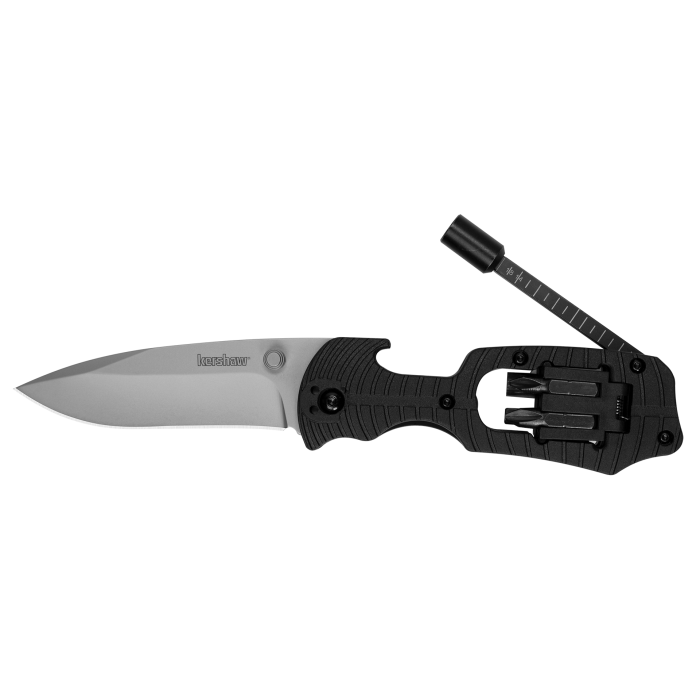
So what makes the Select Fire a multi-tool? A bit socket. The shaft is 2 inches long and has a standard hex 1/4in socket at the end. It has a magnet to hold the bits in place.

The socket rod has three positive detents. One is full close, one is ninety degrees and one is 180 degrees. They are strong detents, moving close to “am I going to break something” when I first started working with it.

This give you a good 1/4 driver, which for me is a big plus as it is the standard screw head size for many items, like dishwashers, washing machines, furnaces and others.

There is onboard storage for 4 standard bits. Two per side. The holders are spring loaded to hold them closed. The bit holders are firm but not stupid tight. Bits move in and out with little effort but I don’t think they would “just slide out”.

When the carrier is closed, there is no space for the bits to slide out. They are stopped by the knife body.

It comes with a PH1, PH2, 5mm slot, and 7mm slot bits. I will be replacing the slotted with a gunsmithing version. I will replace the other slot with a Ph0. Ph0 is used for many electronics.

So far, I’m impressed and happy with the knife/tool. I might write a follow up in a 6 plus months, but for now, this is an acceptable replacement knife.

Oh, the one thing I would not use it for is processing game. It has too many places where blood and tissue could get. Since I have knives for game processing, this is not an issue, for me.

100% Inspection – Updated

Update: After one of our commenters provided me with the correct term for this type of case, I was able to research “Stepped-cases” and found this is a thing.

As a reloader, I understand just how expensive and hard to get powder got. And how much more expensive it is today than 5 years ago. I believe that somebody spent the time and money to research reduced loads in smaller case sizes to get an answer that said it was cheaper to use more brass than it was to use more powder.

Regardless, my point remains, 100% inspection of cases is good policy and could save your firearm, hand, or even life.


Diamond K came through for me again. 2000+ cases arrived for processing.

1000+ .45 ACP and 1000+ 9 mm cases total. While they sell by count, they are actually shipping by weight.

From my quick test, 10 9 mm cases weigh around 37.3g, 250 cases are 932.5g. Counting by weight, I received about 40 extra cases in the 9 mm order, plus 2 extra in the .45 ACP. There was one .22 LR case and a single small stone holding that .22 case inside the 9 mm case.

But that isn’t the fun find.

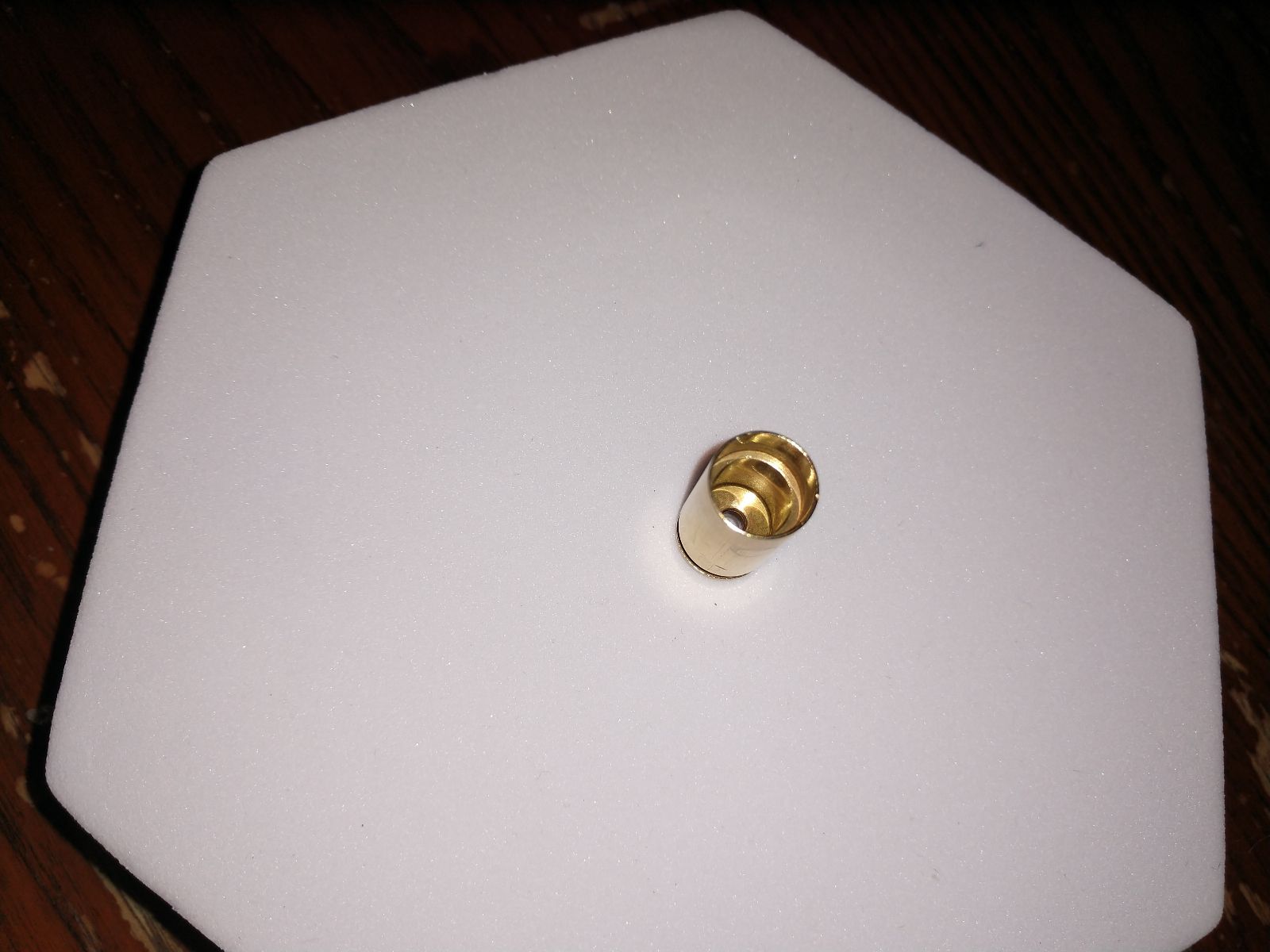
Somebody missed a step:

That casing was not drawn out correctly. Somebody put a primer on the case, added powder and a bullet.

And it went to one of us like that.

When you are reloading, inspect every case.

The arguments get weaker and weaker

Giffords has stepped in on a PA case with arguments to have the case heard en banc

Theses are some of the weakest arguments I’ve seen so far, from the infringers.

They are arguing that the panel majority applied a requirement that the regulations presented by the state “need only be ‘relevantly similar'” instead of “analogous.” They claim that it is too strict of an interpretation.

They claim that the panel required a precise historical analogue, which is too rigorous, nearly making it a “historical twin”.

The problem is that they don’t even meet that lower standard of “relevantly similar”.

One part of the argument is that the Supreme Court has stated that time-place limitations are constitutional. Thus, a ban on 18-20 year-olds carrying firearms is acceptable because it is only a limit for the duration of “the emergency”.

They fail to note that “the emergency” has been ongoing for over 3 years now.

So they go to their second argument.

1791 isn’t the right time frame. You need to use 1868!

Giffords claims that the Supreme Court did not set the date. This is not true. The meaning of the constitution, was set when it was adopted. The meaning of each amendment was set at the time it was ratified.

In this case, the Second Amendment was ratified in 1791. That is the correct era.

The argument that it should be 1868, when the Fourteenth amendment was ratified is bogus. The 14th incorporated the meaning of the constitution, as it was understood when adopted and amendments 1-13 were ratified.

This is so weak, it shows that they are losing, becoming more and more desperate.

Friday Feedback

The lawsuits are moving forward across the country. It is obvious that the different plaintiffs are working together.

A few months ago, we were all waiting for the circuit courts to issue their opinions. My expectation was that we would then see everything end up back in the inferior court for another couple of years of litigation before we made progress towards the Supreme Court.

I believe that we now have 5 cases before the Supreme Court seeking cert.

If the Supreme Court decides to hear the cases, it is likely they will consolidate the cases and then address multiple questions at the same time.

This week, I’ve been working on software to allow me to more easily follow Supreme Court cases. I’m using it as another learning curve.

I’m also getting ready to do some product photography for a website, it should be fun.

I also have an interesting 9mm case that I want to share with you. A clear example of why we should inspect every case before we use it.

Here’s hoping you have a wonderful weekend. Please let us know what you are thinking about in the comments.

The Little Things Make A Difference

I first purchased my web tumbler more than 20 years ago, as a ball mill.

It has made more than a few pounds of black powder.

Today, it is used mostly for cleaning brass. I’ve been looking and looking for better ways of cleaning my brass.

There are two different times when I’m cleaning brass, before it is processed, and after it has been sized and trimmed.

For after trimming, the wet tumble does a good job of removing those sharp edges. I like using it.

Dawn and LemiShine were not doing a good job of removing the Imperial Sizing wax. The fix was to use a cycle of Purple Power.

The current method is 45 minutes with Dawn Dish soap, followed by 45 minutes with LemiShine.

After trimming, it would be Dawn, Purple Power, and then LemiShine. 45,30,45.

This leaves my brass looking “like new”. Amazing. If you exclude the LemiShine, it doesn’t stay pretty as long, nor does it get as pretty.

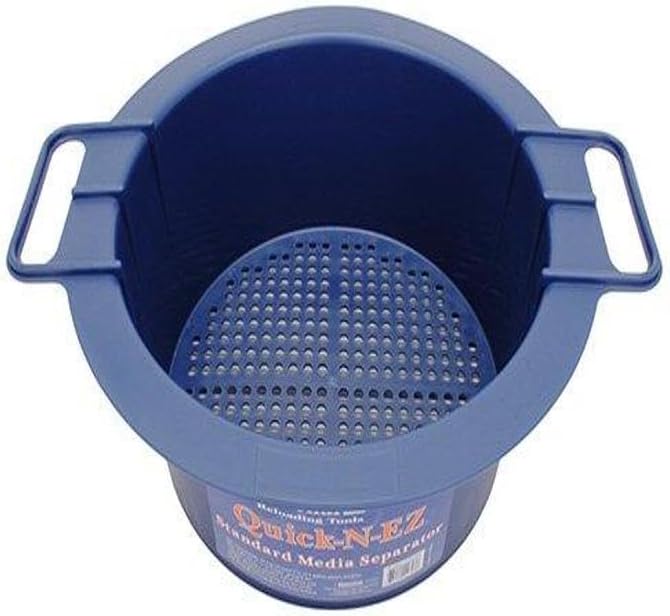
So what is this “little thing”? It is a freaking sieve. Yes, a sieve.

Is it perfect? No. It just works better than other things I’ve tried.

It fits in a 5 gal bucket. I just empty the tumbler into it, rinse the casings, shake a bit and then rinse again.

Most of the steel pins fall through into the bucket. I spend 3 to 5 minutes, stirring the cases and tumbling them to get most of the pins out of the casings. It isn’t perfect, by far. It is very much “good enough”.

This silly little sieve has taken a “I do not want to do job” and turned it into “no big deal”. It takes less than 10 minutes to move to the next stage.

It has improved work flow to the point where I cleaned 2000 cases in a little more than a day.

If you wet tumble, this might be worth the $10 to you.