
Second Amendment Jurisprudence
It is sometimes hard for me to understand just how far we’ve come in Second Amendment jurisprudence. I remember the time when there were legal battles and arguments about who did the right extend to.
On one side, there was a group of people saying that the right belonged to the militia. Since the right belonged to the militia, the only people or group of people that had standing to challenge on Second Amendment grounds were the militia. Since the only legal militia was the National Guard, under the control of the state, the only people who had standing to challenge a state law on Second Amendment grounds were the state.
In 2008 the Supreme Court smashed that argument to pieces. They applied their standard methods and stated it plainly: Dick Heller had the constitutional right to have a handgun in his home for self-defense in ready condition. Right?
Nope, the holding was broader than that.
-
- The Second Amendment protects an individual right to possess a firearm unconnected with service in a militia, and to use that arm for traditionally lawful purposes, such as self-defense within the home. Pp. 2–53.
- The Amendment’s prefatory clause announces a purpose, but does not limit or expand the scope of the second part, the operative clause. The operative clause’s text and history demonstrate that it connotes an individual right to keep and bear arms. Pp. 2–22.
- The prefatory clause comports with the Court’s interpretation of the operative clause. The “militia” comprised all males physically capable of acting in concert for the common defense. The Antifederalists feared that the Federal Government would disarm the people in order to disable this citizens’ militia, enabling a politicized standing army or a select militia to rule. The response was to deny Congress power to abridge the ancient right of individuals to keep and bear arms, so that the ideal of a citizens’ militia would be preserved. Pp. 22–28.
- The Court’s interpretation is confirmed by analogous arms-bearing rights in state constitutions that preceded and immediately followed the Second Amendment. Pp. 28–30.
- The Second Amendment’s drafting history, while of dubious interpretive worth, reveals three state Second Amendment proposals that unequivocally referred to an individual right to bear arms. Pp. 30–32.
- Interpretation of the Second Amendment by scholars, courts and legislators, from immediately after its ratification through the late 19th century also supports the Court’s conclusion. Pp. 32–47.
- None of the Court’s precedents forecloses the Court’s interpretation. Neither United States v. Cruikshank, 92 U. S. 542, 553, nor Presser v. Illinois, 116 U. S. 252, 264–265, refutes the individual-rights interpretation. United States v. Miller, 307 U. S. 174, does not limit the right to keep and bear arms to militia purposes, but rather limits the type of weapon to which the right applies to those used by the militia, i.e., those in common use for lawful purposes. Pp. 47–54.
- Like most rights, the Second Amendment right is not unlimited. It is not a right to keep and carry any weapon whatsoever in any manner whatsoever and for whatever purpose: For example, concealed weapons prohibitions have been upheld under the Amendment or state analogues. The Court’s opinion should not be taken to cast doubt on longstanding prohibitions on the possession of firearms by felons and the mentally ill, or laws forbidding the carrying of firearms in sensitive places such as schools and government buildings, or laws imposing conditions and qualifications on the commercial sale of arms. Miller’s holding that the sorts of weapons protected are those “in common use at the time” finds support in the historical tradition of prohibiting the carrying of dangerous and unusual weapons. Pp. 54–56.
- The handgun ban and the trigger-lock requirement (as applied to self-defense) violate the Second Amendment. The District’s total ban on handgun possession in the home amounts to a prohibition on an entire class of “arms” that Americans overwhelmingly choose for the lawful purpose of self-defense. Under any of the standards of scrutiny the Court has applied to enumerated constitutional rights, this prohibition—in the place where the importance of the lawful defense of self, family, and property is most acute—would fail constitutional muster. Similarly, the requirement that any lawful firearm in the home be disassembled or bound by a trigger lock makes it impossible for citizens to use arms for the core lawful purpose of self-defense and is hence unconstitutional. Because Heller conceded at oral argument that the D. C. licensing law is permissible if it is not enforced arbitrarily and capriciously, the Court assumes that a license will satisfy his prayer for relief and does not address the licensing requirement. Assuming he is not disqualified from exercising Second Amendment rights, the District must permit Heller to register his handgun and must issue him a license to carry it in the home. Pp. 56–64.
- The Second Amendment protects an individual right to possess a firearm unconnected with service in a militia, and to use that arm for traditionally lawful purposes, such as self-defense within the home. Pp. 2–53.
478 F. 3d 370, affirmed.
This wasn’t an as-applied holding; this found that the D.C. law was unconstitutional.
But it was much more important that striking down several laws forbidding The People from having functional firearms in their homes changed how the lower courts (were supposed to) evaluate Second Amendment challenges.
This upset the gun grabbers, so they fought back. Many of the inferior courts said, “D.C. is a special case because it is a federally controlled area, not a state. The Second Amendment does not apply to the states.” Their stated reasoning for this was that the Supreme Court had never explicitly told them that the Second Amendment was a part of the Constitution and applied like everything else in the Constitution.
The Seventh Circuit Court of Appeals actually said that since the Supreme Court had never said the Second Amendment was part of the Constitution, the state of Illinois did not have to respect it.
This led to McDonald, where the Supreme Court, once again, told the inferior courts, “Stop being jackasses; of course the Second Amendment applies to the states.”
These two cases advanced Second Amendment jurisprudence immensely. They opened the floodgates to a slew of Second Amendment challenges.
And there were actual advances in The People regaining some of their protected rights.
That is, until the inferior courts found a new hook. Interest balancing.
The inferior courts said, “We are too stupid to understand how to evaluate Second Amendment challenges as Heller told us. So we are going to look to First Amendment jurisprudence for guidence.”
While this might sound good on its face, it wasn’t when twisted by the states and inferior courts. First Amendment jurisprudence is littered with free speech exceptions. While the core protected rights are strongly protected, there is a lot of case law that gives rise to exceptions.
Consider political speech. Everybody knows you can get up on your soapbox and start yapping about anything political. But the courts have actually put limits on this. For example, they can restrict the time and place of such speech. You can’t set up your soapbox in the middle of an intersection. You can’t use a megaphone at midnight to make your speech.
The courts have gone further in limiting some types of speech. There are restrictions on certain topics at certain locations. You can’t show pornographic movies on the sidewalk outside a school. Even if that would be an acceptable location to give a political speech.
The gist was that there was a “core” protected right that had the strongest protections, and then there were other parts of the protected right that were not so strongly protected.
In First Amendment jurisprudence, the courts balanced how much the modern day regulation infringed on the “core” protected right and balanced it against the “good” of the modern day regulation.
In the inferior courts, they went to town with this exception process. When it came to Second Amendment challenges, the courts had three steps: 1) Is the plain text of the Second Amendment implicated? 2) How much does the modern regulation impede the core protected right? 3) What are the benefits of the modern infringement?
Being evil but not stupid, these inferior courts then bypassed the first question: Is the plain text implicated? If they were to answer this question in the negative, that would be a reason for appeals, and their decisions could be overturned on just that. If they said the plain text was implicated, then they have established a record that they could be held to later.
So they did the sidestep; they said, “Without making a determination, we accept that the modern day regulation does implicate the plain text of the Second Amendment.” They never said a single modern day infringement actually implicated the Second Amendment.
Having made that assumption, they then evaluated the infringement against the core protect right of armed self-defense within the home. This is similar to evaluating a rape by how much lube was being used. Yes, you have a right not to be raped, but they used a lot of lube so it didn’t hurt all that much.
Having decided how much it was hurting The People, they then looked at the government’s stated intentions, not the results, not what was actually happening, but on what the state said their intentions were. If those intentions were “good enough” when balanced against the pain The People were feeling, the courts ruled in favor of the state.
The reality was that the courts were working backwards. They wanted “the rape” to continue, so they looked at the government’s stated intention in passing the regulation, decided what level of scrutiny would survive that intention, and then justified that.
We were right back where we started from. The inferior courts in gun grabbing states were consistently (always, the Ninth Circuit Court en banc has never ruled against the state in a Second Amendment Challenge) finding for the state on interest balancing reasons.
In 2022, the Supreme Court issued their opinion in Bruen. Bruin took issue with the two-step shuffle. Justice Thomas wrote that the two step shuffle was one step too far and restated Heller’s core jurisprudence: When the plain text of the Second Amendment is implicated, the burden shifts to the government to prove that the modern regulation is a match for this Nation’s history and tradition of firearms regulation.
The holding in Bruen was that NYC’s may issue game was inconsistent with the Constitution. That part of the “core” protected rights of the Second Amendment was the ability to carry, to bear arms, outside the home.
The gun grabbers ran back to their corners and immediately put into place new laws to stop people from legally carrying. In some ways, the people of New York were worse off after Bruen than before. Before Bruen, if you were wealthy, connected, or lucky, you could get a permit to carry. Once you had that permit, you could carry in most places. After the Bruen tantrum, The People could get permits, but they couldn’t carry anyplace because every place they wanted to carry was off-limits, or the ability to get to a place where they could legally carry put them at risk of going through a prohibited location.
Consider a subject of New York state who has a permit to carry. They want to drive through NYC to get to some place. If they were to drive through Times Square, they would be in violation of one of the many locations where carry is prohibited.
As the governor of New York state said when asked where people could legally carry, “I don’t know, maybe some streets?”
The inferior courts were in a quandary; they had clear marching orders from their bosses, but that would require them to overturn most gun control laws. They had to do something.
They immediately pivoted to “We are to stupid to do our jobs.” Even though they have been through years of schooling on how to interpret and understand the laws of this Nation, even though they have studied case law for nearly a decade before being allowed to practice law, and even though most of them have some experience before being appointed to the bench, history was beyond them.
The legal profession is nearly 100% about interpreting the legal history of this Nation. How can a judge make a ruling on anything without looking to history? It could be the history of last week or of 250 years ago. If a judge is looking at a challenge to 18 U.S.C. § 922(g), they are looking at history from nearly 60 years ago when the Gun Control Act of 1968 was passed.
If they are looking at machine gun regulations, they are looking at laws from 1986. Before Heller and Bruen, the courts routinely looked at the Sullivan Act from 1911.
All of that is “Legal History” and that is all that Bruen demanded they do.
When that wasn’t making headway, they turned to sensitive places.
And still they were losing ground.
Under Joe Biden, the DoJ brought Rahimi to The Court. This was an attempt by the Biden DoJ to gut Bruen. The thinking was that Mr. Rahimi was a bad man doing bad things who deserved to be disarmed and incarcerated. We still won and Second Amendment Jurisprudence advanced again.
The important parts of Rahimi, for us, was that the Supreme Court clearly stated that any loss of Second Amendment protected rights could only be temporary. There is no such thing as a lifetime loss of gun rights. The second big thing was that to remove someone’s Second Amendment protected rights, the person must be adjudicated a danger to themselves or others.
This is actually a death knell for Red Flag laws. It hasn’t happened yet, but until you are adjudicated in a court of law with proper representation, you cannot lose your Second Amendment protected rights.
Because of Rahimi, there are hundreds of challenges to 18 U.S.C. §922(g)1, felon in possession. Some of these have made it to the Supreme Court and are waiting on final disposition; some have been rejected. But for every one that made it to that stage, I’m sure there are dozens that were resolved in an inferior court.
Which brings us to June, 2026. The Supreme Court has issued two new Second Amendment opinions.
The first was Hemani, another case with bad facts. Mr. Hemani is a bad man, in my opinion, but not in the opinion of the courts. He hasn’t been adjudicated of any violence. In fact, his charges were simply one count of violating 18 U.S.C. §922(g)3.
18 U.S.C. § 922(g) 3
It shall be unlawful for any person —
- who is an unlawful user of or addicted to any controlled substance (as defined in section 102 of the Controlled Substances Act (21 U.S.C. 802));
to ship or transport in interstate or foreign commerce, or possess in or affecting commerce, any firearm or ammunition; or to receive any firearm or ammunition which has been shipped or transported in interstate or foreign commerce.
Nothing about his terrorist-loving parents nor the fact that he is a dual citizen and also loves him some terrorists.
This was an as-applied opinion. It will be used to help other people who are accused under §922(g)3, but it doesn’t strike down §922(g)3 as is. We’ll have to wait to see how the government responds. The most likely change would be the removal of “unlawful user.”
As Hemani pointed out, tying the loss of Constitutionally protected rights to definitions under complete and arbitrary definitions by a federal agency is inconsistent with the Constitution.
But that is not the big part of Hemani. The important part was that it reaffirmed Heller, Bruen, and Rahimi as well as defining how to do regulation comparisons.
This is a big step forward. The inferior courts have a bad habit of saying “close enough” when it isn’t. It makes sense why this case was taken. It allowed The Court to issue an opinion focused on deriving analogous regulations from this Nation’s history and tradition of firearms regulations.
When the court issued Wolford v. Lopez, it was a win for people living under vampire rules. This is relief for millions of people. It didn’t sound like it was an important win for Second Amendment jurisprudence.
I was wrong. It is a huge win for us.
Whereas Hemani took on the “how” and the “why” of matching, Wolford v. Lopez takes on the inferior courts, pushing the historical analysis into the linguistic analysis for a Second Amendment challenge.
We know how to do a plain text analysis. The inferior courts have said they are too stupid to do so.
U.S.A. v. Hemani 608 U.S. ___ (2026)
This opinion is great for the Second Amendment community and the country as a whole.
First, what is the “Holding”. The holding is the courts ruling in the case. This is the thing that is of interest to the parties directly involved. It is the guilty/not guilty part of the case.
The Fifth Circuit Court of Appeals issued a Per Curiam opinion on January 31st, 2025. They found that 18 U.S.C. §922(g)(3) was unconstitutional as applied to Mr. Hemani. Per Cuiam means that there were no oral arguments before the court as the court felt there was no need. They had enough information based on what had been filed with them. They may or may not have considered what the parities had to say or they could have just read what the lower court’s opinion was.
Regardless, they ruled that Mr. Hemani could not be charged under §922(g)3.
One of the interesting details of this case is that Mr. Hemani had no other charges against him. There was the sole count (information) that he had violated 18 U.S.C. §922(g)3. The government was arguing that his admiting to using pot several times a week and there being a gun in his home was enough to get him 15 years behind bars and the loss of his firearms rights.
The United States was not happy about this outcome. They appealed to the Supreme Court, and Certiorari was granted.
As a Second Amendment advocate this scared me. I, and others, were concerned that The Court would issue a weak opinion because Hemani is a bad man. Yeah, he is. His mother is worse and his father not much better. They are actively interacting with foreign bad actors. This is barely touched on in this opinion.
The Court continues to remind us that no right is absolute, but this opinion does a good job of explaining that “no right is absolute” requires the government to do the heavy lifting of text and historical tradition.
So what is the focus on this opinion and why do the liberals dislike the opinion they signed on to?
The focus is on how to determine if there is a match to this Nation’s historical tradition of firearms regulation.
It starts by saying that it does not address if 1864 or 1791 is the proper date.
Why?
Because this is federal gun law. The only date possible is 1791 and The Court knows this. The Court explicitly states this does not answer that question but not why. It goes on to say it doesn’t matter because the government loses regardless of the year.
But the opinion starts by given a better definition of “text”. <q>To determine when the government infringes the Second Amendment, we begin by asking whether the Amendment’s terms cover the conduct in question.</q> This is a wider definition than “the text of the Second Amendment”. In Heller The Court defined “terms” this reference harkens back to the Heller decision.
We’ve defined these terms, use them. An important but subtle thing.
We move on to “require a historical twin” or “precise … historical precursors”. And this is where it starts to get good.
Gorsuch explitcly states that while a historical regulation must match in “why” and “how”, these are not the limit on what must match. There are other features that might cause failure. The anti-gun people will try to twist this to mean that “how” and “why” don’t have to match if they find something else, but that’s not my reading of the line.
Be on the lookout for new arguments from the state (bad guys) arguing that some new simularity between today’s regulation and some past regulation make them the same. Look, both these laws talk about spitting; this means we can ban guns if you spit on the sidewalk.
Regardless, the rest of the opinion focuses heavily on how to compare a modern regulation’s “how” and “why” to this Nation’s historical tradition of firearms regulation.
In the end, the holding is as applied to Mr. Hemeni. In reality, parts of §922(g)3 will change or have changed. Parts of the form 4473 will need to change. People being put in prison for smoking pot will stop. And the link of §922(g)3 to the Controlled Substances Act(CSA) is broken, forever.
The place where things get more interesting is in Justice Thomas’ concurance. First he agrees with everything the opinion has to say, but then he says that somebody really should question if §922(g) is consistent with the Constitution.
This is as big if not bigger than his concurance on a resent Per Curium where he said that it was time The Court started issuing Per Curium opinions to help regular people, not just criminals and not over trivial mistakes that make no difference in the outcome. He wrote this to address the fact that The Court will often grant cert and then issue a Per Curium when some technical issue happened at the appellate court or lower court. Frequently these Per Curiums change nothing in the final out come but do inform the inferior courts on how to act.
Here hs points out that Congress has been using the commerece clause to gather power where they are not authorized any. The original meaning of the clause was to make sure that the states were not messing with each others commerce. That goods made in one state could be sold in another without teriffs or other government busy body actions.
The Congress has created laws that punish people for making things for use by themselves because that means they are not buying from someone else (commerce) and that someone else could be out of state, therefore affecting interstate commerece. Seriously, there are laws on the books that are justified because making something yourself means you didn’t buy from some big out of state entity.
§922(g) can only exist because the firearm in question might have crossed state lines sometime in the past. You might have purchased it in your state, you might never have left your state, your gun might never have left your state, your gun might even have been manufactured in your state, but that gun might have been sold across state lines.
I expect to see someone file a case on these grounds in the near future. In this way, Thomas is very good at predicting the future.

An Update
Things have been happening around here, but I have stopped posting regularly. Reading Divemedic’s consistent posts has been pushing me to get back into it.
What happened, in general, is that I’ve been getting healthier. I’m still losing weight, and my mental health has been improving. In addition, a change in other medications is also helping.
My wife’s job now includes a long commute. This means that when she gets home, I’m done on the computer. I’m out there in the living room with her. Spending time with her is more important than anything on my computers.
So what’s happening?
- The woodworking shop is a considerable step forward. The front window is installed. We have most of the downstairs insulated; we have more than 1/2 of the shop paneled in 1/2 OSB. I’m currently priming the OSB.
- We have the Multibuild panels ready to be installed in the wood shop as soon as the panels are fully painted.
- We have 700 board feet of lumber I milled air drying. The moisture meter says they are ready to use when I want.
- The tripod crane is built, and I’m working on the leg extensions. Currently it has 7 ft. legs. The extensions will add 3 1/2 ft per extension, and I am working on 6 extensions. This gives me 7 ft, 10.5 ft and 14 ft leg options. With the 14 ft option, I can use this for lifting heavy loads into the truck or trailer.
- We now have a 5.5×9 trailer with a ramp. This makes me less dependent on my son for moving heavy things. I can roll the snowblower or lawnmower onto the trailer to take it for servicing.
- The chainsaw has been upgraded from 0.325 pitch to 3/8 (0.375) pitch, which provides me with access to ripping chains and longer bars.
- My local metal supply people are now working with me and I’m getting good prices; basically, I’m buying steel by the pound. Though it is difficult to remember to say “Hot rolled” and “Cold rolled” when I’ve been trained to say “A36 hot rolled” or “1018 cold rolled”.
Home Depot was selling 1.5″ sch40 black pipe for $7+ per foot. My supply house sold me 21 ft sticks for $60 each. Much cheaper.
- We are nearing the end of SCOTUS OT2025. I have a predictions on the 5 platform cases while we wait for the opinions to issue on the vampire rule out of HI and §922 canabis prohibitions.
- I’ve finally established a good working relationship with my AI tools.
I will fill out some of these soon. Mostly the SCOTUS cases and the AI.
Meanwhile, I’m getting closer to being back to building steam engines.

Court Games
Grok has made doing some of my legal research easier. In particular, it has done a better job of finding PDFs of cases than my normal search tools. And faster too.
Today I was looking into some more Second Circuit Court of Appeals games because it reminds me of what happened with Bianchi (this case became known as Snope).
The courts do not like to relitigate decisions. Once they make a decision, they want to keep repeating that decision.
Bianchi was a direct challenge to Kolbe which was decided earlier by the Fourth Circuit using means-ends methods. As Bianchi was making its way through the inferior courts, the courts simply said, “This is just Kolbe revisited. We decided this already. Denied.” It wasn’t until the Fourth Circuit heard the case en banc that a new decision could be made. Though they made the same decision, against The People.
Today we are litigating Antonyuk. One of challenges was against an administrator who denied pistol permits to some plaintiffs. The administrator defendant has asked that the suit against him be dismissed based on a recent Second Circuit court opinion in Kellogg.
Kellogg was a challenge against an administrator who had denied pistol permits to the plaintiffs. The merits panel fell back on an earlier case from 2018, before Bruen, to rule that since the administrator had the title judge, his administrative duty of issuing pistol permits was actually a judicial duty giving rise to absolute immunity from civil suits.
One of the major holdings from Bruen is that subjective assessments are not allowed in granting pistol licenses. While pre-Bruen there might have been a judgment taking place, after Bruen it is entirely objective and just an administrative task.
It is no different than a clerk at the DMV looking to see if the paperwork is filled out correctly, that proper payments have been made, and all other conditions have been met. This means that there is no immunity for those judges.
But the Second Circuit didn’t even bother. They said, “We aren’t allowed to deviate from the past, so administrators are really judges and have absolute immunity.” They even confused this reader by explaining that they can’t overrule en banc opinions, even though Libertarian Party was not heard en banc. A request for a rehearing en banc was requested and denied, and cert was denied from the Supreme Court.
You really need to follow all the citations. There is so much hidden in those citations; you cannot take them at face value.
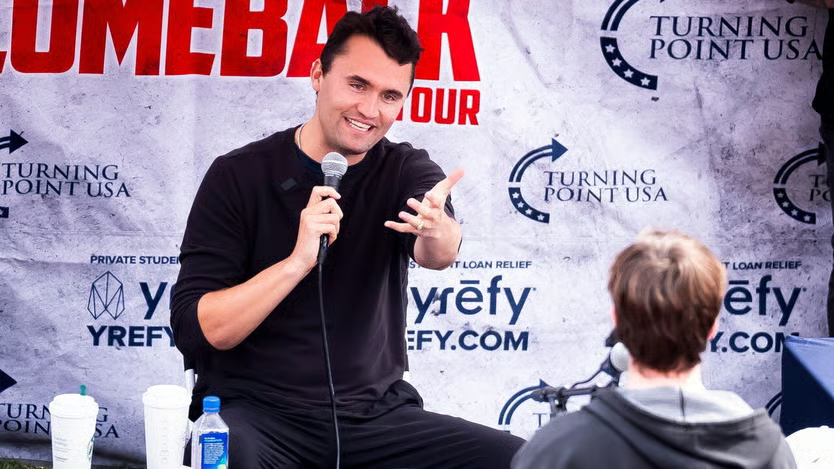
Charlie’s Voice
It is hard to get past the masked kid arguing, but Charlie just does his thing.

Working Network?
We’ll be back to regular postings tomorrow. Tuesday Tunes, then “Envy” and “Show Me Your Papers.”
In the best of all worlds, every server would have two interfaces (NIC) with two ports cross-connected to two switches.
Each switch would be cross-connected to their upstream switch and so forth until you reach your redundant gateways.
The problem with this setup is that you can end up with loops that will take that part of the network down.
This means that switches need to be smart enough to keep that from happening. And you have to configure your network to allow for all those cross connections.
This means that a room will have three subnets. Primary 1, Primary 2, and Management. The switch needs to have routing capability. Then you use a routing protocol like OSPF to make magic happen.
OSPF sends out routing information often. Timers are measured in seconds, not minutes. This allows every router/switch to pick the best path at that instant.
Last week I determined that there was a problem with uplink speeds to the network. I was getting maybe a hundredth of what I should have been observing. This became obvious when I was attempting some bandwidth tests of client configurations.
So we start the process of elimination. The first thing to eliminate is the provider network. They could not provide a remote speed test because I was using my router; therefore, it required a technician to be dispatched.
The goal was to eliminate any questions regarding their side of the “demarc,” or demarcation.
The demarc is the separation of responsibility between the provider and the customer. Everything on their side of the demarc is their responsibility; everything on my side is my responsibility.
In my installation the demarc is the Optical Network Terminator (ONT). The ONT is a fiber modem; it’s not really, but it works for our purposes.
The provider prefers to provide the ONT, the router/access point/switch/VoIP gizmo. If they provide that gizmo, they move the demarc to that gizmo.
My issue is that the gizmo in question is always home quality, never better. My router is just a router. It has two 2.5 Gbit Ethernet ports and two 10 Gbit SFP ports. It has a 60 Gbit internal bus and provides DHCP, DNS, Proxy, port forwarding, and many other professional features. My access points are on a controller that monitors the power usage and adjusts the power of each access point to produce the best coverage. This allows me to have multiple Wireless Access Points (WAP) within the house and grounds that don’t interfere with each other.
Better yet, as you move from place to place, your device will seamlessly transfer to different WAPs as needed, without getting new IP addresses.
Regardless, my equipment is much better than what they provide.
We tested from the ONT and got good upload and download speeds. A step in the correct direction.
The next test was from the router. This gave me acceptable speeds, much better than 0.260 Gbit.
This left SFP modules, SFP sockets, and fiber. Being lazy, I start with SFP modules. Switching modules doesn’t help. Next I swapped the cables. Finally, I swapped the router ports.
Nothing fixed it. I currently believe that the SFP port/slot on the router has an issue.
Since I had a second switch, I could have used that; instead, I decided on a network upgrade.
The new switch was configured. It was attached to the second SFP port on the router. All the management networks and the DMZ network were attached to it. Removed from primary (router1). Then router2 was cross connected with router1 via a Direct Attach Connector (DAC). A DAC is a wire with module connectors on both ends. They are cheaper than fiber plus two modules and will run at very high speeds. They are the connector of choice for SFP to SFP within a meter or so with no sharp bends.
It took way too much time to get everything configured correctly. Mostly because I just didn’t have all the pieces correctly configured.
My network map was wrong. I had 192.168.99.x/24 allocated to P2P connections. It isn’t allocated to P2P. It is allocated to a remote subnet that is part of the local network via a VPN. Oops!
One that was taken care of, I had working connections between the gateway and both routers. But the routers would not talk to each other.
Turns out that I had the DAC plugged into the wrong slot. Once I had it in the correct slot with the correct media type, everything just started working.
I now have a cleaner network, with more options, and better bandwidth than ever before. It is working as I anticipated. It just took way too long to accomplish.
New Server
I moved the site to a new server. It appears to be more responsive.
On the downside, I don’t know if the citeserver is still working, and I have a server that has decided to kick the bucket.

Using AI
Using AI
Discover how AI is revolutionizing content creation in our latest article. By leveraging Grok, a powerful AI tool, the tedious task of formatting articles—such as removing hard line breaks and adjusting fonts—becomes effortless. With just a click, Grok can transform raw text into polished HTML, generate unique excerpts, and even craft social media posts. From clean, ready-to-run code to seamless API integration, explore how AI can save time and enhance readability. Dive into this astonishing journey of automation and see how it could transform your workflow!
The world is changing. It might be getting better.
I started speaking with Grok Thursday night. I was treating it as a search engine. What I wanted was a method to format the daily dump.
There is a lot of good content, but I wanted a method to make it look nicer without having to spend an excessive amount of time working it over. When I am quoting legal opinions, the longest part is manually formatting the quote.
Manually quoting means removing hard line breaks, removing hyphens, and adding the proper font style back. It just takes time.
What I want is to be able to click a button and have WordPress make a call to the Grok API to apply formatting to the article. Hopefully making it easier to read.
Grok 3 was able to give me good feedback on how to accomplish what I needed. The code was clean, commented, and ready to run.
I do read this stuff.
This led me to setting up an API account to use Grok 4 directly. I asked Grok-3 to provide me with code to do so.
Over the course of an hour or so, we were able to create a Python program that will fetch an article from the site. Reformat the article for proper HTML. Provide an excerpt that is different from the first part of the article. Create a post for X, and make that post.
This is pretty astonishing, in my opinion.
Now comes the testing.