Month: November 2023

He’s too Dangerous to Have a Gun

Legal Rant
B.L.U.F.
Rambling about how to disarm “dangerous” people. Put them in prison.
(1800 words)


A well regulated Militia, being necessary to the security of a free State, the right of the people to keep and bear Arms, shall not be infringed.

The unqualified command of the Second Amendment is “shall not be infringed”. This applies to all The People.

As a society, we want our family, friends, and community to be “safe”. To that end, we create protections.

The primary protection is a threat of state violence on those that would harm others.

When the cops show up and arrest somebody, they are inflicting violence on that person in the name of the state. When that person is remanded for a custodial sentence, there is state inflicted violence in that as well.

The state wishes to maintain a monopoly on violence.

The right to self-defense is in direct opposition to that monopoly. Self-defense is not limited to self vs. another person or other people, it also includes the right to defend yourself from the state.

The Second Amendment protects our right to armed self-defense. Since it protects an aspect of self-defense, it is in direct opposition to the state’s goal of a monopoly on violence.

Unfortunately for the state, their goal of a monopoly on violence is a threat to our safety. How? Because the state cannot proactively keep us safe. They can only reactively respond. Often long after the harm has been done.

If there is a credible threat to you or your family, the state will not provide you with protection. At the most, they might send a squad pass your home slightly more frequently than normal. This is not real protection. It is barely a deterrent.

Since the state cannot protect you and yours, they offer to predict who is most likely to be a threat to (the state) you, or (the state) your family, or (the state) your community.

Predictive actions by the government are facially unconstitutional. You have a presumption of innocents. You must be found guilty in a court of law beyond reasonable doubt. Only after you have been found guilty can the state punish you.

Remember, you have rights and powers. The state has powers and authority. The state has the power to break down your door, search your home and person, detain you and punish you. They only have limited authority to exercise that power.

You have your rights, you might not have the power to defend your rights against a more powerful (the state) foe.

When the state uses its power to strip you of your rights, they are causing irreparable harm. They are only authorized to do so after a finding of guilt.

What happens when the state is aware that a group of people are too dangerous to be armed? How do they disarm those people?

According to congress, there are 9 reasons a person can be disarmed because they are too dangerous to possess firearms.

The law does not disarm those people. It only orders them to not possess firearms. A very different thing, indeed.

From this data, we can see that about 33% of all homicides of family members are done without a firearm. If the purpose of §922(g)(8) was to protect potential victims by predicting that a family member was dangerous, then it would apply to all arms. Not just firearms.

The state has argued, unendingly, that there are protections in place for those accused of potential domestic violence. That a court will only issue a TRO that triggers §922(g)(8) after due process.

Let’s see, the accused has to “receive actual notice”. Does that mean a certified letter? A process server? Or does it mean first class mail?

When I was divorcing my first wife, it was not pretty. On the weekend of my birthday, I went to pick up my children at her home. She did not answer the door. She refused to come out.

Of course, it is past closing time at the courts, there is nothing the courts can do. Finally, she came down. I took a few steps back, away from her, stuck my hands in my pockets to stop from making unintentional gestures that might be interpreted as threatening.

I left without my children. I left without touching her. I stopped at a phone to call my lawyer and report what had happened. My estranged wife went to the cops and filed a complaint. She didn’t bother to tell them that we had lawyers. She didn’t bother to inform them that we were in the process of getting a divorce.

She wrote my address so badly that when the court issued a summons to appear, they sent it to the wrong county.

According to the court system, I should have known about the summons because they sent it by first class mail.

They didn’t have any problems finding me when the court issued a warrant for my arrest for failure to appear. For that, they contacted the DMV and asked them for my address. Simple.

When the state says that the TRO only counts if the accused “received actual notice”, I do not trust that those words mean the same thing we think it mean.

The state offers another requirement, that the accused has an opportunity to participate in the hearing. If the accused actually gets the notification, and if the accused has enough warning to get to the hearing, and the accused has the means to get to the hearing, and the accused can get time off to attend, they can attend.

There is nothing in the law that requires the hearing be held where the accused can get to it.

Going back to my estranged wife, the court where the case was being heard was in a different county. It required me to drive for an hour, each way, to attend. Those hearings are always during the workday. They are not tightly scheduled, so you have to take a day off to attend.

There is no public defender for the accused. They have to bring their own paid for lawyer or represent themselves. The person filing for the TRO has a great deal of state provided support. Search for how to file for a Domestic Violence TRO and you will find multiple results for help in filing.

So now we get to the second part of the clause, “includes a finding that such person represents a credible threat to the physical safety of such intimate partner or child; or”. That sounds pretty good. That means the court would have to have evidence that there was a real threat.

What, that ended with an “or”. That means there is another way for clause B to be satisfied.

“by its terms explicitly prohibits the use, attempted use, or threatened use of physical force”. What does that mean? It means that if the TRO says, “don’t hit your wife” it satisfies clause B.

So to restate the requirements for a TRO that triggers §922(g)(8) the accused has to be sent notification of the hearing, they have to have permission to attend the hearing, and the TRO has to have language in it forbidding physical force or threats against the purported victim.

A predictive finding from the legislature in §922(g)(8) is not constitutional, on its face.

What about other predictive findings of the legislature, you know, future crimes?

The state feels that the potential for punishment of custodial detention exceeding a year is enough to trigger §922(g)(1).

It does not require a finding of guilt for §922(g)(1) to attach, just an indictment. President Trump is currently a prohibited person because he has been indicted on charges that could exceed more than a year of imprisonment.

The state has not been able to point to any regulations from the founding error of disarming people how were not dangerous.

Is there any real likelihood of President Trump going out and shooting somebody? Not really. He is not “dangerous” in that way.

The state then turns to a definition game. Rather than prove that a person is dangerous via objective standards, they use legislative predictions. That being if the punishment would be for more than one year.

That is not a finding of dangerous. There are thousands of regulations that can get you sent to prison for a term of greater than a year. Few of those are actually indicators of “dangerous”.

The standard example being Martha Stewart. She is not “dangerous”, she is a prohibited person.

This makes §922(g)(1) facially unconstitutional.

How about those people who were convicted of acts of violence? Should they be disarmed?

They are disarmed, for the duration of their imprisonment. There is a finding of dangerous in these cases, in that the crime they were convicted of was a violent crime.

What about when they are released from prison? Should their rights be reinstated?

This is the more difficult question, in my opinion. So I push the issue slightly. When a person is sentenced according to the sentencing guidelines, they are being punished according to those guidelines.

If the sentence is for 70 months, and they are released after 62 months, they still have another 8 months of punishment. At the end of the full 70 months, their rights are restored.

But we know there is a high rate of recidivism. The more so when violence was part of the original crime.

If there is such a high probability of recidivism, then your punishment isn’t working! Fix it!

The rapist that has destroyed the lives of 10 women is sentences to 60 months. He gets out and 4 years. He rapes another couple of women before he is captured and put away again.

Why was he let out after only 4 years? Why wasn’t he kept longer?

I was watching a TV show. One of the characters tells her parole mentor that she hasn’t had anything to drink in 18 months. The mentor points out that it is a meaningless statement because she’s locked up where there is not supposed to be any alcohol.

There is no way to predict behaviors based on the behaviors when a person is under observation.

Florida has a 10-20-life regulation. My understanding is that these are enhancements based on the use of a firearm in a crime. Their answer is, “don’t do the crime if you can’t do the time.” Those are 10, 20, and life enhancements for using a firearm during certain crimes.

Punishment must deter people from doing the crime. It must not chill the exercise of our rights.

of The People Shall Not Be Infringed!

Legal State Arguments
B.L.U.F.
A look at how the state is attempting to restrict our rights by redefining what “The People” means.

(2450 words)


Heller was the first domino to fall in the restoration of our Second Amendment protected rights. McDonald was the next. After a long time, we had the third domino fall, Bruen.

After Heller there was a rash of cases that were filed. As these cases made their way up the court system, the infringing, rogue, courts profoundly erred in how they interpreted Heller.

They looked at the methodological processes that were used to decide cases in court. Two different methodologies were examined, and then adopted. The first was how the Supreme Court had addressed First Amendment cases.

They determined that the rights protected under the First Amendment were not absolute. There were exceptions. To determine if a regulation is constitutional, the regulation is evaluated using “strict scrutiny”.

Under strict scrutiny, the state must show that there is a compelling state interest, that the regulation is narrowly tailored and is the least restrictive means available to the state. Strict scrutiny only applied to content-based or viewpoint-based regulations. If the regulation was not abridging content or viewpoint speech, then intermediate scrutiny was applied.

This also matched the ways and reasons injunctions/stays were issued, likelihood of success on the merits, irreparable harm, balance of equities, and public interest.

Given these two methodologies, the inferior rogue courts adopted a means-end methodology for Second Amendment rights. First, the court would determine that the regulation did not infringe the core right of self-defense too much, just like they determined content or viewpoint-based speech. The courts then looked at the state interest.

If the state interest was “compelling”, the court would use strict scrutiny. If the state interest was not compelling, the court would use intermediate scrutiny.

Having decided on the level of scrutiny, the rogue courts would assume without finding that the regulation being challenged was facially unconstitutional, and then rule it constitutional because the state had shown significant interest to justify the regulation under the level of scrutiny used.

This stopped progress in Second Amendment challenges. Just as the previous profoundly erroneous evaluation of the Second Amendment only applying to the militia.
Read More

Fonts? What are they good for?

I am a computer scientist. I went to university to learn how to be a computer scientist. Some of the classes I took were named things like “data structures” “FORTRAN IV” “Assembly” and “Compilers”.

I’ve written three compilers, around four or five different interpreters, studied and understand bit manipulation.

I’ve done bit fiddling on a panel of switches to boot a computer.

With all of that, I’m a noob compared to Donald Knuth. This guy wrote the book, literally, on computer science. The Art of Computer Programming is that book.

What is more amazing than writing that book, is how that book came to exist. I’m telling this from memory, so I might get some details wrong.

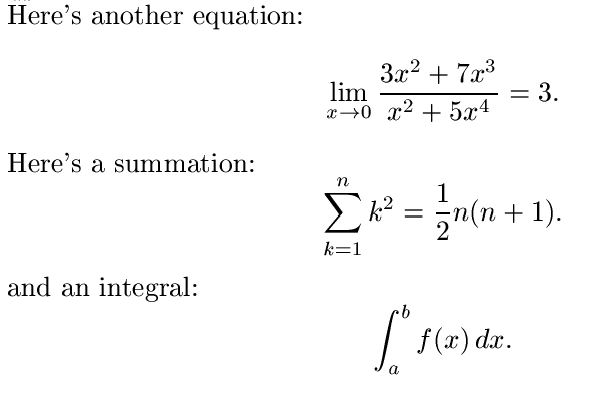
At the time, the cost of publishing textbooks was high. If you wanted to drive the price up, just add a math formula to your textbook.

That little bit of math could add hundreds of dollars to the cost of making a textbook. Worse, it was typeset manually by people that might not get it right.

Donald didn’t like that. So he decided to just write some software to do it for him. But first, he needed to follow the concepts.

That concept is what we now call “write once”. You don’t define something in two different places. You define it once, and everything is built from that single source.

He wanted to write a program to typeset books that was self documenting and “did the right thing”. So he invented a new language, called “web”. He now needed a program to convert “web” files into something that a computer would understand.

He wrote “tangle”. Tangle takes a .web file and produces a PASCAL file (programming language) and a .tex file. The pascal program that was created can then read the .tex file and produce a typeset book, ready to print.

Donald taught himself typesetting. His programs and books taught me programming.

Donald needed to typeset and then print the book. To typeset the book, he needed to know the fonts that were being used and more than that, he had to know how each glyph in the font was positioned within a rectangle.

So as an example, consider the word “fit”. This word has three characters, but when printed in a professional font, the “fi” characters are combined into a single glyph that looks great to the eye.

Donald went out to get a professional font. Nobody would sell it to him for reasons. So… Donald learned how to create fonts. He invented an entirely new way of describing fonts. And wrote another book in “.web” to create metafont.

The fonts we use today are TrueType Fonts or derivatives of that format. TrueType fonts are based on the metafont format.

This is where I became interested in typesetting and fonts. I learned more than a little bit, and I’m still a noob about it.

Fonts have a purpose. Each font is designed for a particular purpose. For that purpose, they should do a good job.

There are “display” fonts and “text” fonts. Display fonts are used for big things, like headlines. Text fonts are for reading things.

If you look at the characters closely, you might notice that some characters have little “feet” or flourishes on them.

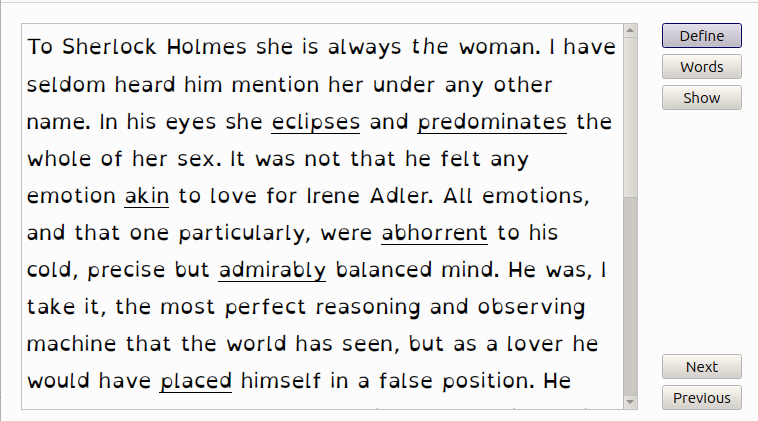
You should see the base on the bottom of the “q”. It has a sort of rounding to it. It flows nicely. These are “serifs”.

This font is based on URW’s New Century SchoolBook font. It is one of the most common fonts used in books. It is an easy-to-read font when you are looking at a wall of text.

When it is enlarged, like the image above, that readability is not as good. When we are using large characters, such as in a banner or headline, we want to use a “sans serif” font. A font without serifs.

The most famous of those is Helvetica. This is owned by Adobe. Microsoft created their version of Helvetica, called “Arial”. There are free versions that look nearly the same.

The default font that this site uses is a sans serif.

As I said the other day, I’m writing software to help with teaching English as a Second Language. We are using some texts designed for different levels. I need to be able to display text in a video meeting that was easy for my students to read.

So I picked one of the ugliest fonts I’ve ever found.

It just looks wrong. It looks like it is melted, it doesn’t have weight in any one direction. Sometimes a stroke is heavy on the left, sometimes on both sides. It is just wrong.

But its purpose is not to be beautiful. Its purpose is to be easy to read. It is.

The font is called “OpenDyslexic”. It is designed to help combat the issues of dyslexia. Since I have dyslexia, I should use it more often. I don’t.

The interesting thing is that all of my students using it were thrilled with it. They found it very readable.

Better still, my wife, the reading specialist, loves it. She loves it enough that she is going to get it installed at her school for her to use with her students.

Friday Feedback

It was a big week at the Supreme Court. The Court heard its second Second Amendment case in a year. The odds say we should get the opinion sometime around June 2024.

The left is going on about how this will be a slam dunk win for the state and gun infringers everywhere. MSNBC went so far as to say that the conservative court was retreating from Bruen because Bruen was so untenable.

There is very little chance that Bruen will be reversed. Bruen was a slap down of the inferior courts for not doing Heller correctly. What is possible is that we get an opinion that says that a person who is dangerous to himself or others can be disarmed. If that happens, I expect that the court will also specify precisely how a person is judged to be “dangerous”.

Furthermore, the Court may find that there is no history of disarming a person without due process and vacates §922(g)(8).

Of course, the Court could just vacate the Fifth Circuit court’s opinion and remand it with instructions on how to do it “right”.

Regardless, I’m not concerned about the outcome of this case. It will either be a win for The People or an extremely limited opinion. Meanwhile, the state has admitted that the criteria is “dangerous” which might mean that §922(g) gets gutted when the Range case is heard.

I recently picked up a WWII IFAK pouch to go with my WWII web gear for pistol carry. It is barely big enough for an Israeli Combat Bandage or a SWAT-T tourniquet. I’m trying to decide which is the better to have with me all the time.

I’m leaning towards the Israeli Combat Bandage.

On an interesting note, I’ve complained to Hagar that she gets much better engagement on her articles than I do on mine. I spend 3 or 4 hours writing an analysis of a case, and I’m lucky if I get 2 comments. She whips off an article in 30 minutes and has 10+ comments.

She pointed out that my non-legal articles get more feedback.

Yesterday’s rant about some moron thinking he had discovered “The Loophole” had good feedback. It felt nice.

I hope you all have a wonderful weekend.

We look forward to your comments.

New Work Stuff

One of my clients has a strong base of developers out of his home country. His people are very sharp, very good. They deliver excellent results. If you ever need Drupal developers, I’ll put you in touch with him.

His company works with some of the best educational institutions in the country, delivering top-notch results.

He noticed that some of his developers were having issues with the pronouncing certain words. So at a company-wide meeting, he had a vocabulary list to review. I stepped in it and took over and taught that vocabulary list to the team.

The next meeting, we did a group reading. Again, to build vocabulary and comfort.

This morphed into me teaching multiple session per week of one-on-one lessons.

One minor issue with this is that I want to do it “right”. I went to my wife, a reading specialist, and asked her how to do it better.

She told me.

I looked at how she did it and what she did. Which led me to trying to do it myself.

I am NOT willing to spend two hours in prep to produce the training aids I want.

So, of course, I’m writing software. I’ll spend 120 man-hours building software, so I don’t have to do 20 hours of work.

Sigh.

I’m having a blast doing the lessons, and I am eagerly awaiting the four sessions I’m teaching tomorrow.

“Stupid Is As Stupid Does,” The Hill

[visual-link-preview encoded=”eyJ0eXBlIjoiZXh0ZXJuYWwiLCJwb3N0IjowLCJwb3N0X2xhYmVsIjoiIiwidXJsIjoiaHR0cHM6Ly90aGVoaWxsLmNvbS9vcGluaW9uL2p1ZGljaWFyeS80MjkyMDczLWhvdy10by1jdXJiLWd1bi12aW9sZW5jZS1zdGF0ZXMtc2hvdWxkLXN0YXJ0LWJhbm5pbmctZ3VuLXNhbGVzLyIsImltYWdlX2lkIjotMSwiaW1hZ2VfdXJsIjoiaHR0cHM6Ly90aGVoaWxsLmNvbS93cC1jb250ZW50L3VwbG9hZHMvc2l0ZXMvMi8yMDIzLzA4LzY0Yzk4NDQ4OTUwZDEyLjY2NzE4NTM0LmpwZWc/dz0xMjgwIiwidGl0bGUiOiJIb3cgdG8gY3VyYiBndW4gdmlvbGVuY2U6IFN0YXRlcyBzaG91bGQgYmFuIGNvcnBvcmF0aW9ucyBmcm9tIHNlbGxpbmcgZ3VucyIsInN1bW1hcnkiOiJGZWRlcmFsIGNvdXJ0cyBhY3Jvc3MgdGhlIGNvdW50cnkgaGF2ZcKgcm91dGluZWx5IGZvdW5kwqB0aGF0IHRoZXJlIGlzIG5vIFNlY29uZCBBbWVuZG1lbnQgcHJvdGVjdGlvbiBmb3Igc2VsbGluZyBhcm1zIiwidGVtcGxhdGUiOiJ1c2VfZGVmYXVsdF9mcm9tX3NldHRpbmdzIn0=”]

The Hill starts by telling use that the Rahimi case is about “red flag” laws. It isn’t. Of all the dumb takes that they could make, this is likely the dumbest. It does have a strong emotional punch, though.

They attempt to blame “skyrocketing” gun deaths on the opinions of the Supreme Court. How dare the highest court in the land uphold the law of the land?

So the Hill proposes a solution. The states should outlaw (restrict) the sale of guns.

They explain the meaning of the three Second Amendment cases they actually know about:

In Heller, the Court found that a handgun ban in D.C. violated an individual right to keep and bear arms under the Second Amendment. Two years later, the court expanded this rule nationwide by striking down a similar handgun ban in Chicago. Last year in its Bruen decision, the court concluded that concealed carry permits for guns could not be premised on a proper need requirement. What’s the common thread? This court is extremely protective of an individual’s possession of firearms.

How about, the court is extremely protective of the law, of the Constitution? The right they are protecting is the Right of The People to Keep and Bear Arms.

But you see, there is a loophole. “Keeping and bearing” arms is not the same as a right to buy or sell arms. Isn’t they smart! When people told their parents that brothers shouldn’t marry sisters, they didn’t expect smarts like The Hill got from that union.

What can gun reform advocates do with that? We can pass laws to close gun stores in the 17 states where Democrats have unified control. As a candidate for the state Assembly in New York — one of those 17 states — I am proposing a law telling every corporate entity in the state to make a choice: either stop selling guns or stop doing business in our state.

Those entities that refuse to comply would be subject to dissolution or an injunction preventing further business activity in New York. This would essentially close stores that sell guns in our state, since virtually all such stores are corporate entities. That would not eliminate gun violence, but it would help to stem the tide by making it harder to get a gun.

This idiot then suggests that people who want to buy guns just drive over the boarder and buy them in a red state. This person is advocating a felony. You can’t buy a handgun in a different state. Well, you can, but it has to be shipped to a local FFL.

When his uncle and aunt married each other event then, the best part of him ran down his mother’s leg. He seems to think that the [xCite item=”CK44UVC7″ pos=0] should still be good law. Because of “precedent”.

Regardless, I wish Scott Budow, Democratic candidate for New York State Assembly, District 52 all the respect he deserves.

Rahimi oral arguments, big picture take away

(1100 words)

The very first thing to note is that Mr. Rahimi isn’t actually involved with this case. He was recently interviewed in prison, where he claims to be “reformed”. He says that he will never touch another gun and wishes the case would just go away.

With that out of the way, the takeaway from today’s oral arguments is that everybody is playing on a bigger chessboard than just this case.

§922 is the unlawful acts portion of the Gun Control Act. (I wonder if “gun control” implicates the Second Amendment?)

This case is about §922(g)(8), a person with a restraining order for domestic violence being a prohibited person. According to Mark Smith, only about 21 convictions per year are made on §922(g)(8). This means that this is not an arrow in the quiver of the state. This is a tack they place on the chair of somebody they have already kitted up.

Rahimi was charged with §922(g)(8) because he was a bad man doing bad things and the authorities needed him off the streets now. He is currently in prison for all the other things he did. If this charge were thrown out, it would not change his situation in the least.

It is also important to note that this case was brought back from the dead by the Fifth Circuit court. Just before Bruen was issued, they had found, via means-end, that §922(g)(8) was constitutional, and the charge would stand against Mr. Rahimi.

After Bruen, the Fifth Circuit court brought the case back. On the post Bruen pass through the Circuit Court, they found that §922(g)(8) was unconstitutional. I do not remember if they remanded the case back to the district court. Regardless, we had a circuit court opinion that followed Bruen and found that parts of the GCA were unconstitutional.

At the same time, the Range case is currently seeking certiorari. That case is likely to be taken up by the Supreme Court as well. If the Supreme Court grants certiorari on the Range case, it will mean that there would be three gun rights cases to be heard by the Supreme Court within the next year, maybe even this term.

What this means, is that the Rahimi case is a holding action by the state, DOJ. They would love a win. The facts of Rahimi are bad. Mr. Rahimi was a bad man doing bad things.

Therefore, the briefs and oral arguments today, were about setting the groundwork for the cases to come without losing this case.

What does the state want out of this?

Thank you to Justice Kagan for getting the state to actually say it out loud:

Yes. I think that there are three fundamental errors and methodology that this case exemplifies and that we are seeing repeated in other lower courts and that this case provides an opportunity for the Court to clarify that Bruen should not be interpreted in the way that Respondent is suggesting.

The first error we see is that Respondent has asserted here and other courts have embraced the idea that the only thing that matters under Bruen is regulation. In other words, you can’t look at all of the other sources of history that usually bear on original meaning.

And I don’t think that that can be squared with this Court’s precedents, starting with Heller, which consulted a – a wide variety of historical sources, the same kind of evidence we’ve come forward with here about English practice, state constitutional precursors, treatises, commentary, state judicial decisions. All of that is relevant evidence about the scope of the Second Amendment right, and I think the Court could make clear that it’s not a regulation-only test.

Second, I think that looking just at regulations themselves, one of the fundamental problems with how courts are applying Bruen is the level of generality at which they’re parsing the historical evidence. Court after court has looked at the government’s examples and picked them apart to say: Well, taking them one by one, there’s a minute – minute difference between how this regulation operated in 1791 or the ensuing decades and how Section 922 provisions operate today. And I think that comes very close to requiring us to have a dead ringer when Bruen itself said that’s not necessary.

The way constitutional interpretation usually proceeds is to use history and regulation to identify principles, the enduring principles that define the scope of the Second Amendment right. And so we think that you should make clear the courts should come up a level of generality and not nit-pick the—the historical analogues that we’re offering to that degree.

And, third and finally, I think that in many instances, courts are placing dispositive weight on the absence of regulation in a circumstance where there’s no reason to think that that was due to constitutional concerns.

So, for, example here, we don’t have a regulation disarming domestic abusers. But there is nothing on the other side of the interpretive question in this case to suggest that anyone thought you couldn’t disarm domestic abusers or couldn’t disarm dangerous people. And in that kind of context, I think to suggest that the absence of regulation bears substantially on the meaning of the Second Amendment is to take a wrong turn.

It’s contrary to the situation the Court confronted in Bruen where there was a lot of historical evidence to say states can’t completely prohibit public carry, and against that evidence, you might say that the absence of regulation is significant. But, here, there’s nothing on the other side of this interpretive question, and I think that that just shows that you shouldn’t hold the absence of a direct regulation against us.
— Transcript

There you have it, the state wants to gut Bruen. First, they want the lack of a regulation to indicate that the current regulation is constitutional. This flips the issue on its head. The plaintiff would then have to prove that the lack of regulation was because the people of the founding era knew it was unconstitutional.

Likewise, They are unhappy when the nuanced approach is not accepted, and they have to actually find matching regulations, which don’t exist.

And the big one? They want Second Amendment cases to become expert battles. Instead of courts having to do their jobs, to understand the law (regulations), it will become a “Which expert do I want to pick?”

I intend to read the rest of the transcript later today. Hopefully, I’ll have a more complete write-up on the arguments.

The Assumptions We Make …

The Supreme Court heard oral arguments in Rahimi today. I’m listening to the arguments and reading the transcripts.

I’ve not heard much from Justice Jackson that makes me consider her to be a “good” justice. Today she is showing some significant signs of attempting to do her job correctly.

She is questioning the state, and she is making the state actually define their position regarding historical analogs. In this particular line of questioning, she asks Then what’s the point of going to the founding era? I mean, I thought it was doing some work. But, if we’re still applying modern sensibilities, I don’t really understand the historical framing.

Furthermore, the lawyer for the state is good. She is staying on point, she is making her points. She is doing a much better job than the briefs indicted they would do.

Tuesday Tunes

The first couple of times this came on my feed, I was unhappy. “When I die, I don’t wanna go sober.” sounds like such an unhappy ending. My lady said something about how she really liked the song. I had to listen again.

This is not about being an alcoholic.

Later, I stumbled across their video. I smiled all the way through. So many happy people in the crowd. Young, old, children, all swaying, and singing.

A song that reverberates with the crowd.

I hope you enjoy “Sober” by Little Big Town.

Gear Review, WWII Reproduction Web Gear

Recently, I wrote about my WWII reproduction web gear for around the house carry. The short of it is that I really like it. It is adjustable enough, it is comfortable.

Later this week, I’ll have a period correct medical pouch to go with it. All of this means I’ll have a functional, modernly equipped, WWII rig.

The suspenders are cool. They aren’t adjusted correctly yet because of other issues. When I stand up, I don’t feel like my belt and holster will hit the floor. The load is nicely distributed. They are nice enough that I will likely get a second pair to attach to my cartridge belt. 80 rounds of 30-06 in enblok clips is a charming option.

The mag pouch is a slight problem. It will not hold extended magazines, so I’ve used it with 7 round magazines that match WWII issue. That’s fine. The pouch has two pockets, each pocket will hold two magazines.

This is pretty impressive for the time. It means that an officer with just a side arm was carrying 29 rounds of .45 ACP into battle. Just on their belt.

For me, the location of the pouch is an issue. It slips over the web belt and then snaps to hold it in one location. The pouch is always in the same location, it is not a horrible reach, but it isn’t “right”.

With my modern gear, my magazines are carried on my weak side such that my arm comes back, grabs a magazine and in a smooth motion comes up, presenting the mouth of the magazine to the firearm. Fast and easy.

With the WWII pouch, the movement is to the front left of centerline. Opening the pouch is fast enough, though not as fast as a tension retained magazine. The issue for me is that the motion from there to the pistol is not fluid. There is a twist and jerk that sort of happens. Mostly because the magazine is perpendicular to the magazine well instead of being parallel.

In addition, my dun-lap-over covers the pouch when I’m sitting. I can still get a mag out, but no way I’m getting a mag back into the pouch while seated.

The holster is nice. It seems well enough constructed. It is universal enough to carry just about any type of full-sized pistol.

Now we come to the downside. The bleeping web belt itself.

Do NOT buy a reproduction belt for anything except standing and marching for short periods of time.

It was too thin, it was far too flexible. This meant that the hooks holding the holster to the belt came loose while the belt was attached. More than once, I have stood up, or gotten out of the car, only to find the holster dangling from just one hook. It looks bad and there is a real risk of it falling off entirely. I do not want that to happen.

The second problem with that thin belt is that the holes punched into the canvas for the eyelets will stretch under the load of holster plus 1911. Add to that a bit of torque while sitting, and I’ve had multiple eyelets rip out of the belt after less than two weeks of wear.

I’m now searching for sources for higher quality web belts. I think I’ve found one, but the cost is much higher than I’m ready to pay today.

Original WWII M1936 Webbing Canvas Pistol Belt with M1911 Colt Holster and .45 Colt Magazine Pouch is the version I purchased. Yeah, what was I really expecting for $42?