Isn’t Form 4473 Unconstitutional?

In [xCite item=”2BWL9AJA” pos=0], the Supreme Court found that the BATFE had exceeded their authority in changing the definition of “machinegun”. The ATF argued that they were just interpreting the law that congress had passed.

This is in keeping with our governmental forms. The three branches of the government are the legislative, executive, and judicial. The legislative branch creates laws, which must be approved by the head of the executive branch. Or the congress must override the president’s veto. The executive branch then implements those laws. The judicial branch defines what the laws actually mean.

In addition, the judicial branch is tasked with evaluating laws that are in conflict to determine which law overrides the other.

So, if the ATF can just make up laws, where did the 4473 come from?

It came from a Democrat, of course. Instead of yelling about “mass shootings” and “school shootings” the cry in the 60s was about assassinations. That is to say, three assassinations. JFK, RFK, and MLK. Because three assholes killed three men, we had our ability to acquire firearms infringed.

In 1968, the Gun Control Act of 1968 was passed. This codified the first full on gun control in the country. The NFA attempted to establish full gun control with full registration and prohibitive taxes on all firearms, but it only did it to machineguns, short barreled shotguns, short barreled rifles, and suppressors.

The reason given was that this would force all the bad guys to buy guns in person.

The 4473 was part of the executive’s implementation of the GCA of 1968. Every question on the 4473 is supported by code, not regulation. If you read §922(g) you will see that it is translated directly into questions in from 4473.

From 1968 through 1993, the process was a buyer went to the FFL, decided what firearm they wanted to buy. Filled out the 4473 and walked out with the firearm.

There was no waiting.

If a bad guy wanted to buy a gun, he could walk in, fill out the 4473 and just lie. This meant that when he decided to use his gun in an illegal way, or was picked up as a felon in possession, they could add on lying to an FFL, lying on the 4473.

This would stop the bad guy from doing bad things.

Since evil people are going to do evil, and criminals will do criminal acts, this didn’t actually work like the gun-control infringers said it would. It didn’t stop anybody. To get a feel of just how bad this is:

On a personal note, the form fails to keep certain persons from obtaining firearms. This failure is seen in Question 11.f.
[xCite item=”NMKBKZ47″ pos=1]

This was a former ATF agent. He truly believes that a piece of paper stops people. This is the same sort of person that gets women killed by denying them firearms but giving them a restraining order.

One of Hagar’s friends was murdered by her estranged husband. She had a restraining order against him. This didn’t stop him from killing his wife and children. Nor did taking some of his guns from him. He had decided to commit murder. Why would violating a restraining order slow his rampage down?

I’m sure that when she held up the restraining order, it stopped the bullets he fired at her.

In the 90s, the infringers started screaming that the 4473 wasn’t stopping criminals. They demanded that background checks be done before a person took possession of their firearm.

The original goal was to add waiting periods while the background check was being done. There are states that have excessive waiting periods. I was upset when purchasing some rifles and all pistols required me to wait 21 days. Oh, even though that sounds like three weeks, it is really 4 weeks and 1 day. Because those are business days. This was when I was back in Maryland.

The NRA was the group that got NICs as part of the deal. When some moron tells you that the NRA supported background checks, they didn’t. What they did was fight for a compromise of an instant background check, with the default being you get the firearm.

Some “compromises” they defeated were options where the state had 30 days to reply, but there was no penalty if they took longer. Just ask J. Kb. how the state is perfectly willing to use their incompetence as an excuse to deny you, your Second Amendment protected rights.

So, is form 4473 “Constitutional”?

The answer is yes. This is because the form is a proper implementation of the GCA of 1968.

Is the GCA of 1968, as amended, Constitutional?

Bruen did not answer that question. Bruen told the inferior courts how to properly apply the Heller methodology.

If the individual’s (proposed) conduct implicates the plain text of the Second Amendment, the state has the burden to show representative regulations from this Nation’s historical tradition of firearms regulation.

If we have a hypothetical case, where a person was stopped for a routine traffic stop, and during that stop admitted to smoking a little weed and the cops find he is in possession of a firearm. According to §922(g)(3), he is a prohibited person. He is going to jail. See the Range case.

Did his conduct implicate the plain text of the Second Amendment? Yes. Gun, bear, possess, Second Amendment implicated.

If the Second Amendment is implicated, the state has the burden to prove this Nation’s historical traditions of firearm regulation (in the 1790s) would have prohibited a person who smoked weed (or drank) from keeping or bearing arms.

Since the state cannot do so, §922(g)(3) is Unconstitutional.

Which takes us to lying to an FFL.

for any person in connection with the acquisition or attempted acquisition of any firearm or ammunition from a licensed importer, licensed manufacturer, licensed dealer, or licensed collector, knowingly to make any false or fictitious oral or written statement or to furnish or exhibit any false, fictitious, or misrepresented identification, intended or likely to deceive such importer, manufacturer, dealer, or collector with respect to any fact material to the lawfulness of the sale or other disposition of such firearm or ammunition under the provisions of this chapter.
[xCite item=”LBGES7CQ” pos=2]

If §922(g)(3) is unconstitutional, then lying about being a drug user is not a material fact. Thus, no violation of §922(a)(6).

Which only leaves §924(a)(1)(a). This gives a penalty for making a false statement or representation. This is where I yell IANAL!!!!

My reading says that this could stand.

Regardless, the 4473 is still here. It is being challenged because §922(g) is being challenged.

Final note:

Q7: Has ATF issued a new Form 4473, Firearms Transaction Record?
Under the Paperwork Reduction Act, federal agencies are required to seek public comment and assess the burden associated with any changes to federal forms, through a process managed by the Office of Management and Budget. Consistent with that process, ATF has not been required to issue nor has it issued any changes to the Form 4473, since April of 2012. When the form was last changed (2012), ATF published the changes in the Federal Register and provided a 60 day comment period for the public to comment on the form, as required under the Paperwork Reduction Act. ATF received no public comments.
[xCite item=”KLGPHSDJ” pos=3]

See, the ATF is not changing the form very frequently, OOPS!

ATF Form 4473 (5300.9)
Revised August 2023
— ATF Form 4473 (5300.9) Rev. Aug 2023

It seems like the ATF lies even when they have nothing to lie about.

Cargill v. Garland, what does it mean?

This is “the bump stock” ban case. It has been kicking around for a while.

In October 2017, there was a mass casuality event in Las Vagas, Nevada. 58 people were killed and over 500 were wounded.

When the police breached the room they believed the shots were coming from, they found a corpse, IIRC. I don’t believe the cops shot him.

They found a number of weapons, some of which were AR15 style semi-automatic rifles. They found magazines and at least one of the rifles was equiped with a bump stock.

President Trump, looking at the make up and the will of the congress told the ATF to ban bump stocks.

One version says that Trump is a traitor to the Second Amendment for doing this. Another says that Trump was playing 5D chess and kept congress from acting.

The ATF promligated a new regulation where they redefined “machinegun” to include semi-automatic firearms equiped with bump stocks as machineguns, and demanded that all owners of bump stocks turn them in within 90 days or face charges.

Mr. Cargill turned over 2 bump stocks to the ATF, under protest, then filed suit challenging the final rule as being in violation of the Administrative Procedure Act.

This is NOT a Second Amendment challenge. This is an Administrative Act challenge. It is a claim that the ATF did not have the authority to exerciese its power the way that they did. The ATF can not change laws nor can they make laws.

The district court found for the ATF. A merits panel of the Fifth Circuit court afrimed. The case was then heard en banc where the Fifth Circuit reversed the merits panel. Note that this was a weak finding.

The Fifth Circuit en banc found that under the rule of lenity, the plaintiff, the good guy, wins.

The rule of lenity is that when the law is ambiguous, The People win.

This means that the case was appealed to the Supreme Court which granted cert and issued their opinion today.

So what did the Supreme Court actually say?

Justice Thomas delivered the opinion of the court. He answered the question put to them. Did the ATF exceed its statutory authority? The Supreme Court said they had.

With this, the ATFs rule is gone. Does this mean that we can now own bump stocks? The answer is a strong “maybe”.

If your state has banned bump stocks, those laws are still good. This opinion only affects the ATF’s Rule. It was found that the ATF did not have the authority to redifine the meaning of “machinegun.”

Even if your state’s government waved the magic pen and banned bump stocks, those bans have to be fought in court. This case is not even good case law for a state level executive ban.

This case is even weaker as case law IF your state’s legislature passed bills that were signed into law banning bump stocks.

On the good news side, Justice Thomas does a great job of describing the trigger group of an AR-15. This makes it absolutely clear that an AR-15 is a semi-automatic firearm. This can be used to slap down the Woods and Easterbrooks of the country that find that AR-15’s aren’t even arms protected by the Second Amendment.

This is why I like originalist Justices. Justice Alito concurered. He wrote that he was agreeing with the majority because that is what the law said. He then goes on to say that if the Congress that defined what a machinegun was knew about devices like bump stocks, they would have considered a bump stock to be a machinegun.

But he says very clearly:

There is a simple remedy for the disparate treatment of bump stocks and machineguns. Congress can amend the law—and perhaps would have done so already if ATF had stuck with its earlier interpretation. Now that the situation is clear, Congress can act.
[xCite item=”2BWL9AJA” pos=0] Justice Alito, concurring.

But the biggest take away comes not from the majority opinion, but from the minority dissent.

On October 1, 2017, a shooter opened fire from a hotel room overlooking an outdoor concert in Las Vegas, Nevada, in what would become the deadliest mass shooting in U. S. history. Within a matter of minutes, using several hundred rounds of ammunition, the shooter killed 58 people and wounded over 500. He did so by affixing bump stocks to commonly available, semiautomatic rifles. These simple devices harness a rifle’s recoil energy to slide the rifle back and forth and repeatedly “bump” the shooter’s stationary trigger finger, creating rapid fire. All the shooter had to do was pull the trigger and press the gun forward. The bump stock did the rest.
[xCite item=”2BWL9AJA” pos=1] Justice Sotomayer, dissenting

The dissent gives us “in common use” for semiautomatic rifles and implicitly says that AR-15s are not M-16s

Not a Second Amendment win, but a win for The People.

Garland v. Cargill

Congress has long restricted access to “‘machinegun[s],’” a category of firearms defined by the ability to “shoot, automatically more than one shot … by a single function of the trigger.” 26 U. S. C. §5845(b); see also 18 U. S. C. §922(o). Semiautomatic firearms, which require shooters to reengage the trigger for every shot, are not machineguns. This case asks whether a bump stock—an accessory for a semiautomatic rifle that allows the shooter to rapidly reengage the trigger (and therefore achieve a high rate of fire)—converts the rifle into a “machinegun.” We hold that it does not and therefore affirm.
[xCite item=”2BWL9AJA” pos=0] Justice Thomas

More later.

Friday Feedback

We are halfway through the month of begging and have not met our goals.

Please consider purchasing: 1 Month server Hosting, or 1 Month Web Services, or just a A Cup of Coffee.

J.Kb. has some items for sale there in The Shop


Yesterday was the 13th anniversary of the delivery of my machine shop. Wednesday, I was working in the shop and felt like I actually knew what I was doing.

I have a new project, making springs. This is to repair an oil can check valve. I also noticed a need for custom springs in certain objects that are dealing with reciprocating masses and loud noises.

I need to make mandrels and a wire feed device. The choices are: Blondihacks, This Old Tony, simple stupid, and simple not stupid.

My current inclination is to go with simple, not stupid. This is a cylinder with an 1/8 hole down the center almost to the end. The end is cone-shaped. The top of that cone is cut off, exposing the center drilled hole. A V notch is then cut from the end of the hole to the tip of the cone.

This is a standard design. I am going to augment this with a flat cut on the top for alignment purposes and a tensioning screw on the side. It looks like I can use brass or a brass tipped setscrew for this.


We are looking for the Supreme Court to do something on the PICA cases from Illinois soon. We are waiting for the Supreme Court to issue their opinion in Rahimi any day now.

Have a great weekend! Please let us know what you are thinking about, any stories we should have covered, and so forth.

Hot Bluing and Nearing Completion of Project

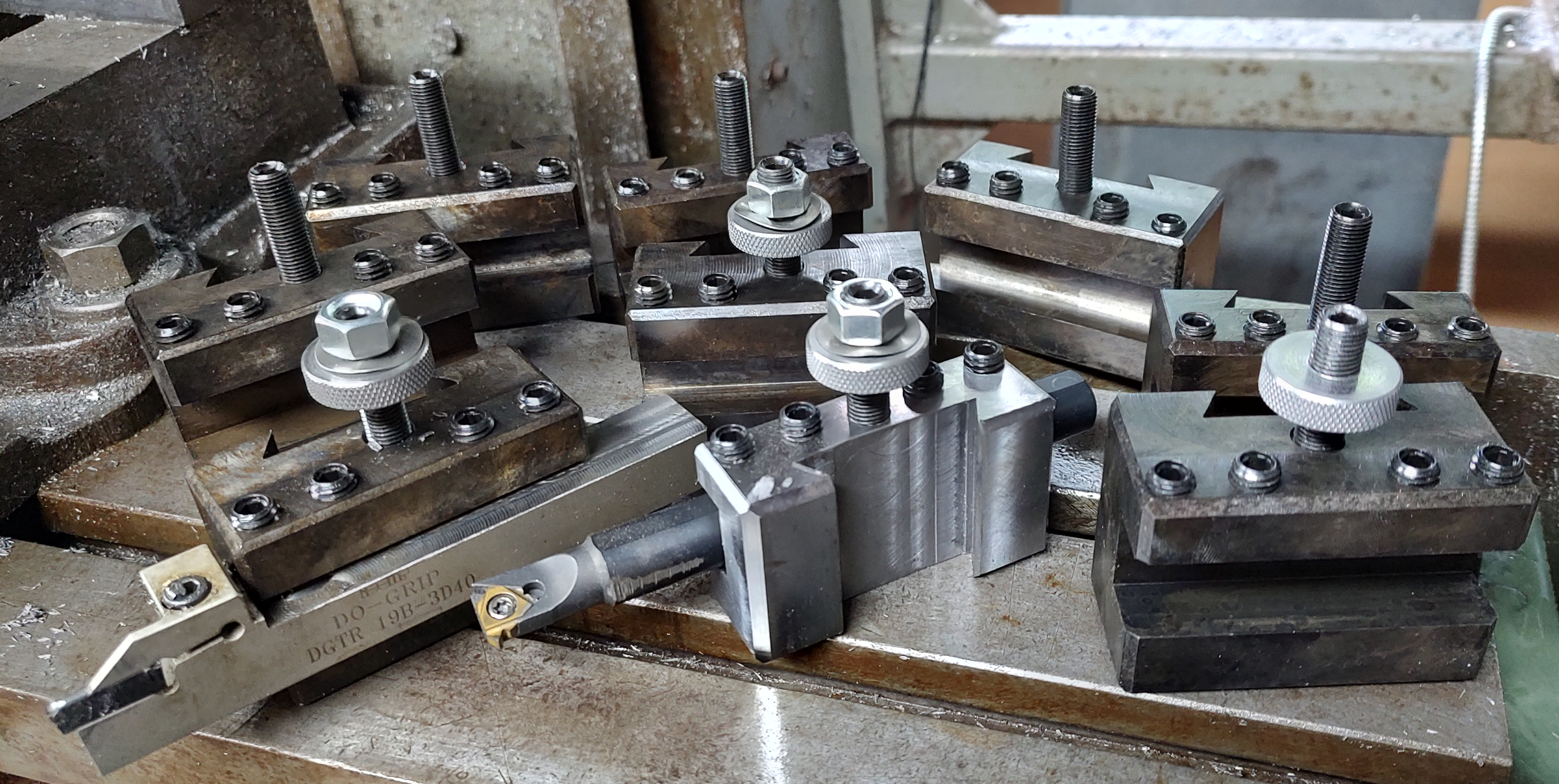
Yesterday, I finished the machining on the toolholder bodies. I need to make 5 adjustment nuts to complete the project. This means there are four toolholders that are good to go, as is.

Comedy of Errors

I do not think there is a single toolholder that is 100% right. There is the one where the tool in the collet grabbed it and chewed on the edges.

There are the three where I cut the dovetail 0.100 too deep.

There is the fact that the adjustment stud is too close to the dove tail. There are the edges where I missed the chamfer and have a ridge where there should be none.

Which takes us to

Hot Bluing

This was so much fun, not.

The formula that I used was 13 cups of water to 4 lbs of sodium hydroxide to 2 lbs of sodium nitrate. Bring to a boil, cook each piece of metal for 30 minutes. Rinse in hot tap water and then coat with WD40 or other oil.

First, I purchased a 5 qt stainless-steel pot to do this in. The stainless-steel handles were attached to the body of the pot with aluminum rivets. This formula will eat aluminum in short order.

Which it did. The pot sprung a leak and the boiling, caustic bluing mixture went everywhere.

I have more cleanup tomorrow to recover from that mess. That stuff started eating my hot plate.

As prep for each piece going in, I first deburred them all, used air to clean them, washed them in the parts washer, used air to dry them. Then Hagar cleaned them with acetone.

I don’t think we got them clean enough. We should have used more acetone and got them 100% oil free.

After they were cleaned, they were hung from spring wire in the pot for 30 minutes. Then rinsed under hot tap water for 2 or 3 minutes.

Finally, they were sprayed down with WD40. I then used a Scotch Bright(gray) to lightly rub the flash rust from them. The results are what you see.

I think they are beautiful. They are not that deep black I was looking for. They have a sort of case-hardened look to them.

Yes, one of them is still in the white. I forgot I had three machined, so it wasn’t processed into the pot.

Next time, I will clean each part better. I believe that the aluminum might have reduced the quality of the bluing solution.

We’ve put it all in a jug for use next time. I might have to remake it, making sure not to get any aluminum in the solution.

It is amazing watching aluminum bubbling away…

Matter of Law

matter of law

A matter of law, or question of law, is a determination of the applicable law as opposed to a matter of fact. Matter of law is seen in judgments as a matter of law where a judge makes a decision applying the relevant laws to irrefutable evidence.
[xCite item=”MFITNXA9″ pos=0]

Consider the “fruit of the poisoned tree”. Detective Billy-Bob is interrogating Jimmy. He asks Jimmy where the loot is hidden. Jimmy tells him.

At court, the defense argues that Jimmy was not afforded his constitutionally protected rights and the “confession”, the loot, the finding of the loot, and the finding of a body with the loot are all “fruit of the poisoned tree”.

As fruit of the poisoned tree, the evidence should be excluded.

This is not a question put to the jury. This is a question of law, or a matter of law. As a matter of law, it is the court’s responsibility to answer the question.

The court will evaluate the evidence and how it was acquired to determine if it should be excluded from the court.

When Jimmy was picked up, he was carrying a gun without the state’s permission. He is charged under state law of having a canceled weapon without state permission slips.

The defense, Jimmy, files a motion challenging the law requiring state permission slips to carry a gun as a facial challenge. This means that they think the law is unconstitutional in all cases. They argue, in the motion, that under Supreme Court case law, if a law or regulation implicates the plain text of the Second Amendment, the individual conduct is presumptively protected by the Second Amendment.

The lawyers say simply, “It involves a gun. He wants to bear it. That implicates the plain text of the Second Amendment. The state has the burden of showing a tradition of firearms regulations that is in keeping with this Nation’s historical traditions of firearm regulations.” (Sorry for the poor language.)

The court then issues his opinion. He is answering a matter of law. He says to the state, “The plain text is implicated. You now bear the burden to …”

The court then reads the motions, the replies, the counter replies, holds a hearing where the parties present/argue their standpoint.

The court then issues their opinion. If the court says the state failed to meet their burden, the charge is dropped. If the state met their burden, then the charge is kept.

Let’s say the court says that the law is constitutional. At trial, the state will present evidence that Jimmy was in possession of a firearm at a particular time, that he was not issued a permission slip and any other evidence they feel will convince the jury of the facts.

After both parties have presented their arguments, it is the court’s responsibility to tell the jury what facts they need to determine. After the jury has made their determinations of the matter of facts, they will mark their verdict.

So, the jury determines facts, the court determines law.

In the Hunter Bidden cast, I have not looked for the defense challenging Count III on constitutional grounds.

Jury Instructions

Having been following actual court cases for the last couple of years, I’ve figured out a few minor things.

One of the most important things is that most of the work in a court case is done outside the courtroom and before the first argument is uttered.

In the United States, a court can only hear a case where there is an active dispute. Each person involved in the case has a part to play.

When the case is heard, the rules will be interpreted and enforced by the judge. His job is to control what evidence is presented.

It is then the task of the jury to evaluate that evidence to determine the “truthfulness” of each piece of evidence, then to evaluate if that evidence proves beyond reasonable doubt that the defendant is guilty.

Which takes us to jury instructions. The jury instructions are the point at which the judge informs the jury of how to evaluate the evidence presented and what it takes to prove a charge.

Count I — False Statement in Purchase of a Firearm (18 U.S.C. 922(a)(6))

Count One charges that the defendant knowingly made a false statement in the purchase of a firearm, in violation of Title 18, United States Code, Section 922(a)(6).

To find the defendant guilty of this offense, you must find that the government proved each of the following four elements beyond a reasonable doubt:

First: The seller was a licensed dealer;

Second: That the defendant made a false statement while acquiring a firearm from the seller;

Third: That the defendant knew that the statement was false;

and

Fourth: That the false statement was intended or likely to deceive the seller with respect to any fact material to the lawfulness of the sale of the firearm.
[xCite item=”EVZM6AKI” pos=0]

There are only three elements that the jury is determining in count I. The parties stipulated that the seller was an FFL.

The second element is whether Hunter Biden was lied about being an Are you an unlawful user of, or addicted to, marijuana or any depressant, stimulant, narcotic drug, or any other controlled substance? — Form 4473 Q21(f). If the jury believes that Hunter was doing crack at the time he filled out the 4473, then he made a false statement.

The third element is whether Hunter knew he was lying. Yeah, that’s an easy one.

The fourth element asks if the lie was done to deceive the seller into selling the firearm in violation of 922(g).

The judge clarifies that the statement is “false” if it was untrue when it was made.

Count I is lying to the FFL. Count II is lying on the 4473. They are the same instructions but worded slightly differently.

Count III is of more interest to us:

To find the defendant guilty of this offense, you must find that the government proved each of the following four elements beyond a reasonable doubt:

First, the defendant was an unlawful user of a controlled substance or addicted to a controlled substance;

Second, the defendant knowingly possessed a firearm, that is a Colt Cobra 38SPL revolver with serial number RA 551363, while he was an unlawful user of a controlled substance or addicted to a controlled substance;

Third, at the time the defendant knowingly possessed the firearm, he knew he was an unlawful user of a controlled substance or addicted to a controlled substance; and

Fourth, the firearm was transported across a state line at some time during or before the defendant’s possession of it.
[xCite item=”EVZM6AKI” pos=1]

There is no mention in this set of instructions to consider if §922(g)(3) is unconstitutional. That question is a legal question and would be answered by the judge.

The parties stipulated to the firearm traveling across state lines.

Here is the unanimity section.

The indictment charges the defendant with being an unlawful user of a controlled substance or addicted to a controlled substance. The government is not required to prove both that he was an unlawful user of a controlled substance and addicted to a controlled substance. It is sufficient for the government to prove, beyond a reasonable doubt, that he was either an unlawful user of a controlled substance or addicted to a controlled substance.

Each of you must agree with the other jurors as to whether the defendant was an unlawful user of a controlled substance, or was addicted to controlled substances, or both. If you unanimously agree that he was either an unlawful user of a controlled substance, or was addicted to a controlled substance, or was both, and met the other elements as to the offense, you may find the defendant guilty. Unless each of you agree that the government has proven that he was either an unlawful user of a controlled substance or addicted to a controlled substance, then you must find the defendant not guilty.
[xCite item=”EVZM6AKI” pos=2]

This is where Donald Trump was screwed in the jury instructions. Here, the court states that the jury must agree unanimously that Hunter was an unlawful user of a controlled substance, OR the jury must agree unanimously that he was addicted to a controlled substance.

If they agree unanimously that he is an unlawful user AND addicted to a controlled substance, then he is both.

In the Trump jury instructions, the court said that there was no need to unanimously agree on a predicate crime. The jury just had to agree, unanimously, that there was A predict crime.

The jury found Hunter Bidden guilty of all three counts.

Tuesday Tunes

Well, they hung my brother before I could say
The tracks he saw while on his way
To Andy's house and back that night were mine
And his cheating wife had never left town
That's one body that'll never be found
You see little sister don't miss when she aims her gun

Washington v. Gator’s Guns, an update

Washington state has a rash of infringements happening. After the bills were signed into law, multiple suits were filed.

Those suits that were filed in the north, near the capitol, were heard in district court, The People lost, and the cases are on appeal with no end in sight (Ninth Circuit court)

The state went after a multitude of shops that were selling magazines and scary things. All of those cases were also heard in the northern state courts.

Now something interesting happened, a case was filed in the southern courts and The People won, sort of. They lost on appeal, if I recall correctly.

The state then attempted to pass legislation requiring that all state suits be filed in the capitol.

A small gun store in the southern part of the state in Cowlitz County called “Gator’s Guns” continued to sell “scary” things, and the state was upset at this flaunting of their infringement.

So they filed charges. But Cowlitz County is not Capitol City. The judge down there in Cowlitz County found for The People and issued a preliminary injunction enjoining the law. Meaning that people could buy “scary” things again.

83 minutes after that injunction was issued, a commissioner for the state supreme court stayed the injunction.

To understand how ridiculous this is, this implies that the commissioner read the entire order plus the request for a stay and made a reasoned response in 83 minutes.

I am a rapid reader, I don’t read that fast. Multiple lawyers have stated the same on YouTube, take it for what it is worth.

At oral arguments, the commissioner spent more time talking about himself and how he is an expert and was prepared for the stay by doing his research, that he was prepared when the request for a stay came in.

That stay is still in place.

This week the Washington state supreme court agreed to consider the case. This is the state equivalent of granting cert.

It is unlikely to be great news for The People, given how the commissioner acted. But it is going to happen.

Maybe Rahimi will issue before they hear the case, and they will learn something good from the Supreme Court.

The state supreme court is a court that is inferior to the US Supreme Court.

Lawfare and the Media

It was just announced that UPS and FedEx are being sued by the families of the victims who died in Uvalde. Yes, the shipping companies are being sued.

The goal is to make it as difficult to conduct business around firearms as possible. The claims are that these companies shipped “parts” to somebody that they should have known shouldn’t have these parts because they make scary guns scarier.

That is not the topic of today’s post. In trying to do research for the new case, I stumbled on a case from June 2023.

There was massive fanfare all through the media about how Daniel Defense, LLC, Oasis Outback, LLC and Firequest International, Inc were all being sued by some Uvalde families because an asshole did bad things with a product produced or sold by a third party.

It turns out that Daniel Defense had absolutely the best defense, they didn’t even bother to respond. Oasis Outback, the company that sold the firearm(?) to the asshole who did the shooting. Firequest also responded.

The gist? Both companies filed motions to dismiss for failure to state a claim. Hearings were held on December 1st, the court dismissed the suite on March 27th. Nine months of lawfare, taking money from people that did nothing wrong.

In one case, a thing which wasn’t a firearm was treated as if it was a firearm, and the seller should have predicted that an asshole was going to do a bad thing with that particular item.

Having lost there, they are no going back to the well, attempting to get UPS and FedEx to decide it is too risky to transport firearms or firearm accessories.

There are some reports that this is already affecting people.