Legal

You win some, You lose some

Today we heard a great opinion out of the Ninth Circuit Court of Appeals. They found that knives are arms. As arms, they are presumptively protected by the plain text of the Second Amendment. Finally, they found that the government had not met their burden of finding a law from the founding that supported their modern infringement.

There is another court ruling out today. This one out of the Supreme Court.

GARLAND, ATT’Y GEN., ET AL. V. VANDERSTOK, JENNIFER, ET AL.
The application for stay presented to Justice Alito and by him referred to the Court is granted. The June 30, 2023 order and July 5, 2023 judgment of the United States District Court for the Northern District of Texas, case No. 4:22-cv-691, insofar as they vacate the final rule of the Bureau of Alcohol, Tobacco, Firearms and Explosives, 87 Fed. Reg. 24652 (April 26, 2022), are stayed pending the disposition of the appeal in the United States Court of Appeals for the Fifth Circuit and disposition of a petition for a writ of certiorari, if such a writ is timely sought. Should certiorari be denied, this stay shall terminate automatically. In the event certiorari is granted, the stay shall terminate upon the sending down of the judgment of this Court.

Justice Thomas, Justice Alito, Justice Gorsuch, and Justice Kavanaugh would deny the application for stay.

There will be a great gnashing of teeth over this. It affects many people, it isn’t great, but it isn’t horrible either.

In late June and early July, the District court found the ATF’s frame and receiver rule to be a violation of law, NOT on Second Amendment grounds. The ruling basically said, “The ATF can’t make law, this “regulation” is them attempting to re-write the law. If Congress wants the law to be as the ATF wants it to be, Congress has to pass that bill.”

Currently, gun control bills in the Congress are fraught with risk for both sides. The gun grabbers do NOT want people looking hard at §921 and exactly what the GCA of 1968, as amended, is worded. §922 is under attack in multiple cases, having somebody challenge the rest of the GCA on constitutional grounds is not something that they want to see happen.

The state had asked the Fifth Circuit for a stay of the injunction granted by the District Court. The state was asking for a stay until the Fifth Circuit heard the case. The Fifth Circuit told them to go pound sand. The state then made an emergency appeal to the Supreme Court looking for that stay.

Normally, these are quick. This took a little longer than Alito wanted.

What this means is that the frame and receiver rule is back until the Fifth Circuit renders their opinion. It looks like that could happen rapidly. The Fifth doesn’t like having their decisions overturned.

It is important to note that the Supreme Court did not rebuke the Fifth. Unlike what was done to the Second and Seventh circuits.

Now the state will drag their heels on this. The 3 judge panel will issue their findings. Regardless of how that goes, the losing party will ask for an en banc hearing. That will happen. If the Vanderstok loses, they will appeal. Their goal has always been to get this to the Supreme Court.

If the state loses, they might just tuck tail and take the L rather than get the Supreme Court involved.

So while this was a step back, I consider it an “ok” outcome. We will win in the end.

On the “Well, that’s to be expected.” Roberts came down on the side of the state. There is nothing strange about that. I just don’t trust him.

I would like to know what Amy Coney Barrett was thinking. She didn’t join with Thomas, Alito, Gorsuch, and Kavanaugh.
§922(g) needs to go away

It is getting bad inside my brain. A couple of articles went past my feeds talking about an arms seizure in MA and straw purchases. I started reading and immediately went to my court sources to get the actual court documents. Rather than trusting what the reporter had to say.

Weapons seizure uncovered Holyoke family’s love affair with illegally obtained firearms [xCite item=”4RIEKL8F” pos=0]

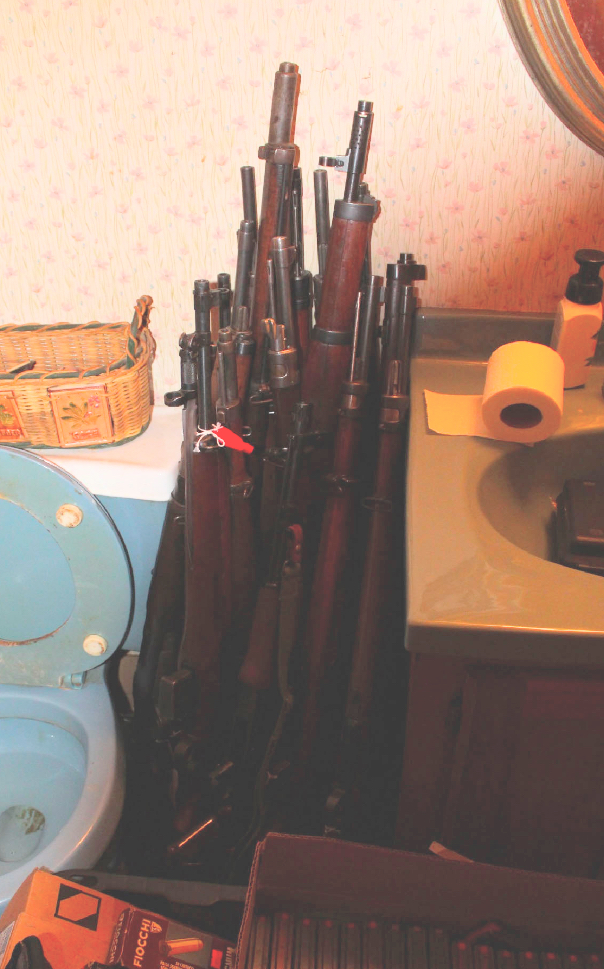
It is a shitty picture of some lovely old weapons. I haven’t even attempted to identify any of them.

The box of stripper clips in the foreground is nice, the pile of magazines in the sink is interesting. I would be happy to take all of those off his hands.

Public personas aside, the Augustos stand accused in both federal and state courts for amassing a stockpile of guns ranging from World War II models to semi-automatic rifles and an Uzi. The elder Augusto is not legally authorized to possess any of them due to an old criminal conviction, a lawyer in the case says.
[xCite item=”4RIEKL8F” pos=1]

I’ll spare you the search, the Uzi they are referring to is a semi-auto version. There are no NFA items in the collection.

As always, the reporter is trying to induce a panic. Was this a large collection? Yes. If this was in a free state, the actual collection would not have been an issue. In MA, it is unlikely that they had registered all those firearms. Much less the magazines and ammo.

The nature and circumstances of the offense are serious, but include mitigating factors that weigh in favor of the requested below-Guidelines sentence. See 18 U.S.C. § 3553(a)(1). The offense is serious in that it enabled his father, Daniel A. Augusto, Jr., to add to his vast arsenal of hundreds of firearms, ammunition magazines, rounds of ammunition, firearms manufacturing equipment, and firearms paraphernalia. (D.3, at ¶ 5). As even the defendant conceded during his second interview with the Bureau of Alcohol, Tobacco, Firearms, and Explosives (“ATF”), many of the firearms were located outside the safes throughout the house because “it honestly got to the point where there was no room in the safes, so stuff just started going everywhere.” (D.3, ¶ 12(d)).
[xCite item=”UKRUHGEW” p=3 pos=2]

English is tricky. Were there hundreds of firearms? Were there hundreds of magazines? Were there hundreds of rounds of ammunition? Or did they just lump them all together to get scary numbers? The statement made in the court filing was that there were more than a dozen semi-automatic rifles … in one of the bathrooms …[xCite item=”UKRUHGEW” pos=3]

The state is attempting to make it sound horrible, they are attacking this man for not having all of his guns in safes.

… obsessively collected firearms to the point that they could not store them safely.[xCite item=”UKRUHGEW” pos=4]

Right now, there are two loaded pistols and a dozen loaded rifles within feet of me that would not be considered “safely stored” in MA. If I still had the grandkid coming over, I’d store some of them differently.
Against this dangerous backdrop, two factors mitigate the defendant’s offense: first, he conducted all of his straw purchases for his father, rather than a stranger; and second, he did not benefit monetarily.
[xCite item=”UKRUHGEW” p=6 pos=5]

I didn’t know there was a “not for money” clause in the don’t buy guns for others.

… the defendant has recognized that his offenses were serious; they contributed to a highly dangerous situation inside his home; and he is better off never possessing firearms or ammunition again.
[xCite item=”UKRUHGEW” p=6 pos=6]

This man is going to lose his Second Amendment protected rights because the government is infringing on his father’s Second Amendment protected rights.

I didn’t find what the father was convicted of doing that made him a prohibited person. It is pretty obvious that he has not been doing evil in a long time.

I’m watching the §922(g) cases wind their way to the Supreme Court. I believe that the court is going to spank the government hard. In Heller, in the dicta, they indicated that §922(g) was presumed to be constitutional. They didn’t clarify that “presumed” means, “We didn’t look at it. That is a question for another day.”

There is no historical regulation nor tradition of stripping The People of their right to keep and bear arms because they are not virtuous people. That is what §922(g) does.

This is just an example of how there are intended consequences.

Of note, I’ve not seen a single story come across my feeds of a person being convicted of straw purchases that was a bad person.

Maybe that’s because they are either getting a sweetheart deal OR they are getting so stitched up that they didn’t stack the federal gun crime on top.

Hanson v. D.C. (ammunition feeding device ban) – Updated

B.L.U.F. Another District Judge gets it wrong because they are another rogue judge.

Somehow, I managed to analyze this case twice. The first was back in April. The quoting is better, the references/citations are better. The snark is about the same. I believe it suggests that I’m getting a little better at this.

The first thing we notice is that judge Rudolph Contreras uses the Ocean State Tactical v. Rhode Island to get his definitions. When a multiple-round device like an LCM is attached, a handgun becomes a ‘semiautomatic’ weapon, meaning that it is capable of rapidly firing several bullets, one right after another.[xCite item=”Q7FCDJKN” p=”2-3″ pos=0] quoting the judge in Ocean State Tactical.

He also plays the language game. The law talks about “ammunition feeding devices”. He switches to “magazine” and once there talks about them as simple boxes. This is precisely the issue that the recent briefing to the Supreme Court addressed. By using the term “ammunition feeding device” throughout their brief, they make a solid case for why it is an arm and not just a box.

The good news is that the plaintiffs (good guys) did establish standing. All the plaintiffs have licenses to carry in D.C. All of them declared that but for the regulation, they would carry ammunition feed devices capable of holding more than 10 rounds. And some of them attempted to register firearms and were denied because the feed devices were “too big”.

Here we start to see the thumb on the scale On December 1, 2022, the Court permitted three nonprofit organizations, Brady, Gifford Law Center to Prevent Gun Violence, and March for our Lives to jointly submit an amicus brief in support of the District.[xCite item=”Q7FCDJKN” p=4 pos=1]. I have yet to find a 2A case where these groups don’t have their grubby fingers in there, pounding the table and attempting emotional blackmail.

Playing Stupid

Read More

O.F.F. v. Brown, Judges Opinion Pt. 2

B.L.U.F.More of analysis of the horrid opinion offered by Judge Karin Immergut out in Oregon.

I’ve since learned that she spent most of her career, before becoming a district judge, working as a prosecutor for the government. She was actually a prosecutor for the ATF. OF course, she found a gun infringement constitutional.


It is pretty clear that the judge was picking and choosing experts, facts, and testimony to get the conclusion she wanted. This is clear from the following:

Plaintiffs offered the chart as an industry report through the testimony of Salam Fatohi, who serves as the Director of Research at the National Shooting Sports Foundation (“NSSF”). Tr. 6/6/2023 356:4–5. Although this Court received the chart in evidence, see Ex. 33 at 7, in assessing the weight and credibility to give Mr. Fatohi’s testimony, this Court notes that the NSSF is a plaintiff in this case and has been a plaintiff in several Second Amendment challenges to firearms regulations. The NSSF is a firearm and industry trade association which advocates for the firearm and ammunition industry. NSSF members have a significant financial interest in the outcome of this case.
[xCite item=”FHMK3ZW8″ n=18 pos=0]

The EVIL gun lobby wants this, we can’t accept their testimony. How about the fact that Everytown, Brady, and a dozen other groups all pile on when there is a Second Amendment Case? Should their testimony be discounted because they have been a plaintiff in several Second Amendment challenges? Maybe the judge should disallow Paul Clement from representing Second Amendment plaintiffs because he’s been involved with several Second Amendment challenges?

Does she really think that all these anti-gun people don’t make money from litigating? I’ve looked at some of the tax filings for some of these groups, they seem to spend significant amounts of money on the administrative and executive salaries.

Nevertheless, based on the parties’ pretrial stipulation, this Court finds that millions of Americans today own LCMs. But this Court also finds that the number of LCMs possessed by Americans is influenced to some degree by whether a firearms manufacturer sells a particular model of firearm standard with an LCM, and whether that firearm is sold standard with more than one LCM. Tr. 6/5/2023 44:16–19; 67:6–17.
[xCite item=”FHMK3ZW8″ p=25 pos=1]

What is she talking about? That most people don’t buy extra magazines for their firearms? Technically, I guess that is true. My M1 Garand came with zero enblocs. I think I have over 50 of them now. All but a few loaded. My PC-9 came with one magazine. I’ve never even loaded it. I purchased 6 Glock magazines to feed it, and then purchased a Glock with a couple of magazines.

My first AR-15 came with two magazines. One was 5 rounds and the other 10. None of the other AR-15s came with magazines. I don’t know how many magazines I currently have. I still have one 5 round mag, and one 10 round magazine. I do have a few 20 round mags, but most of my magazines are 30 rounds.

It does not matter why The People decide to purchase extra magazines or if they just use the magazine(s) that come with their guns. They have decided that ammunition feeding devices with more than 1, 5, 7, 9, 10, or 15 rounds is what they want, those purchases are protected under the Second Amendment.

Plaintiffs offered only limited anecdotal evidence of LCMs actually being used in self-defense. Mr. Ayoob described an incident in which a law enforcement officer fired thirty-three rounds in pursuit of an armed bank robber. Tr. 5/30/2023 39:24–40:16. On cross-examination, Mr. Ayoob also testified about an incident in which two individuals fired nine and three rounds, respectively, at an armed intruder. Tr. 5/30/2023 56:16–57:14. On re-direct, Mr. Ayoob testified to two other incidents with civilians firing more than ten rounds in self-defense: two brothers who owned a jewelry store and fired between thirty and forty rounds to stop an attempted robbery, and one gun shop owner who used an M16-rifle and a sub-machine gun to stop an attempted robbery. Tr. 5/30/2023 95:15–96:13.
[xCite item=”FHMK3ZW8″ p=26 pos=2]

The judge is incorrect in how she categorizes these anecdotal incidents. They are examples of people using their arms to actively defend themselves. They were using those arms for lawful purposes, such as self-defense, by possessing them. They prove The People chose these arms in common use today for lawful purposes.

Conclusion

I’m now behind the curve, here are a couple of YouTube videos that go into just how bad this opinion is.

I might come back to this, but with multiple issues with the k8s cluster resulting in a full day of ClusterFuck and then another 30 minutes of minor CF today. I have not had time to do any more wading through this swamp.


Oregon Firearms Federation, Inc. v. Brown, Judges Opinion

The Judge Said What?

B.L.U.F. An analysis of the horrible opinion out of Oregon where the district Judge decided that arms aren’t covered under the Second Amendment and that there is a history and tradition of requiring government approval before you can exercise your Second Amendment protected rights.

This opinion is 122 pages long. This is not a complete analysis. I don’t think I can stomach that much muck.

Inserted a title and added a “more” block to take the text-wall off the front page


When I originally looked at Judge Karin Immergut, I was hoping for better from her. She was appointed by President Trump. Unfortunately, it appears that her time in liberal cesspools has corrupted her judgement. She has degrees from the University of California, Berkeley, Amherst College, and UC Berkeley School of Law. To say that she was educated in leftest incubator schools is a fair statement.

The Question

Before this Court are two core questions: (1) can the State of Oregon limit the number of bullets to ten, that a law-abiding citizen can fire without reloading; and (2) can the State of Oregon require firearm purchasers to obtain a permit, which imposes various requirements, including a completed background check, safety training, and consideration of mental health status, before purchasing a firearm. After a weeklong bench trial, this Court concludes that the answer to each of these questions is yes. Accordingly, Oregon Ballot Measure 114 is constitutional.
[xCite item=”FHMK3ZW8″ p=”6″ pos=0]

This is a horrible statement of the actual questions in the case. 1) Is banning ammunition feeding devices based on characteristics in violation of the Second Amendment protected rights? 2) Is requiring a member of The People to get state approval before they are allowed to purchase constitutional?

Even with her horrid wording, she should not have been able to find that BM114 is constitutional.

Holding

As explained below, Plaintiffs have not shown that the Second Amendment protects large-capacity magazines, defined as magazines capable of firing eleven or more rounds without reloading.
[xCite item=”FHMK3ZW8″ p=6 pos=1]

I’ll use the words of Paul Clement et al.:

Just last year, the Supreme Court confirmed once and for all that “the Second Amendment protects the possession and use of weapons that are ‘in common use.’” N.Y. State Rifle & Pistol Ass’n, Inc. v. Bruen, 142 S.Ct. 2111, 2128 (2022) (quoting District of Columbia v. Heller, 554 U.S. 570, 627 (2008)). Rather than respect that clear teaching, Rhode Island veered far in the opposite direction, banning all devices that feed ammunition into semiautomatic firearms and are “capable of holding … more than ten (10) rounds,” R.I. Gen. Laws §11-47.1-2(2), -3(b)(1)(i), even though tens of millions of Americans own hundreds of millions of those devices as integral components of the firearms they keep and bear for self-defense. Under a straightforward application of Bruen, HB6614 is profoundly out of step with our nation’s history of firearm regulation and a violation of the Second Amendment.
[xCite item=”MPSB5CX2″ p=1 pos=2]

She even messes up Supreme Court dicta This Court also finds that the text of Oregon’s permit-to-purchase framework is consistent with the type of regulation that the United States Supreme Court has deemed constitutional under the Second Amendment[xCite item=”FHMK3ZW8″ p=6 pos=3]. The Supreme Court never said that any permitting scheme is constitutional, only that shall issue states are assumed to be constitutional.

The court then went forth and said, “If you get a 2A case, look to the plain text, history and tradition to make your ruling. That means …”

We should not have been surprised because she granted Oregon Alliance for Gun Safety’s motion to intervene based on Federal Rule 24 of Civil Procedures, 24(b).

(b) Permissive Intervention.
(1) In General. On timely motion, the court may permit anyone to intervene who:
(A) is given a conditional right to intervene by a federal statute; or
(B) has a claim or defense that shares with the main action a common question of law or fact.
[xCite item=”SZWBSMHX” pos=4]

I believe that she is referring to 24(b)1(B) has a claim or defense that shares with the main action a common question of law or fact the Oregon Alliance for Gun Safety is an anti-gun group that uses emotional blackmail constantly.
Read More

Ocean State Tactical, LLC v. State of Rhode Island Reply Brief


B.L.U.F.We took a look at the bad guy’s arguments via Everytown earlier this week. Today we look at the reply brief submitted by the appellants/plaintiffs (good guys).


There is a huge issue that the good guys have to overcome in these cases, getting the Court to do their job. If you look at the plain text of the Second Amendment, is the proposed conduct implicated? If so, the conduct is presumptively protected under the Second Amendment.

The state is doing all in their power to make this first step as difficult as possible. As we observed in the Everytown brief, they don’t have any historical regulations to support their infringements. Because they don’t have the history nor the tradition, they desperately want to stop cases from getting to that point.

There is an old legal aphorism, “If you have the facts on your side, pound the facts. If you have the law on your side, pound the law. If you have neither on your side, pound the table.”

When I write about “emotional blackmail”, I’m discussing how the state is pounding the table. They don’t have facts on their side, they don’t have the law on their side. They pound the table in frustration, begging the court to give them just a little inch.

What this means, at a tactical level, is that the lawsuit almost all say “It is a regulation of conduct that is protected under the Second Amendment. Grant us an injunction stopping it.” The state then gets to do the song and dance “welllllll, it isn’t actually an arm. It doesn’t go boom boom.”. Or they try and say that as long as they allow you this arm, they don’t have to allow you that arm. All of this is just bonkers when the plain text is used.

Introduction

The plaintiffs start their response:

Just last year, the Supreme Court confirmed once and for all that “the Second Amendment protects the possession and use of weapons that are ‘in common use.’” N.Y. State Rifle & Pistol Ass’n, Inc. v. Bruen, 142 S.Ct. 2111, 2128 (2022) (quoting District of Columbia v. Heller, 554 U.S. 570, 627 (2008)). Rather than respect that clear teaching, Rhode Island veered far in the opposite direction, banning all devices that feed ammunition into semiautomatic firearms and are “capable of holding … more than ten (10) rounds,” R.I. Gen. Laws §11-47.1-2(2), -3(b)(1)(i), even though tens of millions of Americans own hundreds of millions of those devices as integral components of the firearms they keep and bear for self-defense. Under a straightforward application of Bruen, HB6614 is profoundly out of step with our nation’s history of firearm regulation and a violation of the Second Amendment.
[xCite item=”MPSB5CX2″ p=”1″ pos=0]

My lady has a difficult time answering simple questions. “Are you done with your homework?”. Reply: “Sort of, I’ve been working on it for hours. The …(172 words later) so I’m still working on it.” “Thank you, are you done with your homework?” “I just told you.” “No, you didn’t. You said many things in response to a yes, no answer without ever actually answering the question.”

The state is much like that. They don’t actually answer the question presented and instead talk about this or that. The plaintiffs (good guys) can’t force the state to answer. Only the Court can do that. If the state doesn’t answer the court, then the court can treat that none-response as meaningful.

In an effort to salvage HB6614, the state asks this Court to ignore what the Supreme Court has repeatedly identified as “the Second Amendment’s definition of ‘arms,’” Bruen, 142 S.Ct. at 2132, in favor of a definition more to its liking. The state asks this Court to pretend that people do not “use” their firearms when they keep and carry them for self-defense, even though the Supreme Court has explicitly defined the Second Amendment right as a right to “be[] armed and ready for offensive or defensive action,” id. at 2134, not just to fire at would-be attackers. …
[xCite item=”MPSB5CX2″ p=”1″ pos=1]

Exactly what we have been saying. I’m pleased that this reply has stated it so clearly. I expect to use this in the future.

These guys really hammer the state: “Pretend”, “fiction”, “deny Bruen“, “ignore what the Supreme Court”. This is polite lawyer talk for “the state is a lying sack of flaming dog poo”.

HB6614 Violates The Second Amendment

Read More

Ocean State Tactical, LLC v. State of Rhode Island (1st Cir)


B.L.U.F.Looking at another amicus brief by Everytown. Since they are consistently filing briefs in all these Second Amendment cases, it behooves us to see what they are saying.

I came back to add this text. You might get angry with Everytown over this brief. Regardless, they did a good job. Their arguments are self-consistent. They take a stand, then hammer the point home. Their goal isn’t to necessarily win these cases, but to give the court something to hang a bad decision upon.


Everytown is now the overarching group for “Moms Demand”, “Mayors Against Illegal Guns”, It looks like they are claiming “March for our lives” but they don’t do so by name. They claim to have nearly ten million “supporters” with nearly 10,000 of those “supporters” in Rhode Island. Make not that “supporters” are not “members”

For the tax year 2020 they had total revenue of $20,492,640. $20,288,442 of that was from contributions. They reported expenses of $52,280,883 for a net lose of $31,788,243. The largest listed expense is $11,390,489 for other salaries and wages and around $500,000 for the Executives and fundraising. I could not find a “members” number. They only speak in nebulous terms, which could mean anything from a person going around knocking on doors, to the mom that dropped a five dollar bill in their begging hat.

Using the standard modification of language, they claim [Everytown] is the nation’s largest gun-violence-prevention organization, with nearly ten million supporters across the country, including nearly 40,000 in Rhode Island.[xCite item=”RIK53V58″ pos=0]

Argument Summary

Rhode Island’s large-capacity magazine restriction is constitutional under the approach to Second Amendment cases established in New York State Rifle & Pistol Ass’n v. Bruen, 142 S. Ct. 2111 (2022), for the reasons set out in the State’s
brief, Dkt. 00118022922 (“State Br.”). Everytown submits this amicus brief to expand on three methodological points. First, on the initial, textual inquiry of the Bruen framework, Plaintiffs have the burden to establish that large-capacity magazines are protected “arms” within the meaning of the Second Amendment, and they have not met that burden. Second, in applying the historical inquiry of the Bruen framework—asking whether the regulation is “consistent with the Nation’s historical tradition of firearm regulation,” 142 S. Ct. at 2130—the Court should center its analysis on 1868, when the Fourteenth Amendment was ratified. Moreover, 1868 is not a cutoff; examining “legal and other sources to determine the public understanding of a legal text in the period after its enactment or ratification” is also “a critical tool of constitutional interpretation.” District of Columbia v. Heller, 554 U.S. 570, 605 (2008) (second emphasis added). And, as Bruen instructs, this is particularly so where, as here, the challenged law implicates “unprecedented societal concerns or dramatic technological changes.” 142 S. Ct. at 2132. Third, Bruen’s analysis reveals that a small number of laws can be sufficient to establish this nation’s tradition of firearm regulation, at least so long as there is not overwhelming affirmative evidence of an enduring tradition to the contrary. Although not directly implicated here, given the robust historical record before the Court, we highlight that point in case the Court chooses to address it.
[xCite item=”RIK53V58″ p=3 pos=1]

This is pretty clear. The first thing they do is argue that magazines are not arms. More, they place that burden on the plaintiffs (good guys). In many of the infringing cases, we see the state argue this. “AR-15s aren’t arms”, “Big magazines aren’t arms”, “Sawed off shotguns aren’t arms”, but a hunk-o-alumninum is an arm, a plastic stock is a machine gun as is a shoelace.

The second thing is, they argue that the court should look at 1868 as the date to understand what the Second Amendment means. We have discussed this in previous posts. The date of the 14th amendment’s ratification is the date at which 3/4s of the states agreed to accept the Bill of Rights as it was understood in 1791.

They did not redefine the meaning of the Second Amendment in 1868. They affirmed that they accepted it as it was understood in 1791.

Their final argument is that there has been “unprecedented societal concerns or dramatic technological changes” which means that they don’t have to match historical regulations as closely.

The last two arguments are very telling. It means that the state and state operators, such as Everytown, understand that there are no good matches to laws in the founding era. Since there are no good matches, they need to either change the time period or they need to open up what “a good match” means.

They also make the claim that a small number of laws will provide a “tradition and history” of analogous regulations. They are begging for the court to give them as much leeway as possible.

Plaintiffs Have Not Met Their Burden To Establish that the Second Amendment’s Plain Text Covers Their Conduct

Read More

5th Cir. vs 7th Cir., oral arguments

I admit the reason I bothered to do the transcription for this case is because I was playing with my tools. I’m to the point where I am either going to have to learn more, write my own, and learn enough about deep learning and AI training to be able to get the results I want.

Just to give you an idea of where all of these sit, three separate “AI”s worked to produce the video and transcript.

The first one is used to convert speech to sound. It is trained on around 680,000 hours of audio data. On my system, it runs at either 1:10 if I use the large data set and at about 8:1 if I use the small data set. The small data set runs on my GPU. The large does not.

The second AI is tasked with segmenting the audio. That is, it listens to the audio and finds where there is speech and where there is not speech. It can go further and detect that the speech is different. This has nothing to do with turning sounds into words nor in identifying the speakers, just labeling the audio for the next “AI”.

The third AI further segments the audio by speaker. It then clusters the different segments and assigns them a label. These labels correspond to individual speakers.

Finally, the NI (natural intelligence) uses inferences to determine the name of the person who is associated with each speaker.

The audio recording has some of the audio missing from the front.
Read More

Bevis v. Naperville (7th Cir.) oral arguments, analysis


B.L.U.F. An examination of how judges act and how to read the tea-leaves. Also, the sorts of ridiculous things that are said and don’t get rebutted.


The head judge is Frank Easterbrook. He has a history of dumping on the Second Amendment at every chance he can. He is the judge who got means-end into the 7th circuit court.

All quotes are from the machine created transcript, with edits by me. I will only be adding the speaker to the quotes.

present argument on issues raised in their briefing, such as historical analogs like gunpowder restrictions and other issues related to the scope of the Second Amendment. — Hunger

Here we see that she is off to a great start, banning modern sporting rifles and standard capacity magazines is exactly like fire codes from the founding era.

We know from Bruen that courts must begin by assessing whether the regulated instrument is protected by the plain text of the Second Amendment — Hunger. Nope, it is if the conduct is protected by the plain text. She is twisting words here.

The instruments must be arms. They must be bearable, and they must be in common use for self-defense. The instruments at issue here do not satisfy that standard for at least two reasons. First, large capacity magazines are not arms. They are accessories that are not necessary to the operation of any firearm. — Hunger.

We see the standard twisting from “in common use for lawful purposes” into “in common use for self-defense”, no surprise there.

Of course, the Supreme Court has issued an opinion saying that ammunition and magazines are indeed arms.
Read More

Roberrt Bevis v. City of Naperville (7th Cir.)

This is the oral arguments for the above case. This is an AW/LCM ban case.

I hope you don’t have high blood pressure. I’m going to be reading this tomorrow and figuring out what some of the dumbest things said were.

Case argued by Erin Murphy for Amicus Curiae National Shooting Sports Foundation, Inc. and Ms. Sarah A. Hunger for Appellee State of Illinois in 23-1353, Gilbert Dickey for Appellant Javier Herrera, Ms. Sarah A. Hunger for Appellees Brendan F. Kelly and Kwame Raoul and Jessica M. Scheller for Appellees Toni Preckwinkle and Cook County, Illinois in 23-1793, Ms. Sarah A. Hunger for Appellants Brendan F. Kelly and Kwame Raoul and Erin Murphy for Appellees Caleb Barnett, Brian Norman, Hood’s Guns & More, Pro Gun and Indoor Range and National Shooting Sports Foundation, Inc. in 23-1825, Attorney Mr. Thomas G. Maag for Appellees Jeremy W. Langley, Timothy B. Jones and Matthew Wilson in 23-1827. [157] [7320281] [23-1353, 23-1825, 23-1793, 23-1826, 23-1827, 23-1828] (KRA)

Case heard and taken under advisement by panel: Frank H. Easterbrook, Circuit Judge; Diane P. Wood, Circuit Judge and Michael B. Brennan, Circuit Judge. [156] [7320278] [23-1353, 23-1825, 23-1793, 23-1826, 23-1827, 23-1828] (KRA)
Robert Bevis v. City of Naperville, 23-1353, (7th Cir.)


Read More