Rant

Rocky Mountain Gun Owners v. Polis, rogue Court
Legal Court Dunce
B.L.U.F.
Another day, another rogue inferior court scratching for anything that allows them to upload an infringement.

This time it is a CO law requiring a waiting period before taking possession of a legally purchased firearm. The mental gymnastics this Jimmy Carter appointee goes through would make Mary Lou Retton jealous.
(1250 words)


After examining the language of the Second Amendment using the Supreme Court’s analysis in Heller, I find, for the purposes of Plaintiffs’ Motion, that the plain text does not cover the waiting period required by the Act. This conclusion is bolstered by the fact that the Act is a regulation on the commercial sale of firearms and thus is presumptively permissible. However, even if the waiting period implicated the plain text of the Second Amendment, the evidence before me establishes that the Act is consistent with the Nation’s historical tradition of firearm regulation. Plaintiffs, therefore, have not carried their burden to show they are likely to succeed on the merits of their claims.
[xCite item=”MA9NPEB9″ p=13 pos=0]
I have read, or remember reading, that the Supreme Court has issued an opinion on acquiring, purchasing, or selling firearms. It might have had to do with ammunition as well. If anybody can give me a citation to case law regarding acquiring firearms or ammunition by The People, I would greatly appreciate it.
From this reading of the plain text, it is clear the relevant conduct impacted by the waiting period—the receipt of a paid-for firearm without delay—is not covered. Still, Plaintiffs attempt to equate the words “obtain” and “possess.” Reply in Supp. of Mot. for Prelim. Inj., ECF No. 21 at 11 (“The Second Amendment’s plain text applies to ‘an individual’s conduct’ of obtaining a firearm. See Bruen, 142 S. Ct. at 2134 (‘[T]he “textual elements” of the Second Amendment’s operative clause—“the right of the people to keep and bear Arms, shall not be infringed”—guarantee[s] the individual right to possess and carry weapons in case of confrontation.’) (emphasis added, cleaned up).”). But these terms are not equivalent. To “keep,” under the definitions provided in Heller, meant to retain an object one already possessed. It did not mean to receive a newly paid-for item, and it certainly did not mean to receive that item without delay. Likewise, “hav[ing] weapons” indicates the weapons are already in one’s possession, not that one is receiving them.
[xCite item=”MA9NPEB9″ p=15 pos=1]

The court profoundly erred in their reading of Heller and Bruen. The first step is to determine if the conduct proposed implicates the plain text of the Second Amendment.

We turn to the phrases “keep arms” and “bear arms.” Johnson defined “keep” as, most relevantly, “[t]o retain; not to lose,” and “[t]o have in custody.” Johnson 1095. Webster defined it as “[t]o hold; to retain in one’s power or possession.” No party has apprised us of an idiomatic meaning of “keep Arms.” Thus, the most natural reading of “keep Arms” in the Second Amendment is to “have weapons.”
[xCite item=”LPGQXCDT” p=2792 pos=2]

To “have weapons” is the conduct that the plaintiffs (good guys) wish to do. To refute this frivolous argument on the part of this inferior, rogue court, all one needs to do is extend the waiting period from 3 days to 3 years.

Would a waiting period of three years implicate the Second Amendment’s protected right of “keeping”, “possession” or “having” arms? Yes, it would.

Thus, the conduct implicates the plain text of the Second Amendment.

Once the Second Amendment is implicated, the conduct is presumptively constitutional and the modern-day regulation is presumptively unconstitutional and should be vacated.

One of the things we keep discussing is the fight to keep Second Amendment challenges in the legal realm. There is no need for history professors or experts in what the founding fathers wanted or thought. All that is required is an examination of the regulations of the time.

The Government merely needs to bring regulations from the founding era that are a match for the state’s modern regulations to the attention of the court. If they can do that, they will win.

Today, I might have to order a firearm from my LGS. I might have to wait for it to arrive. Or I can choose from something in stock and walk home with it. Professors Spitzer and Roth gave their expert opinion that a three-day waiting period was to be expected in the founding era because people couldn’t just buy the firearm they wanted.

This is irrelevant. If I want a Serbu BFG-50, it will have to wait for it to be made. It will take a few weeks. So what? I can still buy other firearms right now if I wanted it.

This is why the battle of the “experts” is not allowed under Heller and Bruen.

The judge then says that all the case law showing that acquiring a firearm is protected by the Second Amendment is no longer good case law. “Because they happened before Bruen and didn’t examine the plain text”. Of course, he fails to note that the actual methodology was put in place with Heller in 2008, so all those cases after 2008 are good case law IF they followed Heller. I.e., didn’t use means-end.

This judge should be impeached. The Supreme Court ordered the inferior courts to look first at the plain text of the Second Amendment. If the conduct implicated the Second Amendment, the state had the burden to bring forth a history and tradition of regulations that are analogous to the modern regulations.

Because, as the parties agree, no law requiring a waiting period was enacted in the United States until 1923, I must consider “whether ‘historical precedent’ from before, during, and even after the founding evinces a comparable tradition of regulation.” Bruen, 142 S. Ct. at 2131-32 (quoting Heller, 554 U.S. at 631). Bruen explained this inquiry as follows:
[xCite item=”MA9NPEB9″ p-23 pos=3]

First, he says that purchasing a firearm doesn’t implicate the plain text of the Second Amendment. Then he says that since the state can’t show a history of regulations requiring waiting-periods, he is going to look for a tradition of waiting periods.

Since the Waiting-Period Law is a “modern regulation[] that w[as] unimaginable at the founding,” I must reason by analogy and “determin[e] whether a historical regulation is a proper analogue” for, or “relevantly similar” to, the Act. Bruen, 142 S. Ct. at 2133. In doing so, I focus on “how and why the regulations burden a law-abiding citizen’s right to armed self-defense,” and look for a “historical analogue”—not a “twin.” Id. The Governor and Professor Spitzer point to two types of historical analogues: laws involving intoxicated persons and licensing regimes.
[xCite item=”MA9NPEB9″ p=30 pos=4]

This means that there wasn’t a founding era regulation for waiting periods. The fact that society, as a whole, didn’t have the same level of instant gratification as today, doesn’t mean that waiting periods can be forced today.

The judge relies on the Spitzer declaration of laws from 1623, 1631, 1632, 1655, 1868, 1878, 1883, 1879, 1888, and 1893 regulating possession of firearms by intoxicated purposes to justify a waiting period. Please note the era that is missing from that list of dates. That’s right, nothing from the founding era.

Because this is a request for a preliminary injunction, the Winter factors are being analyzed. That is to say, the likelihood of success on the merits, irreparable harm, balance of equity, and public interest. If the challenge involves the deprivation of a core civil right, irreparable harm is done. If the court finds that it doesn’t involve a core civil right, they can use other means to decide on the level of harm.

In the same way, once the court decides the constitution doesn’t apply, they can balance the equities in favor of the state and use “good enough reasons” to determine the public interest.

[xCiteBib]
An Apology

I’m sorry about the quality of this morning’s post. I read it this morning and was, “Did I write this piece of bleep?”

When I started reading the opinion of the Seventh Circuit Court, I was not expecting anything in favor of The People or the Second Amendment. I remember the oral arguments.

What I remember about the oral arguments was the level of disrespect the panel showed to the plaintiffs. How the snark came through in their questions, how belittling they were to the plaintiffs. I remember listening to them attempting to turn semi-automatic rifles into machine guns.

Every excuse I read in their opinion was making me more and more upset. An AR-15 is not a machine gun. It cannot be readily converted to a machine gun. If that were the case, the ATF would have already done it. Any claim that an AR-15 can be banned because it is readily convertible to an M-16 is garbage.

The court is supposed to follow the instructions of their superior court. In this case, the Supreme Court. The Supreme Court has instructed them on how to process motions and appeals regarding preliminary injunctions and TROs. The very first step is always, always, to look at the merits.

That means they have to look at the merits. They have to do the analysis. They have to do the work. They did not.

My ranker kept growing. In the end, I did not do a professional job of analysis. I’m sorry. I will attempt to do better in the future.
– AWA

Seventh Circus Twister Game

Legal Court Dunce
B.L.U.F.
A partial analysis of the Seventh Circuit Court’s recent opinion telling the Supreme Court how it should have been done.
(2350 words)


Drawing your attention to the center ring, we hear Judge Wood say The ink was barely dry on the pages of the Act when litigation began[xCite item=”S78E8A5W” p=8 pos=0] Wow, what sarcasm. Judge Wood, the only reason they waited until then was because they weren’t allowed to file before that moment. Your sarcasm is poor.

When courts are doing serious work, they speak and write in a serious manner. Once the suit was filed and landed in
Judge Kendall’s court …
[xCite item=”S78E8A5W” p=9 pos=1] is not a serious statement. The case was assigned to Judge Kendall’s court. Judge Wood continues in the same way.

A more correct way of saying it would have been “The plaintiffs filed a motion for preliminary injunction.”
Read More

Duncan v. Bonta, stayed pending Appeal

The Judge Said What?
B.L.U.F. The Ninth Circus court issues a stay pending appeal in the California magazine ban.

(1200 words)


I have written reams of electronic paper talking about how the court system “works”. At the top is the Supreme Court. The first level of Article III inferior courts is the Circuit Court of Appeals. The next level down is the Federal District Courts.

I have written about case law. Case law is set by superior courts. The Supreme Court sets the case law. The Circuit Courts then interpret that case law, setting case law for their circuit in turn. The District Courts then apply the law as interpreted by the Circuit Court case law.

If there is no case law within a circuit, then case law established by other circuits can be cited. You can cite to other circuits. If there is a consensus among the other circuits, that is a good place for to start.

Today, the Ninth Circus Court of Appeals issued a stay in [xCite item=”D6FG69DV” pos=0]. They decided, over the vigorous dissent of four judges, that they were not going to actually do their jobs, again.
Read More

Brumback v. Ferguson (E.D. Wash., 22-cv-03093)

The Judge Said What?
B.L.U.F.
A gag inducing opinion from a rogue court.
(2900 words)


Who is Dimke

Dimke graduated from Pepperdine University in 1999 before entering Vanderbilt University School of Law, where she graduated with a J.D. in 2002. From there she went to clerk for Alan B. Johnson, a Reagan appointee. Likely because he did his undergraduate work at Vanderbilt. From there, she moved on to clerk for Richard C. Tallman on the Ninth Circuit.

Tallman is a Bill Clinton appointee. His professional career starts in the government. He was a DoJ lawyer and then Assistant United States Attorney in Seattle. From there, he went into private practice, focusing on white-collar criminal defense.

According to Wikipedia, his notable opinion was:

Bull v. City and County of San Francisco, August 22, 2008. Tallman dissented on the issue of whether San Francisco jails could strip search those detained for minor, non-violent offenses, contending that they should be able to do so due to security needs: “When people are dying as a result of our errant jurisprudence, it is time to correct the course of our law.”

After clerking for Tallman, Dimke became a DoJ Trial Attorney, then an Assistant U.S. Attorney. From 2012 through 2016 she was the Assistant U.S. Attorney for the Eastern District of Washington.

In 2021, Biden nominated her as a Judge for the Eastern District of Washington.

This is a person who has spent her entire career working for the government. As a government lawyer, she gets to choose what cases she prosecutes. If she doesn’t think she can win in court, she can plead the charges down or get some other “win” without having to go to trial.

Her job for all those years was to get wins for the state.

Steps To a Win

Read More

The Games People Play, Duncan v. Bonta (9th Cir., 23-55805)

B.L.U.F.
On September 22nd, Judge Benitez entered his decisions, finding that California’s ban on magazines was unconstitutional. Later that afternoon, the state gave notice of its appeal to the Ninth Circuit. On October 2nd, the temporary stay issued by Judge Benitez will expire. If the Ninth Circuit does not issue a stay before then, California will have its second freedom week in four years.

If there is such a tight schedule, why did the state delay until Tuesday the 26th to file for an Emergency Stay?
(1800 words)


The state is arguing that they need the stay because having magazines “flood into the state” will cause death in the street and more mass shootings. Emotional blackmail.

What is their reason for an appeal?

The district court’s application of the standard announced in New York State Rifle & Pistol Ass’n, Inc. v. Bruen, 142 S. Ct. 2111 (2022), is deeply flawed, and the Attorney General is likely to succeed on the merits of his appeal. Since Bruen, ten other federal district courts have considered Second Amendment challenges to similar restrictions on large-capacity magazines. All but one of those courts has rejected the challenge (or found it unlikely to succeed), concluding that the text of the Second Amendment does not protect the plaintiff’s conduct, or that the challenged law is consistent with the Nation’s historical tradition of firearm regulation, or both. See infra pp. 10-12. In reaching a different conclusion, the district court here distorted Bruen’s methodology, discounted or ignored relevant historical analogues, and relied on untenable and unsupported premises. At a minimum, this appeal raises serious and substantial legal questions justifying a stay pending appeal.
[xCite item=”EY9PCWGJ” p=”2-3″ pos=0]
I am going to go back to the 2017 case of Duncan v. Becerra because Judge Benitez got it right, but only by ignoring the rules. The Ninth Circuit had precedence saying that Second Amendment challenges were determined by means-end analysis. The Ninth claimed that was the correct reading of Heller. Judge Benitez was in an inferior court. The Ninth Circuit court was his boss. He disobeyed them in granting the injunction.

This is worth reviewing. His analysis was part of the basis of Bruen. He got it right, but when we get upset when the inferior courts fail to follow the Supreme Court’s clear rulings, we should see that this inferior court failed to follow the Ninth’s clear rulings.

Lower courts would rather not be first in any major decision. This is likely why the Fourth and Second Circuit haven’t released their opinions. They would prefer those first cases to come from some other circuit, so they don’t get slapped down.

When arguing a case, the parties want to be able to reach for the highest authority they can. Citing legislation, legislative history, doesn’t work very well. What works is when the party can point to a superior court’s ruling on the legislation.

Some kid says, “I don’t have to identify because the law says I only have to identify if I have been lawfully arrested. I’m not under arrest, I don’t have to ID.” This might be true. It doesn’t mean much. If that same kid points to a district court ruling that says the same thing, that might mean something, but only if that district court oversees this area.

If the circuit court overseeing the area has said the same thing, that holds still more weight.

Strangely enough, a Supreme Court ruling does not. That’s because the Supreme Court’s rulings have to be “interpreted” by the appeals court.
Read More

Ronald Koons v. Attorney General New Jersey, a fisk


B.L.U.F.

The Attorney General of New Jersey has filed a brief (100 pages!!!!) explaining why New Jersey’s de facto carry ban is actually constitutional.
(1900 words)


Introduction

The Second and Fourteenth Amendments have always coexisted comfortably with a wide range of firearms restrictions. As the record shows, States historically restricted firearms in particularly sensitive places—such as public assemblies, schools and other educational and literary gatherings, ballrooms, shows, fandangos, fairs, and taverns, parks, zoos, in transit, and more. Founding- and Reconstruction-era States likewise long required individuals to obtain consent from private property owners before carrying firearms onto their private lands. And States historically required individuals to make surety payments before carrying firearms in public, and they imposed strict liability regimes to cover the harms of firearms misuse. States have also long imposed fees relating to firearms or permits. And States have consistently sought to ensure that those who could not be trusted to carry a firearm in public will not do so—including by checking their backgrounds.

Given their historical pedigree, the provisions Plaintiffs challenge—Chapter 131’s sensitive-place restrictions, private-property provision, insurance requirement, fees, and character-reference requirement—all satisfy New York State Rifle & Pistol Association v. Bruen, 142 S.Ct. 2111 (2022). After all, Bruen adopted a historically-grounded test: if States originally understood that particular firearms policies were available under the Second and Fourteenth Amendments, those policies remain on the table for them today. Yet despite the considerable evidence the State provided in its opening brief, Plaintiffs cannot produce a shred of evidence that anyone anywhere saw any of these laws as unconstitutional. In sharp contrast to the evidence in both Bruen and District of Columbia v. Heller, 554 U.S. 570 (2008), this record contains no evidence that any court, State, official, or legal commentator viewed any of these historical sensitive-place requirements as unconstitutional. Plaintiffs cite nothing to suggest that any court, State, official, or legal commentator believed individuals had a right to carry firearms on private land without the owner’s consent. Their arguments are also bereft of evidence of any challenges to the historical surety laws or to strict-liability regimes. And Plaintiffs find no decision or even constitutional debate as to historical fees and permitting processes. Instead, the record reveals “no disputes regarding the lawfulness of such prohibitions.” Bruen, 142 S.Ct. at 2133.

Because Plaintiffs cannot identify contrary evidence, they repeatedly attempt to move the goalposts that Bruen laid out. Plaintiffs repeatedly castigate the State’s historical statutes as measuring “too few” in number, even when the State found eight or even thirty historical predecessor statutes—reasoning that the fact some other States took a different policy approach suggests New Jersey’s modern laws are unconstitutional. But Plaintiffs never explain how their view coheres with our federalist system, in which “the States may perform their role as laboratories for experimentation to devise various solutions where the best solution is far from clear.” United States v. Lopez, 514 U.S. 549, 581 (1995) (Kennedy, J., concurring). Plaintiffs also diminish the State’s voluminous historical evidence as coming “too late”—even though the antebellum and Reconstruction-era evidence consistently favors the State in this case, and even though Reconstruction-era evidence particularly informs how the States understood the scope of the Fourteenth Amendment. Last, Plaintiffs insist sensitive places can only be ones with “comprehensive,” TSA-style security, but the very places that Bruen itself recognized as sensitive (like schools) could not fit the Plaintiffs’ overly-stringent and invented test.

The consequences of this debate are grave. Bruen recognized that the Constitution allows the States to address all manner of “regulatory challenges posed by firearms today.” 142 S.Ct. at 2132. So it adopted a historical and analogical test that allows States flexibility while protecting the constitutional right. Chapter 131 respects that decision, adopting only restrictions that are in line with a centuries-old historical record. Plaintiffs distort Bruen’s measured approach, seeking to impose on New Jersey “a regulatory straightjacket” that limits the State’s ability to protect residents from the scourge of firearms violence—limits that “our ancestors would never have accepted.” Id. at 2133 (quoting Drummond v. Robinson, 9 F.4th 217, 226 (3d Cir. 2021)). This Court should reject Plaintiffs’ arguments.
[xCite item=”825KYJ82″ p=”1-3″ pos=0]

Analysis and Rant

Read More

Dayonta McClinton v. United States

B.L.U.F. A follow on to the Hoover case regarding sentencing.


Yesterday, in Policies are not laws, we discussed how sentencing guidelines work. A short recap:

The courts use a rubric to decide the range of sentences that should be imposed. One axis is the “level” of the crime, the other is the category of criminal. Before sentencing, the court gathers all the information required to use the table. This is done by the Bureau of Prisons using local community resources.

Once the PSR is completed, the prosecutor reviews it, makes changes where required, presents it to the defense. At a hearing, the parties argue over the PSR, and then it is in the Judge’s hands.

The prosecutor will recommend a sentence based on the guidelines. The judge gives the final sentence.

The facts in this case are that Dayonta McClinton and his friend robbed a pharmacy. Afterward, the two got into a dispute and McClinton’s friend was shot and killed.

McClinton was arrested and charged with robbery and murder.

The base level for First Degree Murder is 43 points, which is for premeditated. It looks like the shooting was Second Degree Murder at 38 points.

McClinton was found not guilty of murder in a jury trial. The prosecution was not happy with this.

McClinton was found guilty of robbery. I am going to assume armed robbery. The base level for robbery is 20 with a modifier of 6 for a total of 26 points.

At 26 points, he is up for 63 through 150 months, depending on Criminal History Category. The category is based on how often he has been incarcerated and for how long. There are also modifiers for doing crime while being on probation.

My Google foo is not up to finding criminal histories. My guess is that he is a Category III with 3 to 6 points.

In our table, that gives a sentencing of 78–97 months, or 6.5 to 8 years.

That seems like a reasonable punishment for armed robbery, if the criminal did not achieve room temperature during the act.

Unfortunately for McClinton, that isn’t what happened.

Even though McClinton had been acquitted of murder, the prosecutor used the accusation/charge of murder to modify the location on the sentencing table. This could have been adjustments for the Armed Robbery, or it could be adjustments in the Criminal Category.

If McClinton is bumped up just one category, his sentencing range goes from 78–97 to 92–115. That is a maximum duration of 9 2/3 years, up from 8 years.

But let’s say that the prosecutor added 3 points to the level and bumped him that one category. That takes us to 121–151 months, 10 to 12 1/2 years.

All because he is being sentenced based on a crime he was found not guilty of committing.

The supreme court denied certiorari on the case. Some justices feel that the use of an acquitted charge is wrong. Others feel that the issue isn’t ripe because the sentencing guidelines are being reworked. And Alito took issue with what he felt was Sotomayer advocating for the sentencing committee to make the changes she wants.

[xCite item=”GUTI4KRV” pos=0]

§922(g) needs to go away

It is getting bad inside my brain. A couple of articles went past my feeds talking about an arms seizure in MA and straw purchases. I started reading and immediately went to my court sources to get the actual court documents. Rather than trusting what the reporter had to say.

Weapons seizure uncovered Holyoke family’s love affair with illegally obtained firearms [xCite item=”4RIEKL8F” pos=0]

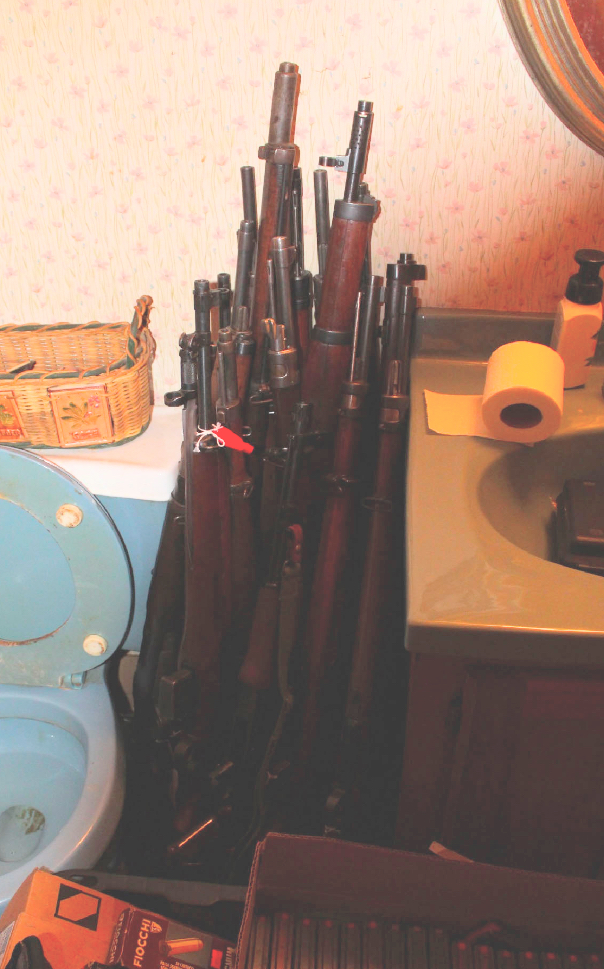
It is a shitty picture of some lovely old weapons. I haven’t even attempted to identify any of them.

The box of stripper clips in the foreground is nice, the pile of magazines in the sink is interesting. I would be happy to take all of those off his hands.

Public personas aside, the Augustos stand accused in both federal and state courts for amassing a stockpile of guns ranging from World War II models to semi-automatic rifles and an Uzi. The elder Augusto is not legally authorized to possess any of them due to an old criminal conviction, a lawyer in the case says.
[xCite item=”4RIEKL8F” pos=1]

I’ll spare you the search, the Uzi they are referring to is a semi-auto version. There are no NFA items in the collection.

As always, the reporter is trying to induce a panic. Was this a large collection? Yes. If this was in a free state, the actual collection would not have been an issue. In MA, it is unlikely that they had registered all those firearms. Much less the magazines and ammo.

The nature and circumstances of the offense are serious, but include mitigating factors that weigh in favor of the requested below-Guidelines sentence. See 18 U.S.C. § 3553(a)(1). The offense is serious in that it enabled his father, Daniel A. Augusto, Jr., to add to his vast arsenal of hundreds of firearms, ammunition magazines, rounds of ammunition, firearms manufacturing equipment, and firearms paraphernalia. (D.3, at ¶ 5). As even the defendant conceded during his second interview with the Bureau of Alcohol, Tobacco, Firearms, and Explosives (“ATF”), many of the firearms were located outside the safes throughout the house because “it honestly got to the point where there was no room in the safes, so stuff just started going everywhere.” (D.3, ¶ 12(d)).
[xCite item=”UKRUHGEW” p=3 pos=2]

English is tricky. Were there hundreds of firearms? Were there hundreds of magazines? Were there hundreds of rounds of ammunition? Or did they just lump them all together to get scary numbers? The statement made in the court filing was that there were more than a dozen semi-automatic rifles … in one of the bathrooms …[xCite item=”UKRUHGEW” pos=3]

The state is attempting to make it sound horrible, they are attacking this man for not having all of his guns in safes.

… obsessively collected firearms to the point that they could not store them safely.[xCite item=”UKRUHGEW” pos=4]

Right now, there are two loaded pistols and a dozen loaded rifles within feet of me that would not be considered “safely stored” in MA. If I still had the grandkid coming over, I’d store some of them differently.
Against this dangerous backdrop, two factors mitigate the defendant’s offense: first, he conducted all of his straw purchases for his father, rather than a stranger; and second, he did not benefit monetarily.
[xCite item=”UKRUHGEW” p=6 pos=5]

I didn’t know there was a “not for money” clause in the don’t buy guns for others.

… the defendant has recognized that his offenses were serious; they contributed to a highly dangerous situation inside his home; and he is better off never possessing firearms or ammunition again.
[xCite item=”UKRUHGEW” p=6 pos=6]

This man is going to lose his Second Amendment protected rights because the government is infringing on his father’s Second Amendment protected rights.

I didn’t find what the father was convicted of doing that made him a prohibited person. It is pretty obvious that he has not been doing evil in a long time.

I’m watching the §922(g) cases wind their way to the Supreme Court. I believe that the court is going to spank the government hard. In Heller, in the dicta, they indicated that §922(g) was presumed to be constitutional. They didn’t clarify that “presumed” means, “We didn’t look at it. That is a question for another day.”

There is no historical regulation nor tradition of stripping The People of their right to keep and bear arms because they are not virtuous people. That is what §922(g) does.

This is just an example of how there are intended consequences.

Of note, I’ve not seen a single story come across my feeds of a person being convicted of straw purchases that was a bad person.

Maybe that’s because they are either getting a sweetheart deal OR they are getting so stitched up that they didn’t stack the federal gun crime on top.

O.F.F. v. Brown, Judges Opinion Pt. 2

B.L.U.F.More of analysis of the horrid opinion offered by Judge Karin Immergut out in Oregon.

I’ve since learned that she spent most of her career, before becoming a district judge, working as a prosecutor for the government. She was actually a prosecutor for the ATF. OF course, she found a gun infringement constitutional.


It is pretty clear that the judge was picking and choosing experts, facts, and testimony to get the conclusion she wanted. This is clear from the following:

Plaintiffs offered the chart as an industry report through the testimony of Salam Fatohi, who serves as the Director of Research at the National Shooting Sports Foundation (“NSSF”). Tr. 6/6/2023 356:4–5. Although this Court received the chart in evidence, see Ex. 33 at 7, in assessing the weight and credibility to give Mr. Fatohi’s testimony, this Court notes that the NSSF is a plaintiff in this case and has been a plaintiff in several Second Amendment challenges to firearms regulations. The NSSF is a firearm and industry trade association which advocates for the firearm and ammunition industry. NSSF members have a significant financial interest in the outcome of this case.
[xCite item=”FHMK3ZW8″ n=18 pos=0]

The EVIL gun lobby wants this, we can’t accept their testimony. How about the fact that Everytown, Brady, and a dozen other groups all pile on when there is a Second Amendment Case? Should their testimony be discounted because they have been a plaintiff in several Second Amendment challenges? Maybe the judge should disallow Paul Clement from representing Second Amendment plaintiffs because he’s been involved with several Second Amendment challenges?

Does she really think that all these anti-gun people don’t make money from litigating? I’ve looked at some of the tax filings for some of these groups, they seem to spend significant amounts of money on the administrative and executive salaries.

Nevertheless, based on the parties’ pretrial stipulation, this Court finds that millions of Americans today own LCMs. But this Court also finds that the number of LCMs possessed by Americans is influenced to some degree by whether a firearms manufacturer sells a particular model of firearm standard with an LCM, and whether that firearm is sold standard with more than one LCM. Tr. 6/5/2023 44:16–19; 67:6–17.
[xCite item=”FHMK3ZW8″ p=25 pos=1]

What is she talking about? That most people don’t buy extra magazines for their firearms? Technically, I guess that is true. My M1 Garand came with zero enblocs. I think I have over 50 of them now. All but a few loaded. My PC-9 came with one magazine. I’ve never even loaded it. I purchased 6 Glock magazines to feed it, and then purchased a Glock with a couple of magazines.

My first AR-15 came with two magazines. One was 5 rounds and the other 10. None of the other AR-15s came with magazines. I don’t know how many magazines I currently have. I still have one 5 round mag, and one 10 round magazine. I do have a few 20 round mags, but most of my magazines are 30 rounds.

It does not matter why The People decide to purchase extra magazines or if they just use the magazine(s) that come with their guns. They have decided that ammunition feeding devices with more than 1, 5, 7, 9, 10, or 15 rounds is what they want, those purchases are protected under the Second Amendment.

Plaintiffs offered only limited anecdotal evidence of LCMs actually being used in self-defense. Mr. Ayoob described an incident in which a law enforcement officer fired thirty-three rounds in pursuit of an armed bank robber. Tr. 5/30/2023 39:24–40:16. On cross-examination, Mr. Ayoob also testified about an incident in which two individuals fired nine and three rounds, respectively, at an armed intruder. Tr. 5/30/2023 56:16–57:14. On re-direct, Mr. Ayoob testified to two other incidents with civilians firing more than ten rounds in self-defense: two brothers who owned a jewelry store and fired between thirty and forty rounds to stop an attempted robbery, and one gun shop owner who used an M16-rifle and a sub-machine gun to stop an attempted robbery. Tr. 5/30/2023 95:15–96:13.
[xCite item=”FHMK3ZW8″ p=26 pos=2]

The judge is incorrect in how she categorizes these anecdotal incidents. They are examples of people using their arms to actively defend themselves. They were using those arms for lawful purposes, such as self-defense, by possessing them. They prove The People chose these arms in common use today for lawful purposes.

Conclusion

I’m now behind the curve, here are a couple of YouTube videos that go into just how bad this opinion is.

I might come back to this, but with multiple issues with the k8s cluster resulting in a full day of ClusterFuck and then another 30 minutes of minor CF today. I have not had time to do any more wading through this swamp.