…….

Tuesday Tunes

I thoroughly enjoy songs that tell a story. Unfortunately for you all, that means bluegrass and country. Either that or I’ll have to torture you with musicals.

The version from the album:

And an extra:

I found this musical accidentally.

state v. state?

When I write about cases, legislation and events, I use the term “state” or “the state” to represent the Government. It doesn’t matter if it is the federal, state, or local government. It doesn’t matter if it is a rule promulgated by an agency or a city ordnance. In all cases, it is still “the state” that is doing it.

When we discuss cases, we speak about the case and the court’s opinion. We speak of Heller, Bruen, or Caetano we know the opinion. We might even know which Supreme Court Justice wrote the majority opinion.

Do you pay attention to the lawyers that are arguing the cases?

You should know Paul D. Clement. He argued McDonald and other 2A cases, and won.

Alan Gura argued Heller and won the biggest Supreme Court case for the 2A ever. Bruen was more about slapping down rogue courts and spoon-feeding the inferior courts how to handle 2A cases.

If you go look at west cost cases, you will find the firm of Michel and Associates with Carl D. Michel arguing for us.

It is highly unlikely that you have heard of J. Matthew Wright. He is the counsel of record for the Rahimi case.

He is ably assisted by Jared Guemmer, Jason Hawkins, Kevin Page, Rachel Taft, T.W. Brown.

They all work for a gigantic entity. Guemmer is part of the Federal Public Defender’s office of Oklahoma. The rest are part of the federal public defender’s office of Texas.

That’s correct, the federal government lawyers are arguing against federal government lawyers.

And the Public Defender’s are doing a great job.

EDC item

After I posted my truck mess, one of the commenters pointed out that it might be the case that you only have what is on your person in that instant.

They are correct. That is one of the reasons I have so many first-aid/stop the bleed kits.

For example, the LBV for my office area is a Condor Recon Chest Rig, in black. It comes with the AR mag pouches built in. It adjusts to “fat” and it is fast and comfortable to get into.

To that, I add one of my blow out kits. I need to add pistol mag pouches to it, which would require me to decide on a SHTF pistol. I like my 1911s. Likewise, I’m uncertain if that’s what I would be carrying in a situation where I’m wearing my LBV.

My normal EDC is actually pretty good. I mentioned much of what I have on my person. I forgot to mention two things:

Two days of my prescription meds and ear plugs.

[visual-link-preview encoded=”eyJ0eXBlIjoiZXh0ZXJuYWwiLCJwb3N0IjowLCJwb3N0X2xhYmVsIjoiIiwidXJsIjoiaHR0cHM6Ly93d3cuYW1hem9uLmNvbS9ncC9wcm9kdWN0L0IwMEhGMlVDRVUvcmVmPXBweF95b19kdF9iX3NlYXJjaF9hc2luX3RpdGxlP2llPVVURjgmcHNjPSIsImltYWdlX2lkIjotMSwiaW1hZ2VfdXJsIjoiaHR0cHM6Ly9tLm1lZGlhLWFtYXpvbi5jb20vaW1hZ2VzL0kvNjFGYzRCZFpXdEwuX0FDX1NMMTEwMF8uanBnIiwidGl0bGUiOiJEeGh5Y2MgNnBjcyBXYXRlcnByb29mIEFsdW1pbnVtIFBpbGwgQm94IENhc2UgQm90dGxlIENhY2hlIERydWcgSG9sZGVyIEtleWNoYWluIENvbnRhaW5lciBDb2xvciBSYW5kb20iLCJzdW1tYXJ5IjoiQW1hem9uLmNvbTogRHhoeWNjIDZwY3MgV2F0ZXJwcm9vZiBBbHVtaW51bSBQaWxsIEJveCBDYXNlIEJvdHRsZSBDYWNoZSBEcnVnIEhvbGRlciBLZXljaGFpbiBDb250YWluZXIgQ29sb3IgUmFuZG9tIDogSGVhbHRoICYgSG91c2Vob2xkIiwidGVtcGxhdGUiOiJ1c2VfZGVmYXVsdF9mcm9tX3NldHRpbmdzIn0=”]

There are many of these available from all the usual places. They are lightweight, waterproof and can be attached to things to keep them from being lost.

I believe this is the size that I have, which holds a pair of the squishes into ear, earplugs. The number of times I’ve used them when not shooting is surprising.

Much of my EDC is like that. I didn’t know I wanted that capability with me until I had it.

My silly example is going around my office and pulling all the staples out of beams, columns, door and window frames, and doors. Those little stable nubs always bother me and I would scratch myself from time to time. When I started carrying my Leatherman and later my Gerber, I would just pull them when I found them.

Regardless, it is worthwhile, in my opinion, picking some of these up. The different sizes can be used for different fun things.

Tuesday Tunes

My son is on the spectrum. His idea of fun is computer games. On the great side of it, he has decided that he is going into the trades. I couldn’t be prouder of him.

His sibling has given me tunes for Tuesdays, as has his mother. Today I asked for his.

He gave me four. Two are cartoon—like singing. I can’t handle it, and I won’t inflict it on you.

His third choice was:

I happen to prefer the choir version:

His last was labeled “American”. It is a song I happen to like. It depends on whether it was “The War of Northern Aggression” or “The Civil War” or “the war to free the slaves”.

A little prepared?

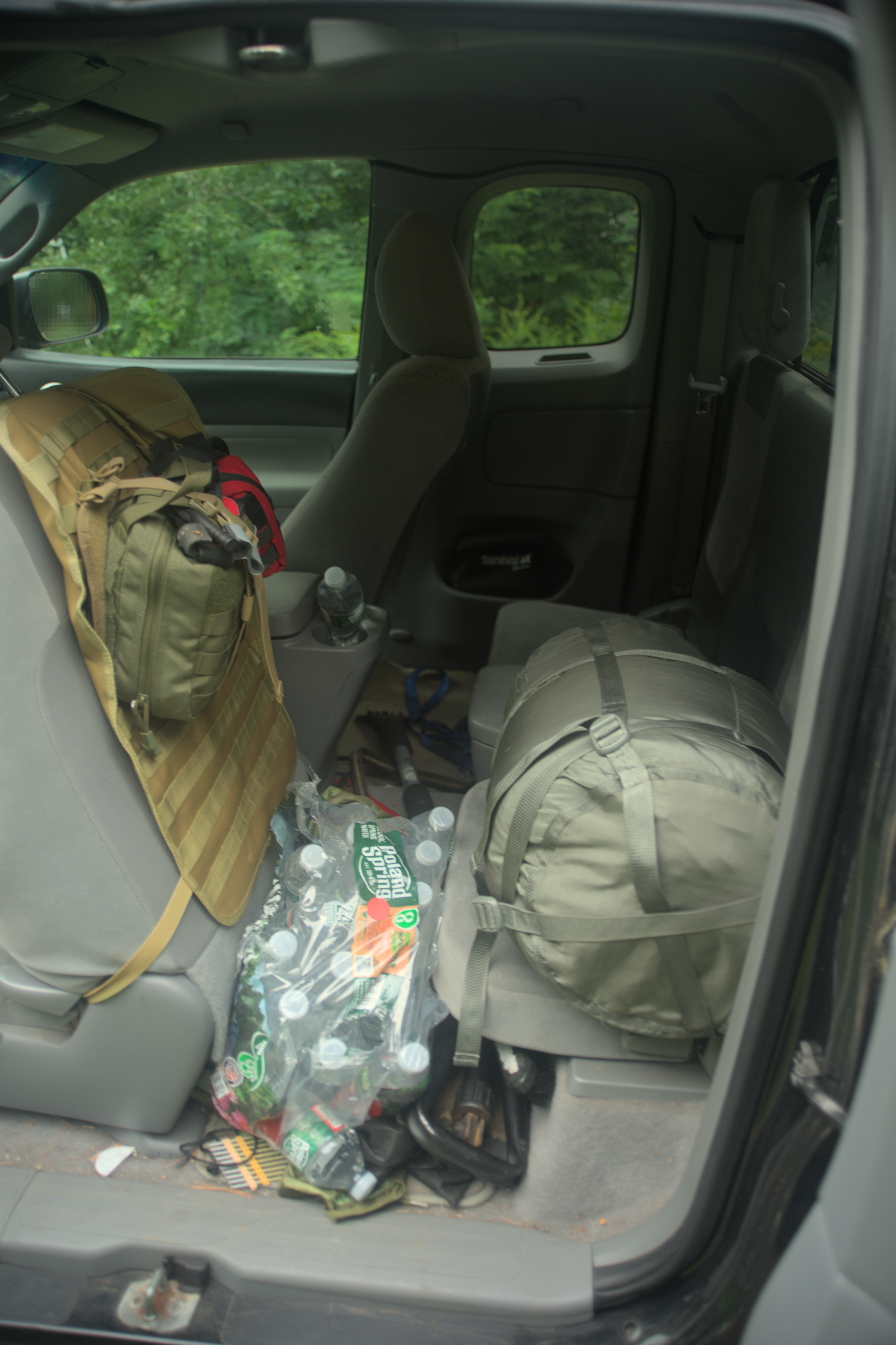
My truck is a mess. I try to keep the front in “ok” but the space behind the driver’s seat is reserved for preparedness.

This is the “always” things:

  • US Military Sleep System.
  • US Military poncho liner.
  • US Military entrenching shovel
  • US MRE’s, not visible, in the door behind the lens
  • Blowout First Aid Kit
  • Boo-Book First Aid Kit (Red)
  • Bottled water.

To this is added the travel bag, a 72-hour pack, when I leave my local AO. That includes my spare boonie hat, a watch cap, another IFAK/blowout+, MRE(1), water filter, 1L canteen, extra ammo, socks, underwear, shirt, US Military poncho, US Military Poncho Liner, misc other stuff.

Fire starting equipment is at every level and in every kit. 440 paracord is at every level, the only thing that changes is the amount. I actually made a belt from paracord. 150 ft of paracord around my waist and it looks like a regular belt.

There are pocket knives everywhere, Gerber multi-tools in most of the EDCs. A nice Cold Steel folding lock blade.

The briefcase is a bit more and besides carrying my laptop it carries a full EDC set. In that one, I have flavored tuna packets. They can be eaten as is or spread on crackers or bread if you have it.

I have Ka-Bar sporks in most gear. The number of times that has been helpful is surprising.

Regardless, start putting together some supplies “just in case”. There are $100s of dollars in my EDC kits, not counting the firearms. I certainly didn’t go out and buy it all at once. It just keeps growing as I find things that work for me/us.

The Bundy Ranch Saga

I’m old enough to remember the events. I remember the Feds telling us that there were no federal snipers pointing guns at the defenders. It was just such a shock to see gun sight camera images of those snipers. I mean, they were clear, and I didn’t know that it was possible with the tech of that time.

There was the follow-on standoff. I did watch the state’s video of the ambush and the death of the one protester.

I was asked to write about that saga. To look into the court cases.

It is unlikely to happen. It falls into the same category of research as Ruby Ridge cases, and the Branch Dividians. Interesting, but a boat load of research that I do not have the resources at the current time.

If somebody wants to send me courts and case numbers, I’ll look into it. My research last night didn’t pop anything except anger at the Wikipedia page.

It is just a little bit of rape, CA’s Ammunition Background checks

Since its inception, the California ammunition background check has been riding at about a 10.8% rejection rate.

Of that, more than 50% were in error. We don’t know if the remaining people were actually prohibited, or if they just didn’t bother to go to the trouble of doing the paperwork.

About 7,500 individuals are rejected each month.

The good news is that the CA DoJ reports that doing all that to law-abiding, responsible citizens resulted in 51 investigations. Those 51 investigations resulted in 15 individuals being arrested.

The state seized 152 firearms, 12 “ghost gun parts”, 237 magazines, and 78,742 rounds of ammunition.

That translates to 3 firearms on average per investigation and 1,500 rounds of ammo.

How the Federal Government intrudes:

Quoting from a charging document:

The possession of the charged firearms affected interstate or foreign commerce; that is, before the defendant possessed the charged firearms, it had traveled at some time from one state to another or between any part of the United States and any other country.

If you bought a gun manufactured by SIG, in New Hampshire, from an FFL in New Hampshire, it is still likely to have been shipped out of state for distribution. That would mean it affected interstate commerce.

The state has gone further and said that even if the firearm was made in your state, that you bought it direct from the manufacturer, in person, that the firearm still affected interstate commerce. Their reasoning is that if that firearm were not purchased, you would have purchased a firearm that did cross state or country lines.

Sentencing Guidelines Clarification

Ok, so If I understand this process correctly, the judge evaluates the character of the defendant based on all available information and uses it to in essence to correct what the judge believes is an injustice, in that the jury erred in its finding.

So the judge overrides the jury’s decision. Is it a backdoor, unethical practice? I don’ t know. But I do believe the criminal history of the defendant should come into play, and I guess I’ll say, regardless of what the evidence swayed the jury to decide. Criminal History Trumps Evidence. I’ve always disagreed that past criminal history was not relevant and therefore not allowed during the trial.

Speaking of perceived injustices, when a surgeon repeatedly harms patients, to the point they are dismissed from their position within a healthcare organization, the butcher can go anywhere else to work. Their history is prohibited by law from following them. The next hospital across the state does not have access to the butcher’s botched surgery history. The Hippocratic Oath today is rendered useless.
[xCite item=”IZEPFAIY” pos=0]

One would think that this is simple, look up the criminal history, respect the rules, get the result. If any three people were to get the same report, they would end up with the same results.
[xCite item=”IZEPFAIY” pos=1]

To begin with, these are called “Guidelines”. This is to imply that they aren’t always followed. The more out of line with the guidelines the sentence is, the more likely the sentence will be overturned on appeal if it is too much. If it is too little, no victim has standing to challenge the sentence.

It is unclear what Sotomayer was speaking about when she described the question. We don’t know from her opinion on the denial of cert. what exactly was done.

There are three parties involved with the sentencing. The first party is the prosecutor, the second is the defendant, and the third is the judge. In a fair and just world, we would want the Judge to respect the law and the guidelines.

The problem is that the guidelines can be manipulated. This is done with modifiers, number of charges brought, and subjective evaluation, where available.

If the judge is looking at this person, that is bad. The judge knows it. The person has been before his bench for various violent crimes over the last few years. He is tired of him getting a slap on the wrist and out again.

There was a case I read about where the accused took a plea deal. The deal was for 5 years with probation. The accused had to allocute to his guilt, he said the words, he claimed it was just to get the deal. The Judge heard the allocution, decided that the plea was off the table, and sent him to prison for 19 years.

The dick wad that was diddling my friends kids was found guilty in a court of law and sentenced to the “special” prison where kiddy diddlers might actually live for a couple of weeks. The judge sentenced him on each count to the maximum, then set them to run serially, then entered into the record that he had other charges that had not been tried — yet.

If he is every given probation, those “other charges” will come up, and he will be put back on trial for the other counts. At this time, it looks like he is eligible for parole on his final sentence sometime in the late 2100s.

When we are talking about judicial discretion, this is what we are thinking about. The judge knew dick was a bad person that should never see freedom again. (The court was aware of some 4 other victims that had not brought charges)

When the PSR was created, the prosecution added the fact that they knew of other victims. They added that there were other charges pending. They added that he had spent two years evading a warrant for his arrest for bouncing checks. All of this factored into his final sentences.

In the case before the Supreme Court, the question was different. The accused was accused of only charged with two things. Armed robbery and murder. He was found not guilty of murder.

When the prosecutor brings the PSR to the judge does he mention the multiple charges for which the accused has not been found guilty? Or is he limited to just the charge he was found guilty of in the case?

Was this his first offense, or was he “Well known to law enforcement”? Was this the first time he had been found guilty of a crime? Is this the first time he didn’t plead out of more serious crimes? None of these questions were answered by the Order Listing.

To me, the fact that a 17-year-old boy is robbing pharmacies at gun point is a pretty good indicator that he is a bad person.

That is what he was found guilty of. Do you, or I think this was his first encounter with the law?

This is why the state is going over the sentencing guidelines. We want the bad ones off the street, yet at the same time we don’t want the one and done overly punished.

There is a balance in here. I don’t know where it is.
[xCiteBib]