Anonymous Web Angel(GFZ)

A little prepared?

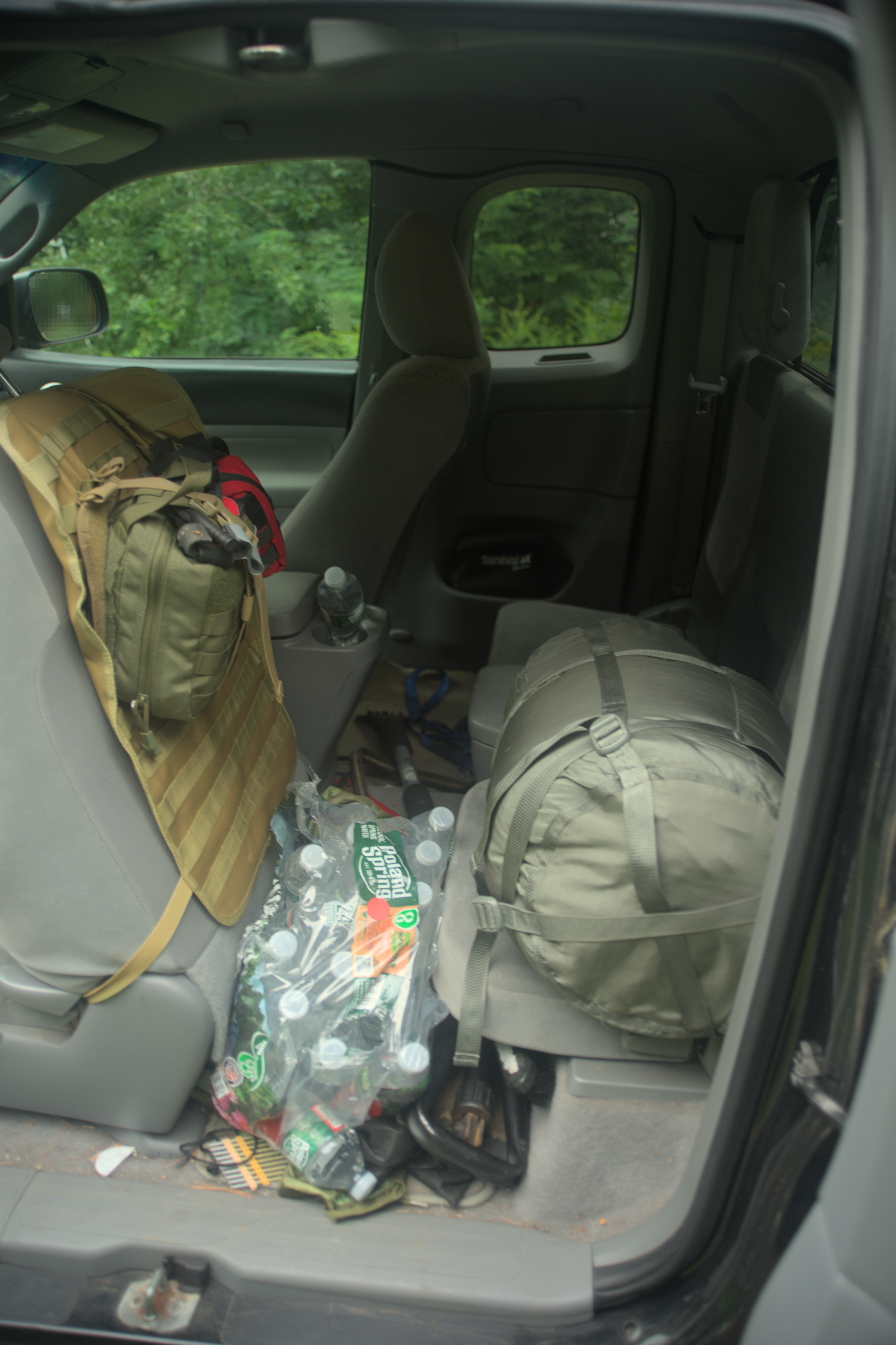
My truck is a mess. I try to keep the front in “ok” but the space behind the driver’s seat is reserved for preparedness.

This is the “always” things:

  • US Military Sleep System.
  • US Military poncho liner.
  • US Military entrenching shovel
  • US MRE’s, not visible, in the door behind the lens
  • Blowout First Aid Kit
  • Boo-Book First Aid Kit (Red)
  • Bottled water.

To this is added the travel bag, a 72-hour pack, when I leave my local AO. That includes my spare boonie hat, a watch cap, another IFAK/blowout+, MRE(1), water filter, 1L canteen, extra ammo, socks, underwear, shirt, US Military poncho, US Military Poncho Liner, misc other stuff.

Fire starting equipment is at every level and in every kit. 440 paracord is at every level, the only thing that changes is the amount. I actually made a belt from paracord. 150 ft of paracord around my waist and it looks like a regular belt.

There are pocket knives everywhere, Gerber multi-tools in most of the EDCs. A nice Cold Steel folding lock blade.

The briefcase is a bit more and besides carrying my laptop it carries a full EDC set. In that one, I have flavored tuna packets. They can be eaten as is or spread on crackers or bread if you have it.

I have Ka-Bar sporks in most gear. The number of times that has been helpful is surprising.

Regardless, start putting together some supplies “just in case”. There are $100s of dollars in my EDC kits, not counting the firearms. I certainly didn’t go out and buy it all at once. It just keeps growing as I find things that work for me/us.

Federal Firearms Act — June 30, 1938

B.L.U.F.
A look at an early 20th century firearm regulation.
(700 words)


I Am Not A Lawyer. I’ve never taken a prelaw course, I’ve never attended a Law School. My interactions with lawyers have been few and far between. What I am is a geek that enjoys understanding. I will often spend far too much time figuring something out that I will never use again. Until I need it.

In looking at the history of firearm regulation, the first federal firearm regulation is the National Firearms Act of 1934. It was my understanding that the next major firearms regulation was the Gun Control Act of 1968. This was followed by the Firearm Owner’s Protection Act in 1985, The Brady Handgun Violence Prevention Act in 1993, the Public Safety and Recreational Firearms Use Protection Act of 1994(AWB) and a few others since then.

At the state level, there were few from 1791 through the 1850s. The first real infringements on the state level happened after the War of Northern Aggression. The first major state level bill was New York’s Sullivan Act of 1911.

I completely missed the Federal Firearms Act of 1938.

Because Robert Spitzer cited the Federal Firearms Act, I became aware of it. I found the original text.

Constitutional Basis For the Infringement

Read More

Background Checks? Text, history and tradition – Correction

Form 4473 is the federal background check paperwork and firearm registration form used by the ATF to make sure you are not a prohibited person and to create a registry. This came into existence in 1993 with the passage of the Brady Handgun Violence Prevention Act. [xCite item=”BQYSSUQN” pos=0]

Correction: Form 4473 came into existence with the GCA of 1968. Which is what my muddled brain remembered. The NICS came into existence with the passage of the Brady Handgun Violence Prevention Act of 1993. My apologies

Out in California, they are currently litigating the background check requirement for the purchase of ammunition.

Something interesting hit me as I was talking about yesterday’s article with my wife. If placing a burden on the purchase of ammunition is conduct protected by the Second Amendment, and there were no regulations for background checks until 1993, does that mean there is no history or tradition of background checks?

With multiple cases moving towards the Supreme Court or all ready there challenging parts of §922(g), will we see §921 fall as well?

4473s are a small rape as compared to states being designated sensitive places and requiring The People to prove they are law-abiding, responsible citizens before being granted permission to exercise the right to keep and bear arms.

I can’t see 2A groups pushing an attack on §921. It is a fascinating thought experiment.

What current laws or regulations in your state would you like to see challenged?

The Bundy Ranch Saga

I’m old enough to remember the events. I remember the Feds telling us that there were no federal snipers pointing guns at the defenders. It was just such a shock to see gun sight camera images of those snipers. I mean, they were clear, and I didn’t know that it was possible with the tech of that time.

There was the follow-on standoff. I did watch the state’s video of the ambush and the death of the one protester.

I was asked to write about that saga. To look into the court cases.

It is unlikely to happen. It falls into the same category of research as Ruby Ridge cases, and the Branch Dividians. Interesting, but a boat load of research that I do not have the resources at the current time.

If somebody wants to send me courts and case numbers, I’ll look into it. My research last night didn’t pop anything except anger at the Wikipedia page.

Rhode v. Becerra — Robert Spitzer’s Declaration


B.L.U.F.This case is before Judge Benitez. I believe he has a hearing scheduled for mid-September on the merits of the case. In response to the defendants (bad guys/state) whining that the case should be evaluated through the eyes of an expert or historian. Judge Benitez ordered the defendants to declare their experts and to allow the plaintiffs (good guys) the opportunity to dispose them.

The state went back to the well of Spitzer and Vorenberg for another set of declarations. They added Jennifer M McCutchen to the list of infringement loving experts as well.

(2300 words)


Who Are the Players

Jennifer M McCutchen is an Assistant Professor at the university of St. Thomas, Minnesota.

Dr. McCutchen specializes in Early American History and Native History, with a focus on the themes of gender, power, exchange, and diplomacy. Her current project is an ethnohistorical study of gunpowder in the late eighteenth-century Creek Confederacy.
[xCite item=”DTPK4NB7″ pos=1]

Michael Vorenberg, associate professor of history at Brown University. In his words:

Final Freedom: The Civil War, the Abolition of Slavery, and the Thirteenth Amendment, was published by Cambridge University Press in 2001. The book was a Finalist for the Gilder Lehrman Lincoln Prize. I am also the author of The Emancipation Proclamation: A Brief History with Documents, published by Bedford/St. Martin’s in 2010. I am the author of a number of articles and essays on Reconstruction and the law. These include: “The 1866 Civil Rights Act and the Beginning of Military Reconstruction,” in Christian Samito, ed., The Greatest and the Grandest Act: The Civil Rights Act of 1866 from Reconstruction to Today (Southern Illinois University Press, 2018); Citizenship and the Thirteenth Amendment: Understanding the Deafening Silence,” in Alexander Tsesis, ed., The Promises of Liberty: The History and Contemporary Relevance of the Thirteenth Amendment (Columbia University Press, 2010); “Reconstruction as a Constitutional Crisis,” in Thomas J. Brown, ed., Reconstructions: New Directions in the History of Postbellum America (Oxford University Press, 2006); and “Imagining a Different Reconstruction Constitution,” Civil War History, 51 (Dec. 2005), 416-26.
[xCite item=”LXA958SU” pos=2]

We round out our merry band of word weasels with Robert Spitzer, in his words:

I am a Distinguished Service Professor of Political Science Emeritus at the State University of New York at Cortland. I was also a visiting professor at Cornell University for thirty years. I am currently an adjunct professor at the College of William and Mary School of Law. I earned my Ph.D. in Government from Cornell University. I reside in Williamsburg, Virginia.

I have been studying and writing about gun policy for over thirty years. My first publication on the subject appeared in 1985. Since then, I have published six books and over one hundred articles, papers, and essays on gun policy. My expertise includes the history of gun laws, gun policy in American politics, and related historical, legal, political, and criminological issues. My book, The Politics of Gun Control, has been in print since its initial publication in 1995. It examines firearms policy in the United States through the lenses of history, law, politics, and criminology. The eighth edition of the book was published in 2021 by Routledge Publishers. My two most recent books on gun policy, Guns across America (Oxford University Press, 2015) and The Gun Dilemma (Oxford University Press, 2023), both deal extensively with the study of historical gun laws. I am frequently interviewed and quoted in the national and international media on gun-related matters. For over twenty years, I have been a member of the National Rifle Association and of Brady (formerly, the Brady Campaign to Prevent Gun Violence).
[xCite item=”Z7BL7P6C” para=”2,3″ pos=3]

Robert’s Attempt at Matching

Read More

It is just a little bit of rape, CA’s Ammunition Background checks

Since its inception, the California ammunition background check has been riding at about a 10.8% rejection rate.

Of that, more than 50% were in error. We don’t know if the remaining people were actually prohibited, or if they just didn’t bother to go to the trouble of doing the paperwork.

About 7,500 individuals are rejected each month.

The good news is that the CA DoJ reports that doing all that to law-abiding, responsible citizens resulted in 51 investigations. Those 51 investigations resulted in 15 individuals being arrested.

The state seized 152 firearms, 12 “ghost gun parts”, 237 magazines, and 78,742 rounds of ammunition.

That translates to 3 firearms on average per investigation and 1,500 rounds of ammo.

How the Federal Government intrudes:

Quoting from a charging document:

The possession of the charged firearms affected interstate or foreign commerce; that is, before the defendant possessed the charged firearms, it had traveled at some time from one state to another or between any part of the United States and any other country.

If you bought a gun manufactured by SIG, in New Hampshire, from an FFL in New Hampshire, it is still likely to have been shipped out of state for distribution. That would mean it affected interstate commerce.

The state has gone further and said that even if the firearm was made in your state, that you bought it direct from the manufacturer, in person, that the firearm still affected interstate commerce. Their reasoning is that if that firearm were not purchased, you would have purchased a firearm that did cross state or country lines.

Friday Feedback

Miguel’s post about harping on health really hit me. I’m struggling.

Two years ago, I was around 330. Today I’m hovering around 292. During the week, I lose weight. On the weekend, I gain it all back. I have to make the conscious decision to not eat bad things on the weekend. It is difficult, but I need to do it.

On the good side of things, my skin doesn’t fit as well as it use to. While my weight isn’t going down, my health is getting better. I do at least 30 minutes of spin, 5 days a week. This has made it much more likely for me to get up and move.

If you can, make a commitment to doing just a bit of exercise, every day. We need you healthy!

Software moves forward. I need to do an update to GFZ’s infrastructure, but haven’t yet.

Meanwhile, the comments are open, please let us know what you are thinking about and what you want to hear about.

Brief of United States v. Rahimi, US Supreme Court – UPDATED

B.L.U.F. The United States filed a brief with the Supreme Court where they argue that the definition of “The People” is in the hands of the state. And other reasons why the state gets to decide when the Second Amendment applies.

(3,800 words)


The Question

Whether 18 U.S.C. 922(g)(8), which prohibits the possession of firearms by persons subject to domestic-violence protective orders, violates the Second Amendment on its face.
[xCite item=”M6XPXT6Z” pos=0]

The question is well-formed and well suited to an opinion by the Supreme Court. This is a dangerous gamble for the state. While they are looking at specifically §922(g)(8) there is nothing to keep the Justices from looking at all of §922(g).

If the Justices decide to look at more than just §922(g)(8) they could very well throw out much of the GCA. In addition, it is likely to put a hurting on many other infringements and infringement arguments.

Like most rights, the right secured by the Second Amendment is not unlimited. From Blackstone through the 19th-century cases, commentators and courts routinely explained that the right was not a right to keep and carry any weapon whatsoever in any manner whatsoever and for whatever purpose. See, e.g., Sheldon, in 5 Blume 346; Rawle 123; Pomeroy 152-153; Abbott 333. For example, the majority of the 19th-century courts to consider the question held that prohibitions on carrying concealed weapons were lawful under the Second Amendment or state analogues. See, e.g., State v. Chandler, 5 La. Ann., at 489-490; Nunn v. State, 1 Ga., at 251; see generally 2 Kent *340, n. 2; The American Students’ Blackstone 84, n. 11 (G. Chase ed. 1884). Although we do not undertake an exhaustive historical analysis today of the full scope of the Second Amendment, nothing in our opinion should be taken to cast doubt on longstanding prohibitions on the possession of firearms by felons and the mentally ill, or laws forbidding the carrying of firearms in sensitive places such as schools and government buildings, or laws imposing conditions and qualifications on the commercial sale of arms.
[xCite item=”LPGQXCDT” p=”2816-2817″ pos=1]

Double emphasis added.

That one sentence is what all infringements hang on since Heller. “Not unlimited” means that the states have been searching for the limit ever since. They will push until a court stops them.

Post Bruen they are losing, but this one sentence is still their foundation.

It is also important to note that Scalia was explicit about “felons and the mentally ill”, but omitted all the other prohibited classifications. This is reading into dicta what was not said. Doing it from our side is just as bad as when the state does it from their side. Though I like to think that the side of the Constitution gets it correct more often than not.

In my opinion, the nothing in our opinion should be taken to cast doubt on … was added to this opinion to get the more left—leaning Justices to sign on, in particular, Justice Roberts.

The Statements with Embedded Assumptions

Read More

Sentencing Guidelines Clarification

Ok, so If I understand this process correctly, the judge evaluates the character of the defendant based on all available information and uses it to in essence to correct what the judge believes is an injustice, in that the jury erred in its finding.

So the judge overrides the jury’s decision. Is it a backdoor, unethical practice? I don’ t know. But I do believe the criminal history of the defendant should come into play, and I guess I’ll say, regardless of what the evidence swayed the jury to decide. Criminal History Trumps Evidence. I’ve always disagreed that past criminal history was not relevant and therefore not allowed during the trial.

Speaking of perceived injustices, when a surgeon repeatedly harms patients, to the point they are dismissed from their position within a healthcare organization, the butcher can go anywhere else to work. Their history is prohibited by law from following them. The next hospital across the state does not have access to the butcher’s botched surgery history. The Hippocratic Oath today is rendered useless.
[xCite item=”IZEPFAIY” pos=0]

One would think that this is simple, look up the criminal history, respect the rules, get the result. If any three people were to get the same report, they would end up with the same results.
[xCite item=”IZEPFAIY” pos=1]

To begin with, these are called “Guidelines”. This is to imply that they aren’t always followed. The more out of line with the guidelines the sentence is, the more likely the sentence will be overturned on appeal if it is too much. If it is too little, no victim has standing to challenge the sentence.

It is unclear what Sotomayer was speaking about when she described the question. We don’t know from her opinion on the denial of cert. what exactly was done.

There are three parties involved with the sentencing. The first party is the prosecutor, the second is the defendant, and the third is the judge. In a fair and just world, we would want the Judge to respect the law and the guidelines.

The problem is that the guidelines can be manipulated. This is done with modifiers, number of charges brought, and subjective evaluation, where available.

If the judge is looking at this person, that is bad. The judge knows it. The person has been before his bench for various violent crimes over the last few years. He is tired of him getting a slap on the wrist and out again.

There was a case I read about where the accused took a plea deal. The deal was for 5 years with probation. The accused had to allocute to his guilt, he said the words, he claimed it was just to get the deal. The Judge heard the allocution, decided that the plea was off the table, and sent him to prison for 19 years.

The dick wad that was diddling my friends kids was found guilty in a court of law and sentenced to the “special” prison where kiddy diddlers might actually live for a couple of weeks. The judge sentenced him on each count to the maximum, then set them to run serially, then entered into the record that he had other charges that had not been tried — yet.

If he is every given probation, those “other charges” will come up, and he will be put back on trial for the other counts. At this time, it looks like he is eligible for parole on his final sentence sometime in the late 2100s.

When we are talking about judicial discretion, this is what we are thinking about. The judge knew dick was a bad person that should never see freedom again. (The court was aware of some 4 other victims that had not brought charges)

When the PSR was created, the prosecution added the fact that they knew of other victims. They added that there were other charges pending. They added that he had spent two years evading a warrant for his arrest for bouncing checks. All of this factored into his final sentences.

In the case before the Supreme Court, the question was different. The accused was accused of only charged with two things. Armed robbery and murder. He was found not guilty of murder.

When the prosecutor brings the PSR to the judge does he mention the multiple charges for which the accused has not been found guilty? Or is he limited to just the charge he was found guilty of in the case?

Was this his first offense, or was he “Well known to law enforcement”? Was this the first time he had been found guilty of a crime? Is this the first time he didn’t plead out of more serious crimes? None of these questions were answered by the Order Listing.

To me, the fact that a 17-year-old boy is robbing pharmacies at gun point is a pretty good indicator that he is a bad person.

That is what he was found guilty of. Do you, or I think this was his first encounter with the law?

This is why the state is going over the sentencing guidelines. We want the bad ones off the street, yet at the same time we don’t want the one and done overly punished.

There is a balance in here. I don’t know where it is.
[xCiteBib]