Anonymous Web Angel(GFZ)

Antonyuk v. Hochul (2nd Cir.)

Legal Case Analysis
B.L.U.F.
This is the long-awaited opinion from the Second Circuit court regarding the CCIA challenges. This panel was anti-gun, there is nothing negative in the opinion that is surprising.

What is surprising is that we won even a little bit.

The plaintiffs will either request an en banc rehearing or take it to the Supreme Court. I believe that the Antonyuk case is at final judgement at the district level. If that is the situation, then this case is ripe to be heard by the Supreme Court.
(3100 words)


The Second Circuit Court has finally issued their opinion on New York state’s Bruen tantrum. It isn’t great.

We now AFFIRM the injunctions in part, VACATE in part, and REMAND for proceedings consistent with this opinion. In summary, we uphold the district court’s injunctions with respect to N.Y. Penal L. § 400.00(1)(o)(iv) (social media disclosure); N.Y. Penal L. § 265.01-d (restricted locations) as applied to private property held open to the general public; and N.Y. Penal L. § 265.01-e(2)(c) as applied to Pastor Spencer, the Tabernacle Family Church, its members, or their agents and licensees. We vacate the injunctions in all other respects, having concluded either that the district court lacked jurisdiction or that the challenged laws do not violate the Constitution on their face.
[xCite item=”4H973XRP” p=4 pos=0]

If you are applying for a CCW in New York, you no longer have to give social media information and access, private property no defaults to “carry ok” rather than “gun free zone”, and Pastor Spencer and his church members can carry in religious locations.

Everything else seems to still stand.

Background

Read More

Reloading: Things that go boom! – part 6

B.L.U.F.
An introduction to how to mess up big time when reloading. Remember, don’t trust me. Read the instructions in your reloading guides, your press and die instructions. Follow their instructions.
(2400 words)


The wonderful thing about reloading is the amount of control you can get over the process of creating the “perfect” load for your firearm. The negative thing about reloading is that a mistake can send you to the hospital, or worse, the morgue.

Every “regular” cartridge has a SAAMI specification for it. The SAAMI specification includes the dimensions of the chamber and the pressures for each cartridge. The SAAMI specifications also include how to perform tests.

In general, we do not have the equipment to perform the tests that would give us objective insight into what our loads are doing. Everything we have to work with is measured after the bullet leaves the barrel. This includes velocity, grouping, and other objective measurements of the results of our load.

Unfortunately, there are many aspects of the reloading process that can change velocity or groupings.

What we cannot measure is the pressure inside the chamber. This is the critical measurement.

COPPER CRUSHER SYSTEM

This system employs a copper crusher cylinder that is compressed by a piston fitted to a piston hole into the chamber of the test barrel. The pressure developed by the gases from the burning propellant acts through the piston hole, allowing the gases to force the piston upward, and thereby permanently compressing the copper crusher cylinder. The Sporting Arms and Ammunition Manufacturers’ Institute has adopted the pressure units designation of “Copper Units of Pressure” (abbreviated CUP) for this system. This designation applies only to values obtained using the particular crushers, tarage tables and methods outlined in this Standard.
[xCite item=”AF2ZGSVI” pos=0]

Here are a few of the pressure measurements from the SAAMI specifications.

Cartridge Max. Avg. Pres. MAP
7.62×39 500
8 mm Mauser 370
223 Remington 520
30 Carbine 400
30-06 500
30-30 Win. 380

When we purchase a “modern” firearm, we are told that the firearm can safely chamber and fire rounds that meet SAAMI specifications. In the US, that is done by manufacturers not wanting to be sued.

When the gun banners scream about “only gun manufactures are protected from being sued”, they are lying. If you purchase a modern firearm and use only reputable ammunition, and that firearm “explodes”, the manufacturer can be sued. And rightly so.

In other countries, they go a bit further.

Proofing

Read More

Friday Feedback

We have another 2A case going to conference with the Supreme Court. It will be sent to conference on January 5th. This is a challenge out of Illinois regarding how the Illinois supreme court is a bought and paid for political entity of the governor.

We are waiting for word from the Supreme Court on the Bevis v. Naperville application for emergency relief. That might even be out by the end of the day.

I hope you have been enjoying my data dump regarding reloading. There have been some great comments. Thank you to all that have interacted.

Please leave us a comment.

National Association for Gun Right v. Naperville, Application for Injunction at Supreme Cour

Legal Case Analysis
B.L.U.F.
The state filed their reply in opposition to having the Seventh Circuit Court’s denial of an injunction on the Illinois gun and magazine ban overturned.

This was done on the Supreme Court’s emergency docket. Justice Barrett required a response from the state, by 1700 Wed. Which they did file.

The application and reply will be distributed to the Court, which will issue a response in the coming days. I actually expect something by Friday. The court will either grant an injunction or deny the injunction. There maybe an opinion issued with that order.

We live in interesting times.
(2000 words)


History

In September 2022, Robert Bevis and the National Association of Gun Rights filed suit in the Northern District of Illinois federal District court. This was a challenge of the Naperville Municipal Code “assault weapon” ban.

By December, the District court had stayed the implementation of the “assault weapon” ban.

In January 2023, the plaintiffs (good guys) and amended their original challenge to include the state law, PICA.

In February, District Judge Virginia Kendall stated that … although the plaintiffs have standing to bring this lawsuit, they are unlikely to succeed on the merits of their claim because Naperville’s Ordinance and the Protect Illinois Communities Act are consistent with the Second Amendment’s text, history, and tradition.

Virginia profoundly erred when she ruled:

Under this framework, Naperville’s Ordinance and the Protect Illinois Communities Act are constitutionally sound. The text of the Second Amendment is limited to only certain arms, and history and tradition demonstrate that particularly “dangerous” weapons are unprotected. See U.S. Const. amend. II; Heller, 554 U.S. at 627.

The plaintiffs appealed to the Seventh Circuit court.
Read More

Review: Diamond K Brass

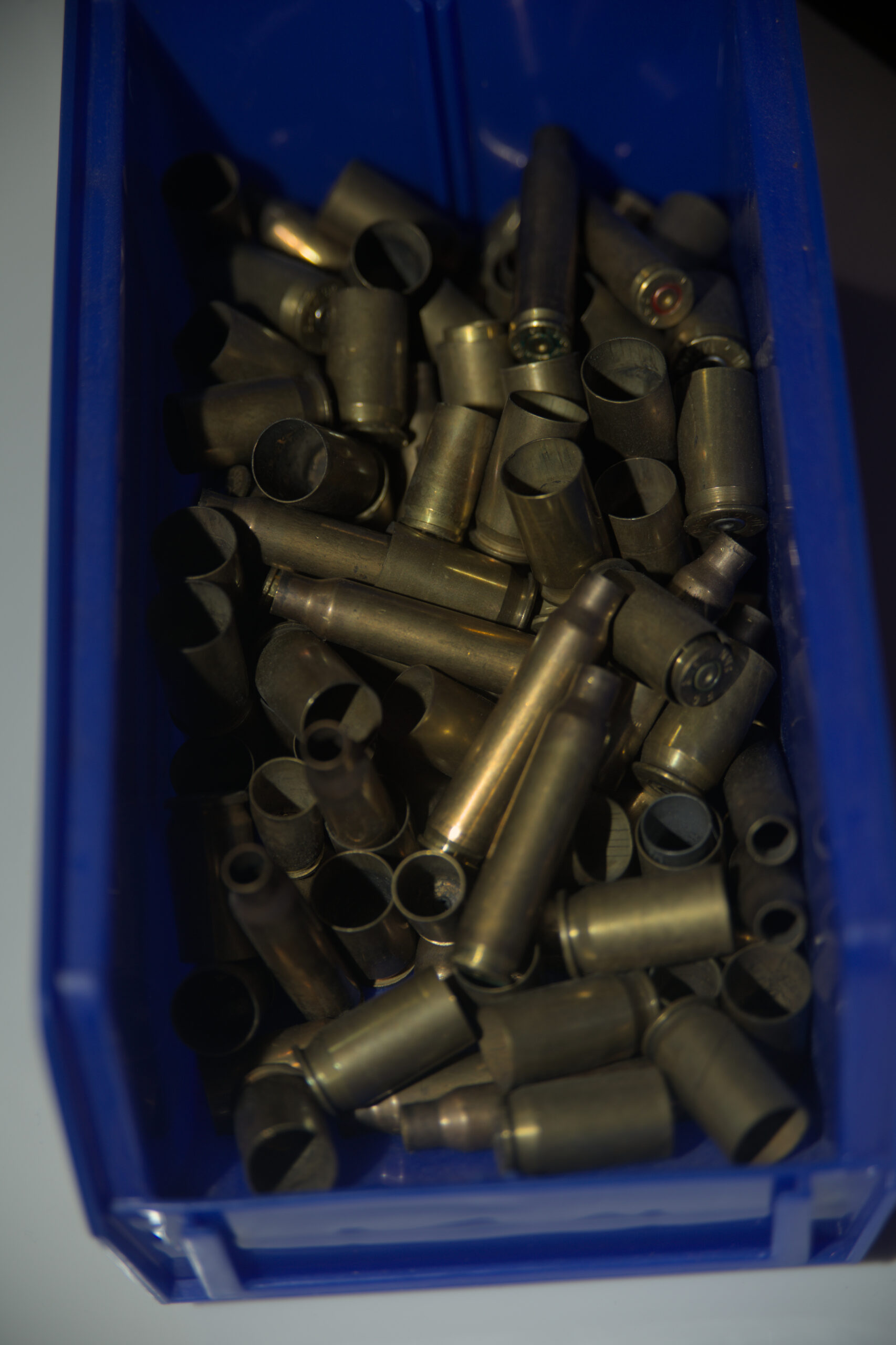
One of the issues I have had is that my brass continues to disappear at the range. I’ve had some luck getting range brass from friends, but not nearly as much as I want.

My last “big” score was 125 pieces of 8mmx57 Mauser for “only” $75.00. Of course, that was my frequent flyer discount along with the fact that it was part of “discount the brass, or I’m not going to buy this here $1000 rifle”.

I was pleased with my last reloading session and wanted to finish filling my ammo cans with 5.56×45. Somebody mentioned Diamond K Brass, so I went looking.

Their prices were so low that I was concerned they might be a scam. They most certainly are not.

When I buy brass from the standard places, if they tell me they are sending me 100 pieces of brass, I’m going to get 100 pieces of brass. Maybe I’ll get 101 pieces.

I took the plunge and ordered 1000+ of .223/5.56 from Diamond K. There was shipping, I was about to walk away when I did the math and decided it was acceptable at $22.00 for insured to me.

What arrived was a boat load of brass. The brass was cleaned but no deprimed. That was my first step.

There was a mix of head stamps. The mix seemed to be about 50/50 .223 and 5.56.

Of the 1000+ cases, I had 4 cases that were too damaged to use. I might have been able to rescue 2 of them, as it was just the case mouth. With a bit of time with the proper tool, I could have opened up the mouth enough for the sizing die to correct any remaining damage.

There was one .300 blackout case. There was one .22LR case. There were two cases that had no powder, but the bullet was still inside the case.

My biggest issue was that one of the head stamps has a primer flash hole that is too small. I can’t get my decapping pin to fit through to punch out the primer. I destroyed one decapping pin when I pushed too hard.

I have a tool on order to bring the flash holes to the correct nominal size. That will happen this weekend. At which time I will be able to finish decapping the cases.

Was the price right? YES. This is good-looking brass. I will be placing more orders with them shortly. Looking at 2000+ .45 ACP, 2000+ 9mm, more .223/5.56, and maybe some strange brass as well.


Reloading: Sizing Dies – Part 5

(3650 words)

When a cartridge is fired, the powder burning creates high pressures. 9MM has a maximum average pressure of 35,000psi. A 7.62×51 NATO has a maximum pressure of 60,200psi. These pressures are high enough to move metal.

1/16″ to 3/5″ brass pipe fittings and standard nipples can be used up to 300psi. In certain applications, the pressure can go to 1000PSI, maybe.

What this means is that if the cartridge case is not supported, it will burst under nominal pressures. This process of the case expanding is a “good thing”. It acts to obturate the flow of gasses around the case and out the breach.

For a cartridge to fit into the supporting chamber, it must be slightly smaller, in all dimensions, than the chamber. If it was an exact match, the round would be difficult to chamber.

When the round is fired, it “fire forms” the case to match the chamber. When the pressure goes down, the metal moves back towards its original size, slightly. This allows it to be extracted from the chamber, more easily.

To help with the extraction process, cases are often designed with a slight taper. When the cases are extracted, as soon as they move back even a small amount, they lose contact with the chamber walls.

When we speak of “straight walled” cases, we typically include these slightly tapered cases.

When the size of the diameter of the bullet is significantly less than the diameter of the case, the case needs to be “necked down”. This creates a “bottleneck cartridge”.

A bottleneck cartridge has pressure pushing the brass forward when the round is fired. This causes the case to stretch a little.

Headspacing

Read More

Reloading: Case Preparation – Part 4 UPDATED

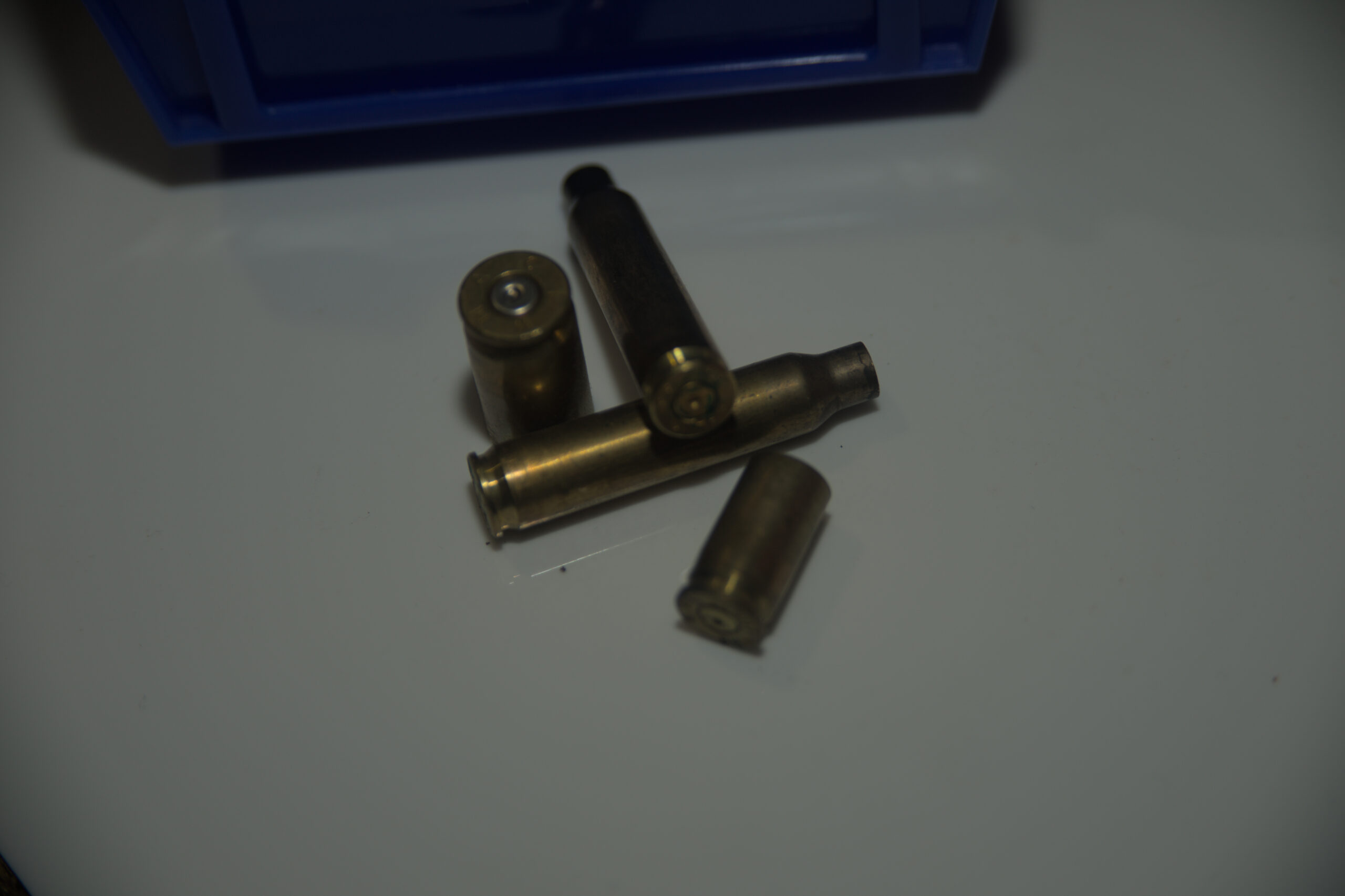
Case preparation starts with getting some brass. In my situation, that is range brass. This is brass that I’ve picked up off the ground at my test range or the shooting range. The only thing I know about this brass at this point is that it is brass and not aluminum or steel.

Notice the green sealer around the primer of the top 5.56×45 case. This indicates that this was likely a military specification round. That sealer is designed to keep water out. The primer is also “crimped” or “staked” in place.
Read More