Month: July 2023

Ocean State Tactical, LLC v. State of Rhode Island Reply Brief


B.L.U.F.We took a look at the bad guy’s arguments via Everytown earlier this week. Today we look at the reply brief submitted by the appellants/plaintiffs (good guys).


There is a huge issue that the good guys have to overcome in these cases, getting the Court to do their job. If you look at the plain text of the Second Amendment, is the proposed conduct implicated? If so, the conduct is presumptively protected under the Second Amendment.

The state is doing all in their power to make this first step as difficult as possible. As we observed in the Everytown brief, they don’t have any historical regulations to support their infringements. Because they don’t have the history nor the tradition, they desperately want to stop cases from getting to that point.

There is an old legal aphorism, “If you have the facts on your side, pound the facts. If you have the law on your side, pound the law. If you have neither on your side, pound the table.”

When I write about “emotional blackmail”, I’m discussing how the state is pounding the table. They don’t have facts on their side, they don’t have the law on their side. They pound the table in frustration, begging the court to give them just a little inch.

What this means, at a tactical level, is that the lawsuit almost all say “It is a regulation of conduct that is protected under the Second Amendment. Grant us an injunction stopping it.” The state then gets to do the song and dance “welllllll, it isn’t actually an arm. It doesn’t go boom boom.”. Or they try and say that as long as they allow you this arm, they don’t have to allow you that arm. All of this is just bonkers when the plain text is used.

Introduction

The plaintiffs start their response:

Just last year, the Supreme Court confirmed once and for all that “the Second Amendment protects the possession and use of weapons that are ‘in common use.’” N.Y. State Rifle & Pistol Ass’n, Inc. v. Bruen, 142 S.Ct. 2111, 2128 (2022) (quoting District of Columbia v. Heller, 554 U.S. 570, 627 (2008)). Rather than respect that clear teaching, Rhode Island veered far in the opposite direction, banning all devices that feed ammunition into semiautomatic firearms and are “capable of holding … more than ten (10) rounds,” R.I. Gen. Laws §11-47.1-2(2), -3(b)(1)(i), even though tens of millions of Americans own hundreds of millions of those devices as integral components of the firearms they keep and bear for self-defense. Under a straightforward application of Bruen, HB6614 is profoundly out of step with our nation’s history of firearm regulation and a violation of the Second Amendment.
[xCite item=”MPSB5CX2″ p=”1″ pos=0]

My lady has a difficult time answering simple questions. “Are you done with your homework?”. Reply: “Sort of, I’ve been working on it for hours. The …(172 words later) so I’m still working on it.” “Thank you, are you done with your homework?” “I just told you.” “No, you didn’t. You said many things in response to a yes, no answer without ever actually answering the question.”

The state is much like that. They don’t actually answer the question presented and instead talk about this or that. The plaintiffs (good guys) can’t force the state to answer. Only the Court can do that. If the state doesn’t answer the court, then the court can treat that none-response as meaningful.

In an effort to salvage HB6614, the state asks this Court to ignore what the Supreme Court has repeatedly identified as “the Second Amendment’s definition of ‘arms,’” Bruen, 142 S.Ct. at 2132, in favor of a definition more to its liking. The state asks this Court to pretend that people do not “use” their firearms when they keep and carry them for self-defense, even though the Supreme Court has explicitly defined the Second Amendment right as a right to “be[] armed and ready for offensive or defensive action,” id. at 2134, not just to fire at would-be attackers. …
[xCite item=”MPSB5CX2″ p=”1″ pos=1]

Exactly what we have been saying. I’m pleased that this reply has stated it so clearly. I expect to use this in the future.

These guys really hammer the state: “Pretend”, “fiction”, “deny Bruen“, “ignore what the Supreme Court”. This is polite lawyer talk for “the state is a lying sack of flaming dog poo”.
HB6614 Violates The Second Amendment

Read More

Friday Feedback

Welcome to Friday! It’s almost the weekend.

I really wish that the climate change gods would decide which way it should be. The last couple of nights I’ve gone to bed, it has been so hot and mucky that I didn’t want to be near my lady. Halfway through the night, I woke up shivering and had to pull up the blankets.

On the good news side, we had about two days of sun. It stopped raining just long enough to get the lawn mowed. Of course, the rain has started back up again before I got the weed wacker out

I’m hoping to do some reloading this weekend. I just have to clear a path to the reloading bench. After two years of not being able to find 30–30 bullets, suddenly everybody has them. I’m going to load a few hundred rounds and do the ballistics on it.

I’m halfway through a reference on ballistics. Not only that, but I actually remember some of my calculus from way back when. My first graphs came close to the correct answer, but not perfect. Likely because I wasn’t using the software correctly.

I picked up a laser range finder today. The range cards show up tomorrow. I intend to have range cards for each of the windows in the house, plus some known locations outside the house.

How many of you have ever used a range card? How many of you have actually used a ballistics chart or table to more accurately put rounds on target at distance?

The squirrel article is in the queue.

I expect to do a product review of the range finder after I’ve had a chance to use it for a bit.

Are you interested in articles about range cards and how to use them? I’ve read a bit and I’m going to put it to use, I am NOT an expert.

Ocean State Tactical, LLC v. State of Rhode Island (1st Cir)


B.L.U.F.Looking at another amicus brief by Everytown. Since they are consistently filing briefs in all these Second Amendment cases, it behooves us to see what they are saying.

I came back to add this text. You might get angry with Everytown over this brief. Regardless, they did a good job. Their arguments are self-consistent. They take a stand, then hammer the point home. Their goal isn’t to necessarily win these cases, but to give the court something to hang a bad decision upon.


Everytown is now the overarching group for “Moms Demand”, “Mayors Against Illegal Guns”, It looks like they are claiming “March for our lives” but they don’t do so by name. They claim to have nearly ten million “supporters” with nearly 10,000 of those “supporters” in Rhode Island. Make not that “supporters” are not “members”

For the tax year 2020 they had total revenue of $20,492,640. $20,288,442 of that was from contributions. They reported expenses of $52,280,883 for a net lose of $31,788,243. The largest listed expense is $11,390,489 for other salaries and wages and around $500,000 for the Executives and fundraising. I could not find a “members” number. They only speak in nebulous terms, which could mean anything from a person going around knocking on doors, to the mom that dropped a five dollar bill in their begging hat.

Using the standard modification of language, they claim [Everytown] is the nation’s largest gun-violence-prevention organization, with nearly ten million supporters across the country, including nearly 40,000 in Rhode Island.[xCite item=”RIK53V58″ pos=0]

Argument Summary

Rhode Island’s large-capacity magazine restriction is constitutional under the approach to Second Amendment cases established in New York State Rifle & Pistol Ass’n v. Bruen, 142 S. Ct. 2111 (2022), for the reasons set out in the State’s
brief, Dkt. 00118022922 (“State Br.”). Everytown submits this amicus brief to expand on three methodological points. First, on the initial, textual inquiry of the Bruen framework, Plaintiffs have the burden to establish that large-capacity magazines are protected “arms” within the meaning of the Second Amendment, and they have not met that burden. Second, in applying the historical inquiry of the Bruen framework—asking whether the regulation is “consistent with the Nation’s historical tradition of firearm regulation,” 142 S. Ct. at 2130—the Court should center its analysis on 1868, when the Fourteenth Amendment was ratified. Moreover, 1868 is not a cutoff; examining “legal and other sources to determine the public understanding of a legal text in the period after its enactment or ratification” is also “a critical tool of constitutional interpretation.” District of Columbia v. Heller, 554 U.S. 570, 605 (2008) (second emphasis added). And, as Bruen instructs, this is particularly so where, as here, the challenged law implicates “unprecedented societal concerns or dramatic technological changes.” 142 S. Ct. at 2132. Third, Bruen’s analysis reveals that a small number of laws can be sufficient to establish this nation’s tradition of firearm regulation, at least so long as there is not overwhelming affirmative evidence of an enduring tradition to the contrary. Although not directly implicated here, given the robust historical record before the Court, we highlight that point in case the Court chooses to address it.
[xCite item=”RIK53V58″ p=3 pos=1]

This is pretty clear. The first thing they do is argue that magazines are not arms. More, they place that burden on the plaintiffs (good guys). In many of the infringing cases, we see the state argue this. “AR-15s aren’t arms”, “Big magazines aren’t arms”, “Sawed off shotguns aren’t arms”, but a hunk-o-alumninum is an arm, a plastic stock is a machine gun as is a shoelace.

The second thing is, they argue that the court should look at 1868 as the date to understand what the Second Amendment means. We have discussed this in previous posts. The date of the 14th amendment’s ratification is the date at which 3/4s of the states agreed to accept the Bill of Rights as it was understood in 1791.

They did not redefine the meaning of the Second Amendment in 1868. They affirmed that they accepted it as it was understood in 1791.

Their final argument is that there has been “unprecedented societal concerns or dramatic technological changes” which means that they don’t have to match historical regulations as closely.

The last two arguments are very telling. It means that the state and state operators, such as Everytown, understand that there are no good matches to laws in the founding era. Since there are no good matches, they need to either change the time period or they need to open up what “a good match” means.

They also make the claim that a small number of laws will provide a “tradition and history” of analogous regulations. They are begging for the court to give them as much leeway as possible.

Plaintiffs Have Not Met Their Burden To Establish that the Second Amendment’s Plain Text Covers Their Conduct

Read More

5th Cir. vs 7th Cir., oral arguments

I admit the reason I bothered to do the transcription for this case is because I was playing with my tools. I’m to the point where I am either going to have to learn more, write my own, and learn enough about deep learning and AI training to be able to get the results I want.

Just to give you an idea of where all of these sit, three separate “AI”s worked to produce the video and transcript.

The first one is used to convert speech to sound. It is trained on around 680,000 hours of audio data. On my system, it runs at either 1:10 if I use the large data set and at about 8:1 if I use the small data set. The small data set runs on my GPU. The large does not.

The second AI is tasked with segmenting the audio. That is, it listens to the audio and finds where there is speech and where there is not speech. It can go further and detect that the speech is different. This has nothing to do with turning sounds into words nor in identifying the speakers, just labeling the audio for the next “AI”.

The third AI further segments the audio by speaker. It then clusters the different segments and assigns them a label. These labels correspond to individual speakers.

Finally, the NI (natural intelligence) uses inferences to determine the name of the person who is associated with each speaker.

The audio recording has some of the audio missing from the front.
Read More

Tuesday Tunes

My wife had her first true vacation in years last month. Her mother invited her to go to Greece with her and her husband. She had a wonderful time, but we were both ready for her to get home.

Preparing for her return, I told Miss Google, “Play love songs from the 50s and 60s.” This worked well on the drive to the airport. And I heard a song I had heard many times before and thought, “That’s the right one for Tuesday Tunes. She’ll readyreally like this and know I was thinking of her and telling her with all my heart how much I love her and missed here while she was gone.”

And of course, in the excitement of seeing her again, I lost the song. I can’t freaking remember the title. Just that it had something nice about saving kisses for her.

Instead, here’s Frank with a love song.

It isn’t the tool, a followup

I had meant to write about “The Four Rules work” last night but decided on a different style of article.

After reading about Alec Baldwin killing a person on set, there was an uproar in the gun community. Many of us wanted Alec arrested and treated like we assume we would be treated. Others advocated from “positions of knowledge” to tell us that it was never Alec’s fault, he was just a trained monkey.

Turns out that Alec was more than just a trained monkey in front of the camera. He was also the producer, which meant he was also responsible for the safety culture on set.

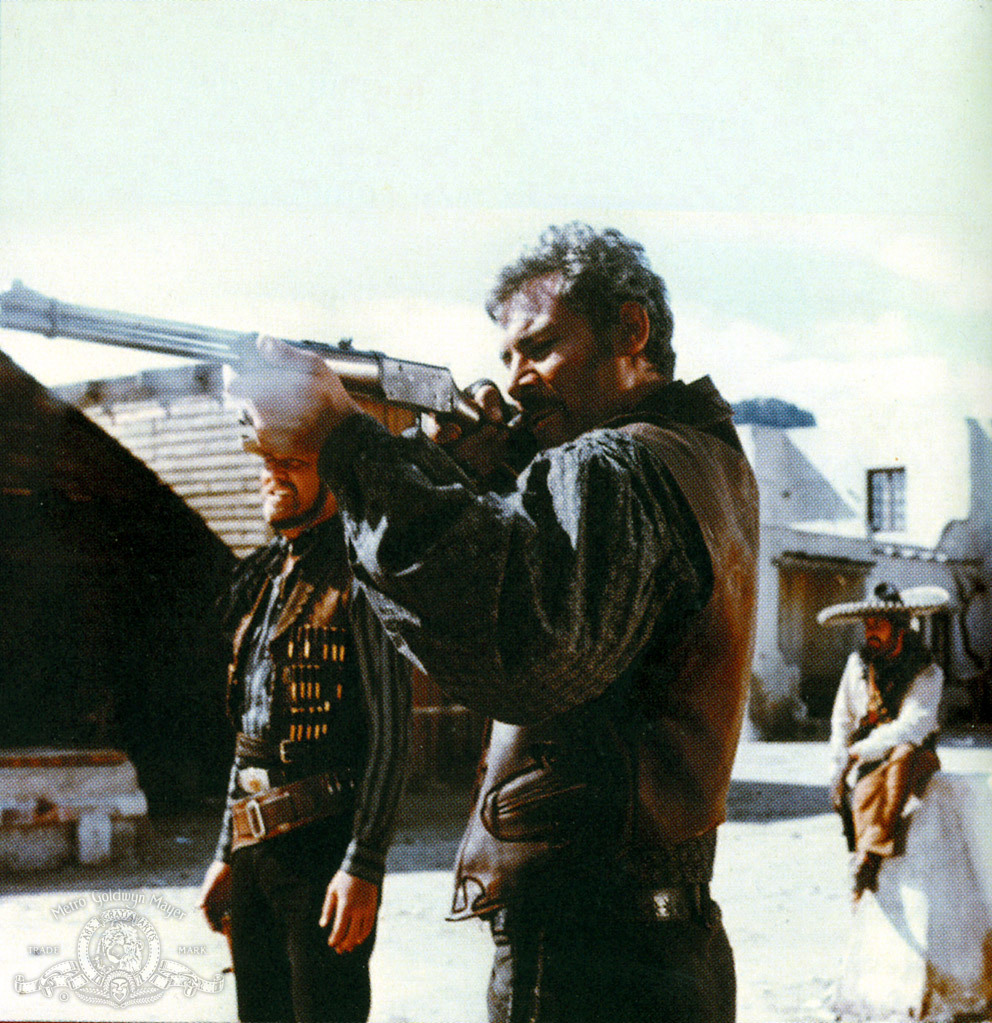
What I really wanted to talk about was, “how come this didn’t happen way back when?” They used to make a “western” a week. There were weekly westerns, which often included gun fights. Why didn’t we see or hear about accidents back then?

Even before Jeff Cooper made his four rules famous, there were westerns shot without incident. How come?

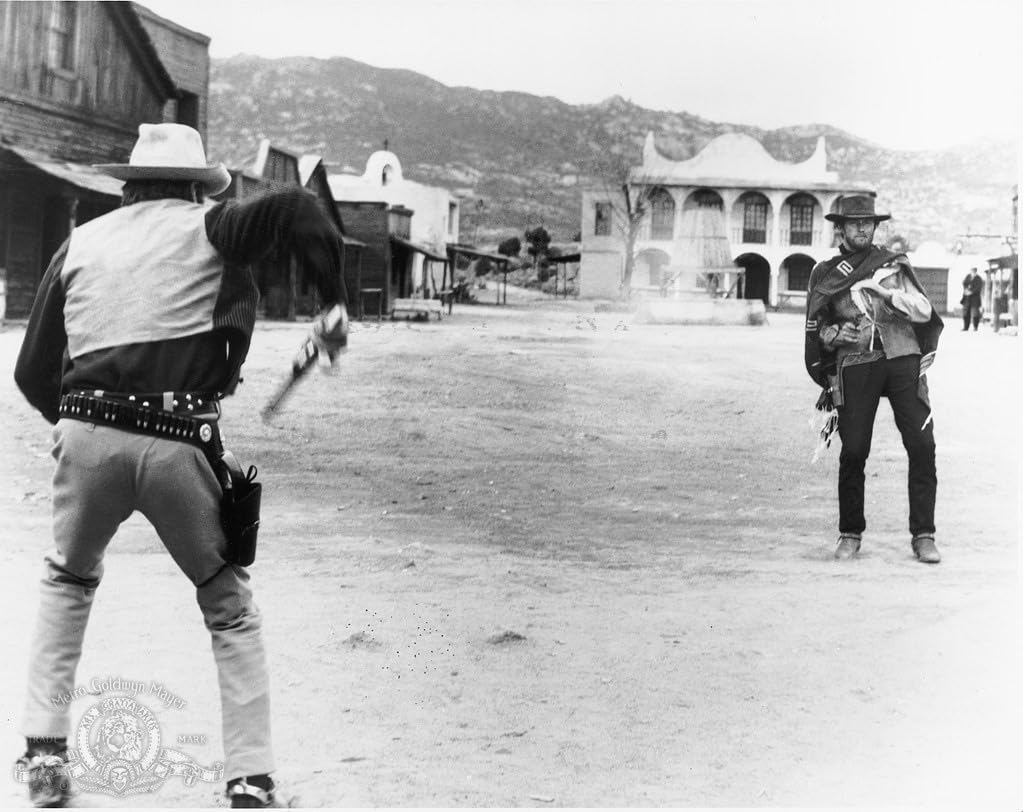
Let’s start with A Fistful of Dollars

In this quick draw scene, nobody is in the line of fire for either shooter.  Clint’s gun is pointed to his left as he fans the hammer.  His intended targets are all offscreen.  He is pointing his gun at nothing.  The bad guy is still in the middle of his draw.  It might look like he is muzzling himself, but it is more likely his muzzle is in front of him.  If you look at the background, the only person is behind Clint.  The bad guy can aim at the fountain, and it will still seem like he is aiming at Clint.

Clint has the bad guy at gun point.  But there is nobody where his gun is pointing.

Shooting at Clint.  But nobody is where that gun is pointing.

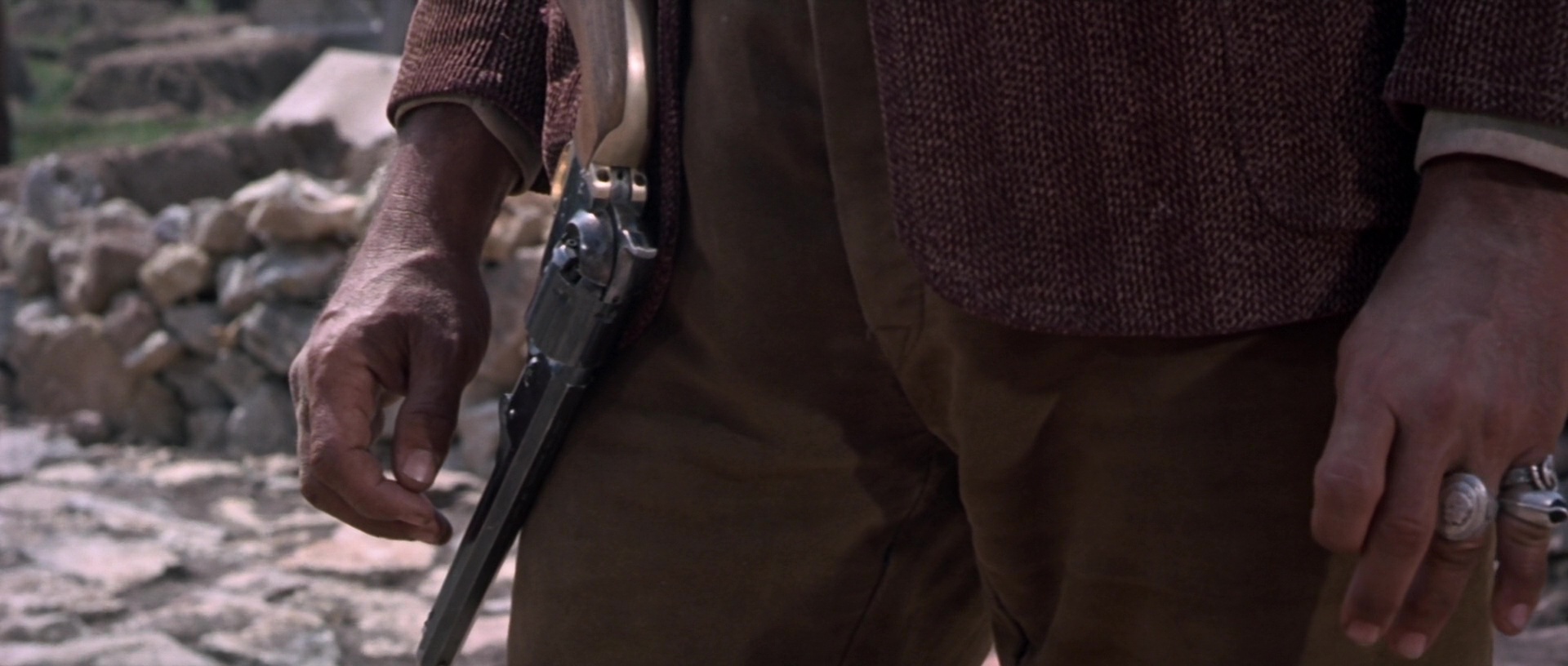
Moving on to The Good, the Bad, and the Ugly, we see the same sort of thing.  Even more, while we see the character’s loading guns from time to time, when you look at closeups of the guns you find something interesting.

If you look at the revolver, you should notice that it doesn’t have a loading gate.  That is because this is a cap and ball revolver.  There is no cap on the nipples.  This makes it trivial to verify that the gun cannot fire.

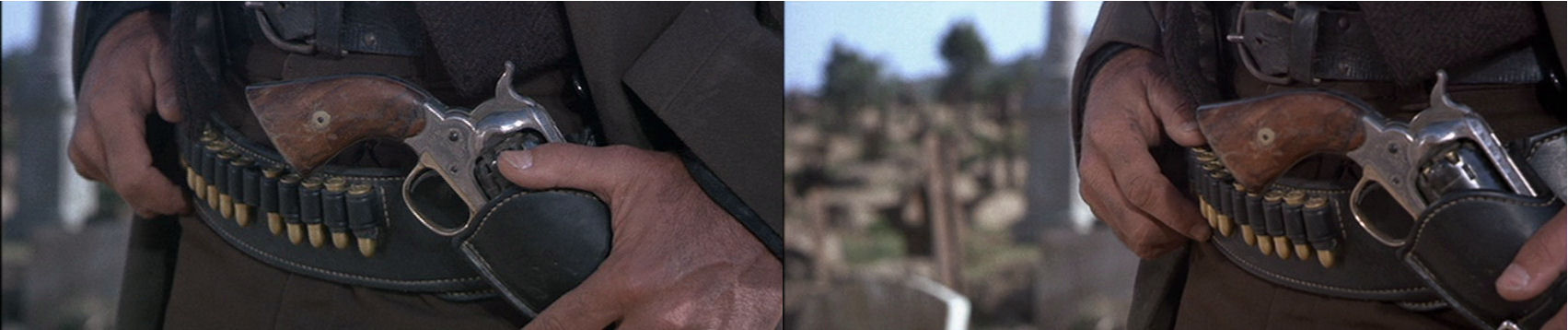
You can see the game being played in these two side by side shots, just before the big gun fight.  The pistol belt has cartridges in it.  All of those cartridges would have been dummy rounds.  Take careful note of the pistol, though.  It is a cap and ball revolver.

The left image is part of the montage of quick cuts between the three actors.  There is no reason for there to even be dummy rounds in that revolver.

The right image is just before he draws.  This is a single cut.  In this image, you can see that his right hand has moved slightly AND there are now caps on the nipples of the revolver.  When Van Cleef draws, he will pull the hammer back and fire the gun.  There will be a soft pop from the cap and a flash.  There may or may not be powder in the chamber.

Regardless, there will be nobody where he is pointing the pistol when he shoots.

In a dozen movies I watched shortly after the Rust shooting, I only saw a couple of scenes where the pistol might have been pointing near a person.  All of those scenes were framed in such a way that it is possible for the gun to have been pointing away from all people.

It is certainly possible to film dangerous looking scenes involving guns without actually putting people at risk.

It isn’t the tool, NM Film Foundation version

The New Mexico Film Foundation brought local filmmakers together Saturday for a “Film Crawl” tour to share business resources that support the independent film industry.

The event began with a gathering at the Wesst building on Broadway, where Daniel Moen, a stuntman for Rising Star Stunt Team in Albuquerque, gave a demonstration about steps of precaution when handling a prop gun.
[xCite item=”9NPJDNKS” pos=0]

This “Film Crawl” came about because Alec Baldwin shot and killed his cameraman. I believe that we can all agree that Alec Baldwin is guilty of manslaughter at the very least. Likely murder.

The short of it was that he took a pistol that he might have thought was unloaded, pointed at his cameraman, and pulled the trigger. This resulted in the death of his cameraman and injury to his director.

Now Alec is a trained monkey. He is supposed to hit his mark and say his lines with the right emotion. Ne is not expected to be a firearm guru.

He is expected to know the four safety rules, and to follow them. If he is not following them, there damn well better be no other way to do it, and every safety precaution should be taken.

Moen used prop guns ranging from a handgun made from a 3D printer to an assault rifle. Throughout the demonstration, he allowed people from the audience to check the chamber of the gun. His next step was to make it known that he was about to shoot, and fired in a direction away from everyone.
[xCite item=”9NPJDNKS” pos=1]

I have some snap-caps, but not for every caliber. Most of the time I don’t need them, or I use just a case. After learning of the Rust incident, I learned a bit more about safety on set and made up a few dummy rounds for testing feeding or loading issues.

Every dummy round has an expended primer in it or hot glue. There are NO pristine primers. If the primer has no dimple, it is a live round.

Each dummy round has two metal BB’s in it. If you shake the dummy round, you can hear the BB’s rattling around in there.

Finally:

  • Treat every firearm as if it is loaded.
  • Never point your firearm at something you are not willing to destroy or kill
  • Make sure you identify your target and what is beyond it.
  • Keep your finger off the trigger until you are ready to shoot.

Even when I KNOW it is a dummy round, I do not point the firearm at anything I’m not willing to destroy, and I treat it as if it has live ammo in it.

According to Moen, depending on the intensity of the gun scene, actors have to go through trainings for months to possibly a year. He said there are many precautions to ensure gun safety on set, but the main one is: don’t bring a real gun.
[xCite item=”9NPJDNKS” pos=2]

I had issues with feeding on one of my Winchester ’94s (post ’64). This meant that I was running the lever and watching how it feed into the chamber. This would cause there to be a round in the chamber with the hammer back, cocked. A mistake could have caused the hammer to drop. Using dummy rounds made this safer.

I was having issues loading rounds into my r92. A couple of dummy rounds let me get things figured out in a safer way.

If I’m working with dummy rounds, there are no live rounds in the area. I can’t say room because often I’m doing work on the dinning room table and there are live rounds and magazines in the dining room.

On the Rust set, they were using the “prop” guns for target practice. All the guns used were real guns. They were not disabled in any fashion. Put a live round in them, pull the trigger, “BANG”. And the crew at least was using them for target practice.

“No real guns, no ammunition on set, especially these days where you can edit everything else in. It’s a little extra for another team you pay, but it’s the literal lives you save,” Moen said.
[xCite item=”9NPJDNKS” pos=3]

This meant that people were bringing live rounds onto the set. A big NO NO NO.

They were putting live rounds into a prop gun. NO, NO, NO, NO, NO!

The production team was rushing the armorer (unconfirmed), which led to a pistol with live rounds being taken by the 2ndassistant, who declared it “cold”. It does not appear that the armorer had checked the weapon to verify it was “cold” and the 2nd assistant didn’t either.

Then Alec took that gun, did not verify it was cold. There is a statement that actors are not allowed to check if the gun they are handed is cold, “for safety reasons”. If Alec had opened the loading gate, rotated the cylinder 7 times, he would have been able to see the unfired primer on at least one of the cartridges loaded.

He didn’t. He pulled the hammer back. Pointed the gun at a person, and pulled the trigger. The gun performed exactly as designed and fired the round.

Terry Futschik, executive director for New Mexico Film Foundation, said that the incident created a change in the industry.
[xCite item=”9NPJDNKS” pos=4]

[xCiteBib]

Application Review: Hornady Android Ballistics

Short answer: 2 out of 5 stars.

This is obviously somebodiessomebody’s work of love. Like me, they are more interested in the data than the user interface.

This leads to a user interface that is barely useable.

There are times when you press on a sentence which acts like a button. These are often small with gray text. In other locations, the same text is on a button.

There is an option to “save” all over the place, but what are you saving? How do you get it back?

In the 4DOF calculator, if you select what you think is a cartridge, it will set the ballistics of the bullet, but not velocity.

The default dashboard has a couple of widgets to let you slowly set the range to target and wind conditions. If you want a table instead, you can click at random until you click on the clipboard/grid in the lower-right corner.

This gives you an option to change the interval between data rows and the total distance you want calculated.

If you like the numbers, press “set”. Do not press the “cancel” button. If you press cancel, it will take you back one screen. You need to click set, which will give you the table you are interested in.

This table is the 2 stars above. It uses either the G1 or G7 drag curves, it uses all the variables you provide. There is time of flight, drop in inches, MOA offset and everything else you could want.

It has a “save” feature. I don’t know where it saves the data nor how to access it, nor how to print it.

Even if the features I’m looking for exist, this app is too clunky to use.

I’ll go looking for an online replacement soon.

I’d actually prefer to get gnuplot doing this for me. I have the G1 and G7 curves, it is just a matter of entering the correct formulas.

It is all about the math, or how come I keep missing? UPDATED


I’m relatively new to this gun stuff. Before the 2000, I didn’t have money for firearms, and after I bought my first round of firearms, I didn’t have money to purchase guns for a long time.

I was forced by good comments to go do math and then visualize it. Thank you, gnuplot.

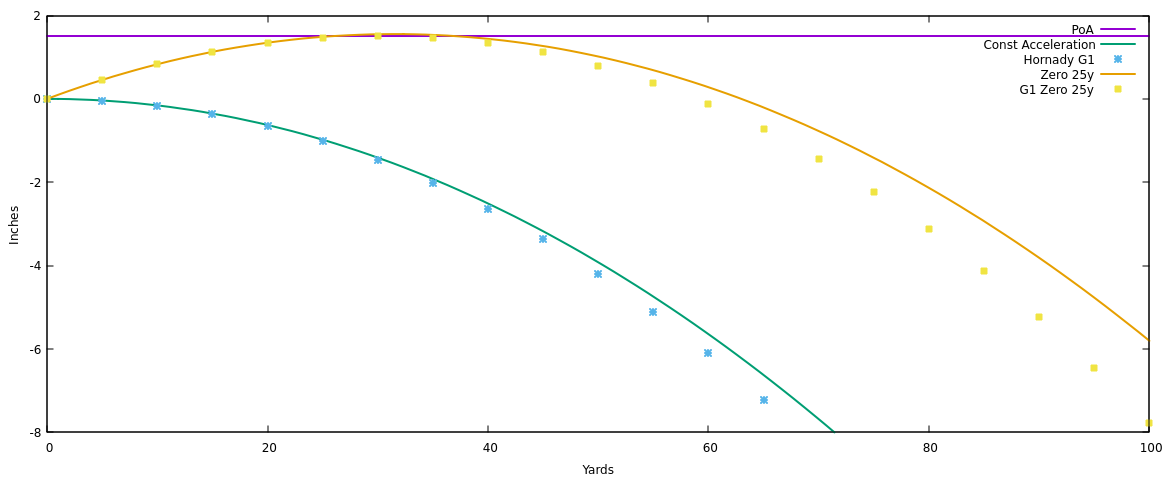
In the graph above, the first line is purple and represents the Point of Aim through the scope 1.5 inches above the bore.
The second line, green, is a simple constant acceleration of gravity in an ideal environment. I.e. bull crap. It is there so that I can have a verification stage.
The next line is the results from the Hornady ballistic calculator app. The values input are BC of 0.12, muzzle velocity of 1050, diameter of 0.22inches, weight of 40 grains. These are the numbers from the CCI subsonic 22LR ammunition.

From looking at the constant acceleration and the G1 calculations, you can see there is a difference. The bullet is losing velocity in the G1 graph and drops more than 8 inches at around the 67 yard mark. The constant acceleration has that happening at around 72 yards.

Next, I “zeroed” the rifle/scope combination at 25 yards. This requires that there be an initial upward component to the path of the bullet. I did not do the math correctly to modify the initial horizontal velocity based on stealing some of that for the upward motion.

The orange line is again constant acceleration. The curve is tangent at 25 yards. Depending on initial velocity, this might not be a tangent, but instead pass upwards through the PoA curve. The M193 out of an AR15 platform, zeroed at 25 yards, continues upwards for a significant distance.

The yellow dots are the Hornady G1 calculations with an initial upward velocity added.

What does all of this mean? It means I’m a visual person and should have spent the time graphing this stuff, so I could actually see what I’m doing.

Thank you for the feedback.


I’m getting better.

At issue is learning the easy things, but not understanding them.

Before I put the new scope on the rifle, I was hitting my target(s) at random ranges consistently. I put the new scope on the rifle, zeroed it, was, very, happy with the groups I was getting.

For many reasons, I didn’t have an opportunity to press the trigger for a while. My partner wasn’t here to help with the meat processing, the weather was too yucky to flesh the hide. I just didn’t get a chance.

I did glass a number of targets over the week, but no shots taken.

Then the other day, everything aligned, and I was good to go for a shot. I waited until he presented a beautiful side view, sighted in to put a round through his eye… slowly pressed the trigger, bang. And he took off. Clean miss.

Hmm, what did I do wrong? The next day I had another opportunity. Again I waited for a good presentation, lined up to take him through the eye. Pressed the trigger.

That damn critter didn’t even flinch.

Why was I missing at these ranges. It didn’t make any sense to me.

My mind started working the problem.

The answer came to me, bullet drop!

I was wrong.

Over the distances I was shooing, the time of flight was less than 0.08s. Using that old school math, we find that the distance a bullet drops in a given time is 0.5at^2 a=32ft/s^2. Fumble fingering the calculator, that gives me a drop of 1.5 inches.

Shit. That’s more than enough to miss that rodent’s entire head.

Add to all of this that because the rifle is sighted at a known distance, it is only at that distance and one other where the point of aim and the point of impact are at the same level.

At 25 yards, the point of impact will be either 3.5 or 3 inches below the perfectly parallel to bore scope. I say 3.5 or 3 because I do not remember whether the scope is 2 inches above bore or only 1.5.

This means that to have the point of impact intersect the point of aim at 25 yards, I have to point the scope down 3.0-3.5 inches.

But as we move the target closer or further from the muzzle, the amount of drop changes. This makes a difference. There is also that difference in angles. With the scope pointing down to get the rifle bore to point slightly up, there will be a period of time when the bullet is low compared to the point of aim.

After that time, the bullet will be high, compared to the point of aim.

Then we add even more stupid to the equations.

I got the new scope because I wanted the hash marks on the reticle to help me with figuring offsets.

The scope is lower cost, so it is a second focal plane reticle. This means that the distance between hash marks stays the same regardless of the magnification.

When the manual says that a hash is 1 MOA, they mean it is 1 MOA at 9x, not at 4x, where I keep the scope.

This means I need to know the magnification to use the hash marks to measure with.

I’m going to head back to the range and do some actual measuring. Then I’m going to use a ballistic calculator to have a better idea of wtf I’m doing and where that bullet is going to be relative to point of aim.

If things go well, I might even be able to figure all of this out, without blowing up my brain.

Once all of this is figured out, I get to repeat it with the Marlin in 30-30.

Friday Feedback

It feels like it has been a long week. I think much of that came from listening for hours of oral arguments. On the better side of things, I believe that I have better code in place to make the task easier next time. I’ve also created tools that do more saves along the way so that I don’t have to redo everything, over and over again.

J. Kb. contacted me to ask, “what was the request about what ammo?” I hope he has an article on 5.7×28 coming up. Having watched a number of YouTube videos about it, I’m curious, but not curious enough to invest in still another caliber.

It looks like there will be some photographs of squirrel processing coming up soon. I want to make sure that I take many photos.

We had a visitor staying with us for a short time. I managed to foist off my Nikon D5500. He had a great time with the lens I let him borrow, but he wasn’t allowed to take that with him. I’m looking forward to seeing what he does with that camera once he picks up a couple of lenses for it.

Having spent today thinking about what I heard in the 7th Circuit Court oral arguments, I think I’ve identified why it was so difficult.

  • The two anti-gun judges were actually rude. Easterbrook made disparaging sighs and other sounds while the good guys were presenting.
  • The Judges were disrespectful to the Bruen court. They actually laughed at some of the phrasing from Justice Thomas’ opinion
  • Judge Wood constantly played dumb, claiming that figuring out what the words of the Second Amendment actually meant was going to be their task, even though the Heller court told them what the words mean.
  • Judge Easterbrook was demanding that the good guys argue against the NFA instead of the actual laws. Sort of: If we decide that an AW/LCM ban is unconstitutional, what’s to keep you from arguing that the NFA is unconstitutional?
  • The Circuit Court represents more than just the state of Illinois. Yet Easterbrook and Wood kept repeating that machine guns and grenades are banned. Machine guns are banned in Illinois, but not in every state under the 7th Circuit.
  • Easterbrook wanted to find some “special” meaning in “in common use today”. He refused to use plain text.

I expected the state to misrepresent the situation. I expected them to make their best arguments, even if they had to make huge reaches. They did not disappoint in that regard. It was just how down right disrespectful Easterbrook and Wood were to the Bruen Court, Murphy and Maag. It was not a good look.


Was the breakdown of the oral arguments worthwhile to you? Is it worth my time to do other oral arguments when they come out?

Other than a Ruger PC9, is there another 9 mm carbine that you like?